Senate Judiciary Committee approves bill to publish full residential addresses on sex-offender registry
February 06, 2023 | JUDICIARY COMMITTEE - SENATE, Senate, Committees, Legislative, Arkansas
This article was created by AI summarizing key points discussed. AI makes mistakes, so for full details and context, please refer to the video of the full meeting. Please report any errors so we can fix them. Report an error »
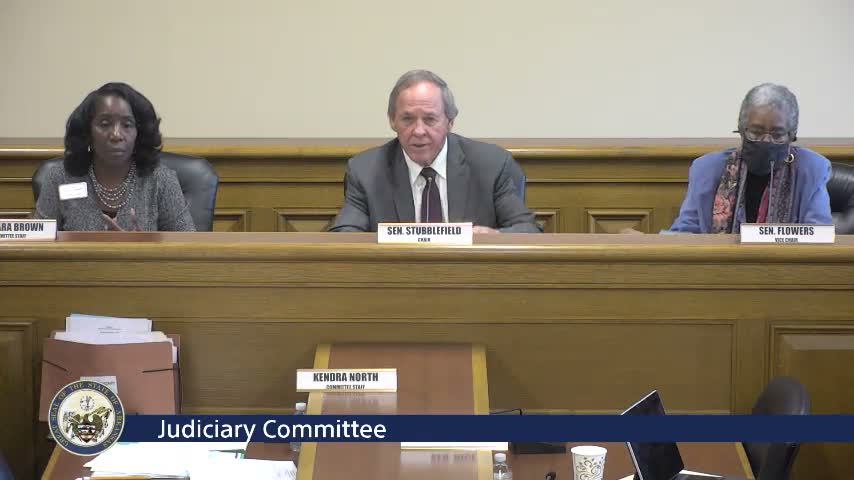
The Senate Judiciary Committee voted to pass House Bill 1004, a measure that would require publication of full residential addresses for certain registrants on the state's sex-offender registry, after proponents argued the change would make publicly available information more usable for safety purposes.
Representative Ray, who presented the bill, said the measure responds to requests from local law enforcement and parents: "The purpose of the *** offender registry is to provide people with the information that they need, to keep themselves and their loved ones safe." He and supporters told the committee that Arkansas is currently one of only four states that does not publish full house numbers on its registry and that many neighboring states do.
The bill drew pushback at committee from citizens and committee members who cited research and safety concerns. John Sarna, identifying himself as a concerned Arkansas voter and reentry advocate, testified in opposition and pointed to peer-reviewed studies he said document episodes of harassment and violence against registrants, arguing lawmakers should "do the research" before changing disclosure rules. "This is a knee-jerk response," Sarna told the committee.
Law enforcement voices backed the bill. Scott Bradley, director of the Arkansas Sheriff's Association, described practical problems with the current "block-only" format in rural counties and in apartment complexes: "It's kinda hard to narrow it down to a block," he said, arguing full addresses help residents and deputies identify where higher-risk individuals live. Jerry Bradshaw, director of the Division of Community Correction, said recidivism in the registered population is not zero but estimated overall at about 3%.
Supporters said courts have repeatedly upheld registries when challenged and that the bill merely aligns Arkansas with most other states while making registry data more user friendly. Opponents said the record shows vigilante incidents have occurred in other states and that more peer-reviewed, population-level research is needed to weigh benefits against risks.
The committee recorded a voice vote after debate; a motion to pass was made and seconded and the bill passed. The committee did not include a roll-call vote or a recorded tally in the transcript.
Next steps: House Bill 1004 passed out of the Senate Judiciary Committee and will move forward in the legislative process.
Representative Ray, who presented the bill, said the measure responds to requests from local law enforcement and parents: "The purpose of the *** offender registry is to provide people with the information that they need, to keep themselves and their loved ones safe." He and supporters told the committee that Arkansas is currently one of only four states that does not publish full house numbers on its registry and that many neighboring states do.
The bill drew pushback at committee from citizens and committee members who cited research and safety concerns. John Sarna, identifying himself as a concerned Arkansas voter and reentry advocate, testified in opposition and pointed to peer-reviewed studies he said document episodes of harassment and violence against registrants, arguing lawmakers should "do the research" before changing disclosure rules. "This is a knee-jerk response," Sarna told the committee.
Law enforcement voices backed the bill. Scott Bradley, director of the Arkansas Sheriff's Association, described practical problems with the current "block-only" format in rural counties and in apartment complexes: "It's kinda hard to narrow it down to a block," he said, arguing full addresses help residents and deputies identify where higher-risk individuals live. Jerry Bradshaw, director of the Division of Community Correction, said recidivism in the registered population is not zero but estimated overall at about 3%.
Supporters said courts have repeatedly upheld registries when challenged and that the bill merely aligns Arkansas with most other states while making registry data more user friendly. Opponents said the record shows vigilante incidents have occurred in other states and that more peer-reviewed, population-level research is needed to weigh benefits against risks.
The committee recorded a voice vote after debate; a motion to pass was made and seconded and the bill passed. The committee did not include a roll-call vote or a recorded tally in the transcript.
Next steps: House Bill 1004 passed out of the Senate Judiciary Committee and will move forward in the legislative process.
Don't Miss a Word: See the Full Meeting!
Go beyond summaries. Unlock every video, transcript, and key insight with a Founder Membership.
✓
Get instant access to full meeting videos
✓
Search and clip any phrase from complete transcripts
✓
Receive AI-powered summaries & custom alerts
✓
Enjoy lifetime, unrestricted access to government data
30-day money-back guarantee
