Senate Judiciary Committee advances bill penalizing 'remaining' in opposite-sex restrooms with minors; SB 270 passes as amended
February 27, 2023 | JUDICIARY COMMITTEE - SENATE, Senate, Committees, Legislative, Arkansas
This article was created by AI summarizing key points discussed. AI makes mistakes, so for full details and context, please refer to the video of the full meeting. Please report any errors so we can fix them. Report an error »
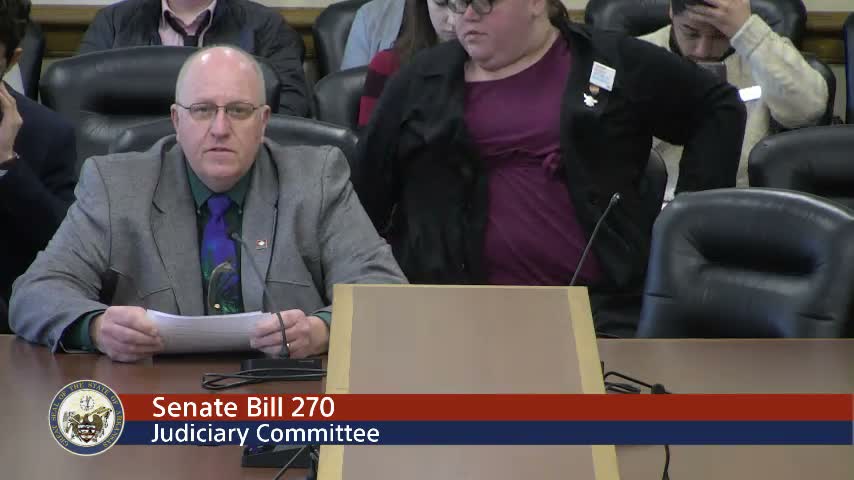
The Senate Judiciary Committee voted to advance SB 270 as amended after extended debate and public testimony, voting to report the bill out of committee on a recorded roll call. The amendment inserted the word “knowingly,” requiring prosecutors to show the defendant had knowledge before bringing a charge.
Sen. Peyton, who carried the bill, said it was intended to protect minors’ privacy in changing facilities and restrooms. “I have 12 grandkids … I’d like the opportunity for them to be in the restroom or changing facility without being exposed to the opposite sex,” Peyton said closing for the bill.
The committee adopted an amendment to add a culpable mental state, and senators then engaged in detailed questioning about the bill’s scope and prosecutorial discretion. Sen. Tucker asked how the statute would apply when someone is already in a stall and a minor enters; Peyton replied that prosecutorial discretion and the requirement to prove the defendant ‘knowingly’ remained would limit prosecutions: “If you’re making an effort to exit, then you wouldn’t be guilty of remaining,” Peyton said. Matthew Miller of Legislative Research had earlier explained that the amendment aims to give prosecutors a clearer standard for intent.
Public testimony drew strong responses on both sides. Jessica Disney, identifying herself as a transgender woman, said she had been threatened and urged the committee to reject the bill: “I strongly urge you to vote no to passing SB 270,” Disney said, warning that the bill would criminalize transgender people’s ordinary use of restrooms. Sarah Everett, policy director at the ACLU of Arkansas, told the committee that the provision would be ‘‘the most extreme bathroom ban in the country’’ and argued it criminalizes routine conduct without requiring harm or criminal intent.
Luke McCoy of Family Council testified in support, saying the measure is a common-sense tool to prevent adults from remaining in restrooms when children are present. Rumba, executive director of a local transgender organization, and advocates from Disability Rights Arkansas and other groups urged the committee to reject the bill and noted a lack of evidence that transgender people present a risk to children in restrooms.
After debate the committee held a roll call. Recorded votes included Sen. Hester Aye, Sen. Rice Aye, Sen. Tucker No, Sen. Gilmore Aye, Sen. McKee Aye, Sen. Clark Aye and Sen. Flowers No. The bill passed and was reported from committee to the next stage.
Supporters said the amendment and the requirement that charges be brought only where a defendant ‘‘knowingly’’ remained narrows the bill and leaves room for prosecutorial discretion; opponents said the statute is overbroad, risks criminalizing routine behavior, and will place transgender Arkansans at particular risk of harassment and criminalization.
The committee record shows both sides urged additional technical clarifications; supporters asked the judiciary to retain the amendment language requiring knowledge, while opponents urged caution about the bill’s breadth. The bill will move forward from committee as amended.
Sen. Peyton, who carried the bill, said it was intended to protect minors’ privacy in changing facilities and restrooms. “I have 12 grandkids … I’d like the opportunity for them to be in the restroom or changing facility without being exposed to the opposite sex,” Peyton said closing for the bill.
The committee adopted an amendment to add a culpable mental state, and senators then engaged in detailed questioning about the bill’s scope and prosecutorial discretion. Sen. Tucker asked how the statute would apply when someone is already in a stall and a minor enters; Peyton replied that prosecutorial discretion and the requirement to prove the defendant ‘knowingly’ remained would limit prosecutions: “If you’re making an effort to exit, then you wouldn’t be guilty of remaining,” Peyton said. Matthew Miller of Legislative Research had earlier explained that the amendment aims to give prosecutors a clearer standard for intent.
Public testimony drew strong responses on both sides. Jessica Disney, identifying herself as a transgender woman, said she had been threatened and urged the committee to reject the bill: “I strongly urge you to vote no to passing SB 270,” Disney said, warning that the bill would criminalize transgender people’s ordinary use of restrooms. Sarah Everett, policy director at the ACLU of Arkansas, told the committee that the provision would be ‘‘the most extreme bathroom ban in the country’’ and argued it criminalizes routine conduct without requiring harm or criminal intent.
Luke McCoy of Family Council testified in support, saying the measure is a common-sense tool to prevent adults from remaining in restrooms when children are present. Rumba, executive director of a local transgender organization, and advocates from Disability Rights Arkansas and other groups urged the committee to reject the bill and noted a lack of evidence that transgender people present a risk to children in restrooms.
After debate the committee held a roll call. Recorded votes included Sen. Hester Aye, Sen. Rice Aye, Sen. Tucker No, Sen. Gilmore Aye, Sen. McKee Aye, Sen. Clark Aye and Sen. Flowers No. The bill passed and was reported from committee to the next stage.
Supporters said the amendment and the requirement that charges be brought only where a defendant ‘‘knowingly’’ remained narrows the bill and leaves room for prosecutorial discretion; opponents said the statute is overbroad, risks criminalizing routine behavior, and will place transgender Arkansans at particular risk of harassment and criminalization.
The committee record shows both sides urged additional technical clarifications; supporters asked the judiciary to retain the amendment language requiring knowledge, while opponents urged caution about the bill’s breadth. The bill will move forward from committee as amended.
View the Full Meeting & All Its Details
This article offers just a summary. Unlock complete video, transcripts, and insights as a Founder Member.
✓
Watch full, unedited meeting videos
✓
Search every word spoken in unlimited transcripts
✓
AI summaries & real-time alerts (all government levels)
✓
Permanent access to expanding government content
30-day money-back guarantee
