Senate committee approves bill to restore parole eligibility for some pre‑2015 residential burglary convictions
March 13, 2023 | JUDICIARY COMMITTEE - SENATE, Senate, Committees, Legislative, Arkansas
This article was created by AI summarizing key points discussed. AI makes mistakes, so for full details and context, please refer to the video of the full meeting. Please report any errors so we can fix them. Report an error »
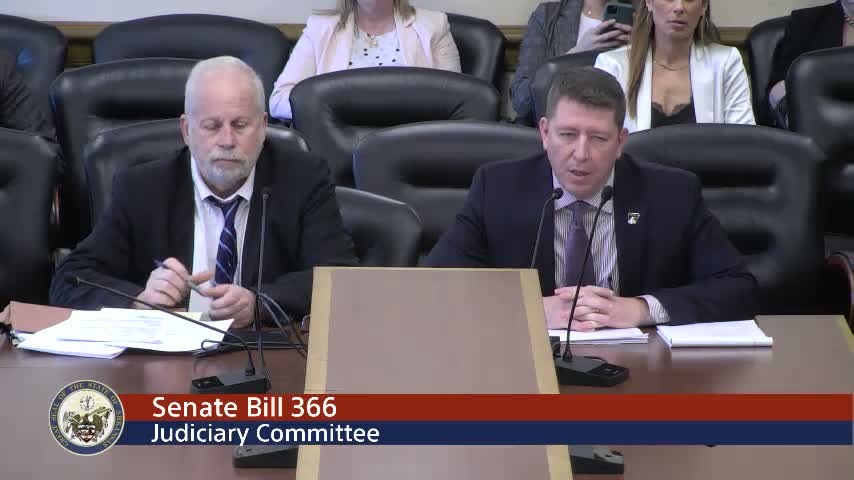
The Senate Judiciary Committee on [date not specified] voted to pass Senate Bill 366, a measure that would restore parole eligibility for people whose residential-burglary convictions occurred before April 1, 2015.
Senator Joshua Bridal, who sponsored the bill, said the legislation aims to correct a change in how the Arkansas Department of Correction applied the violent-offender list. Bridal told the committee he first learned of affected constituents after a constituent’s release was reversed and described written Department of Correction policies and an attorney-general opinion that, he said, created uncertainty for hundreds of people and their families. “All we’re asking for is to reinstate parole eligibility for these people,” Bridal said in his presentation.
Attorney Jeff Rosenzweig, appearing with Bridal, told the committee he had shown members emails and an Attorney General opinion indicating the Department of Correction treated pre‑April 2015 residential burglaries differently for seven years. Rosenzweig said the change in 2022 left roughly 290 people with altered parole prospects, that about 101 of those had already been released under the earlier practice, and that 11 of those reoffended and were reincarcerated. He described the bill as legislative correction rather than an automatic release: “This does not give anyone parole. It merely makes people eligible for parole,” he said.
Bob Moran, prosecutor coordinator for the Arkansas Prosecuting Attorneys Association, opposed the bill’s blanket approach. He said some defendants knew the law at sentencing and that a broad fix would make people who knowingly accepted plea deals eligible for a parole opportunity they did not expect at the time of conviction. He urged case‑by‑case remedies, including letters from prosecutors or executive clemency in particular cases.
Public testimony included emotionally charged statements from Max Hatfield, who said his stepson was among those whose parole‑eligibility date changed after the Department reversed its prior practice. Hatfield said his family had prepared for a 2023 release that had been moved to 2042 and urged lawmakers to ‘‘make this right.’’
Committee members probed constitutional and practical questions, including whether the bill removes residential burglary from the violent‑offender list (it does not) and whether the remedy is the proper legislative tool. Supporters pointed to due‑process and reliance arguments and to pending litigation. Proponents emphasized that the measure restores the eligibility framework rather than modifying convictions or sentences.
The committee voted to pass SB 366. The bill’s passage in committee advances it to the next stage of legislative consideration; the parole board retains discretion over individual releases, and victims retain the ability to participate in parole proceedings.
Ending: The committee’s action makes affected individuals eligible to seek parole but does not alter convictions, sentences, or the parole board’s authority. Victims’ ability to object during parole proceedings remains intact.
Senator Joshua Bridal, who sponsored the bill, said the legislation aims to correct a change in how the Arkansas Department of Correction applied the violent-offender list. Bridal told the committee he first learned of affected constituents after a constituent’s release was reversed and described written Department of Correction policies and an attorney-general opinion that, he said, created uncertainty for hundreds of people and their families. “All we’re asking for is to reinstate parole eligibility for these people,” Bridal said in his presentation.
Attorney Jeff Rosenzweig, appearing with Bridal, told the committee he had shown members emails and an Attorney General opinion indicating the Department of Correction treated pre‑April 2015 residential burglaries differently for seven years. Rosenzweig said the change in 2022 left roughly 290 people with altered parole prospects, that about 101 of those had already been released under the earlier practice, and that 11 of those reoffended and were reincarcerated. He described the bill as legislative correction rather than an automatic release: “This does not give anyone parole. It merely makes people eligible for parole,” he said.
Bob Moran, prosecutor coordinator for the Arkansas Prosecuting Attorneys Association, opposed the bill’s blanket approach. He said some defendants knew the law at sentencing and that a broad fix would make people who knowingly accepted plea deals eligible for a parole opportunity they did not expect at the time of conviction. He urged case‑by‑case remedies, including letters from prosecutors or executive clemency in particular cases.
Public testimony included emotionally charged statements from Max Hatfield, who said his stepson was among those whose parole‑eligibility date changed after the Department reversed its prior practice. Hatfield said his family had prepared for a 2023 release that had been moved to 2042 and urged lawmakers to ‘‘make this right.’’
Committee members probed constitutional and practical questions, including whether the bill removes residential burglary from the violent‑offender list (it does not) and whether the remedy is the proper legislative tool. Supporters pointed to due‑process and reliance arguments and to pending litigation. Proponents emphasized that the measure restores the eligibility framework rather than modifying convictions or sentences.
The committee voted to pass SB 366. The bill’s passage in committee advances it to the next stage of legislative consideration; the parole board retains discretion over individual releases, and victims retain the ability to participate in parole proceedings.
Ending: The committee’s action makes affected individuals eligible to seek parole but does not alter convictions, sentences, or the parole board’s authority. Victims’ ability to object during parole proceedings remains intact.
View the Full Meeting & All Its Details
This article offers just a summary. Unlock complete video, transcripts, and insights as a Founder Member.
✓
Watch full, unedited meeting videos
✓
Search every word spoken in unlimited transcripts
✓
AI summaries & real-time alerts (all government levels)
✓
Permanent access to expanding government content
30-day money-back guarantee
