Senate committee advances bill making it a misdemeanor to pay to destroy petition signatures and requiring 'paid blockers' to register
March 15, 2023 | JUDICIARY COMMITTEE - SENATE, Senate, Committees, Legislative, Arkansas
This article was created by AI summarizing key points discussed. AI makes mistakes, so for full details and context, please refer to the video of the full meeting. Please report any errors so we can fix them. Report an error »
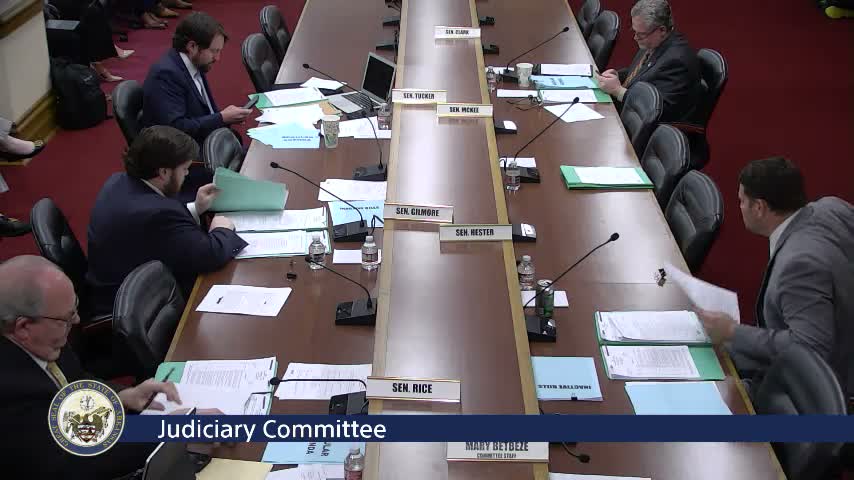
Senator Bart Hester’s proposal to criminalize payment that results in the destruction or suppression of petition signatures cleared the Senate Judiciary Committee after canvassers recounted repeated harassment, threats and offers of money to discard legally collected signatures.
The measure, SB377, makes it a misdemeanor to pay someone to destroy a signature after it has been collected and requires paid “blockers” — people hired to disrupt or dissuade signers — to register and meet the same residency and background-check requirements as paid canvassers. John Burris, who helped present the bill, told the committee that the change is intended to level a playing field in which paid blockers currently face no registration or disclosure obligations that paid canvassers do.
“Paying to destroy a signature after it’s been collected should be a crime,” Burris said while walking senators through an audio transcript and related materials submitted with the bill. He said drafts narrow liability to individuals and persons in control of employees so prosecutors have a tractable enforcement path and added a knowing mental state to the misconduct definition.
Two witnesses who worked as paid canvassers described sustained harassment and what they said were deliberate efforts to keep voters from having their signatures counted. Ted Stearitz said blockers showed up at a farmers market, shouted that canvassers were “lying” and at times threatened violence; he said police were called once that day and told the blockers to leave. “They suggested that they, quote, break my legs and leave me for dead,” Stearitz said, describing multiple incidents in which men followed him and used vulgar and threatening language.
Melissa Harris described being offered money to throw away legally collected petitions and said people later knew and disclosed her name and address. Harris said her house later burned down; she and the sponsor said an independent investigator’s report they provided to prosecutors indicated arson and detected an accelerant, but the state police unit reviewed the file and concluded it was a civil matter. “I can’t say for certain they did it, but I have PTSD and trauma from the continual harassment,” Harris testified.
Committee members pressed sponsors on two lines of inquiry: whether existing criminal statutes already covered the conduct described, and whether the bill’s language might sweep too broadly and raise First Amendment concerns. Senator Clark warned that some behavior described could already be criminally prosecutable (stalking, terroristic threatening, arson) but said the bill may still be useful to address a regulatory gap for paid actors who intentionally disrupt signature-gathering operations.
Sponsors said the bill’s aim is narrow: to prohibit paying someone to destroy signatures and to require paid blockers to be subject to the same registration, disclosure and background checks as paid canvassers, so law enforcement can identify them and pursue charges when conduct crosses legal lines.
After extended questioning and two witness accounts, the committee voted by voice to pass SB377 to the Senate with the committee’s recommendation. The transcript records senators expressing both strong support and concerns about drafting specifics; one member announced a recorded no vote during the voice-vote exchange, and the sponsor said he would work to clarify language if needed later in the process.
The next step for SB377 is consideration by the full Senate, where the sponsor said he would be open to amendments to refine language about intent and the precise conduct that triggers criminal liability.
The measure, SB377, makes it a misdemeanor to pay someone to destroy a signature after it has been collected and requires paid “blockers” — people hired to disrupt or dissuade signers — to register and meet the same residency and background-check requirements as paid canvassers. John Burris, who helped present the bill, told the committee that the change is intended to level a playing field in which paid blockers currently face no registration or disclosure obligations that paid canvassers do.
“Paying to destroy a signature after it’s been collected should be a crime,” Burris said while walking senators through an audio transcript and related materials submitted with the bill. He said drafts narrow liability to individuals and persons in control of employees so prosecutors have a tractable enforcement path and added a knowing mental state to the misconduct definition.
Two witnesses who worked as paid canvassers described sustained harassment and what they said were deliberate efforts to keep voters from having their signatures counted. Ted Stearitz said blockers showed up at a farmers market, shouted that canvassers were “lying” and at times threatened violence; he said police were called once that day and told the blockers to leave. “They suggested that they, quote, break my legs and leave me for dead,” Stearitz said, describing multiple incidents in which men followed him and used vulgar and threatening language.
Melissa Harris described being offered money to throw away legally collected petitions and said people later knew and disclosed her name and address. Harris said her house later burned down; she and the sponsor said an independent investigator’s report they provided to prosecutors indicated arson and detected an accelerant, but the state police unit reviewed the file and concluded it was a civil matter. “I can’t say for certain they did it, but I have PTSD and trauma from the continual harassment,” Harris testified.
Committee members pressed sponsors on two lines of inquiry: whether existing criminal statutes already covered the conduct described, and whether the bill’s language might sweep too broadly and raise First Amendment concerns. Senator Clark warned that some behavior described could already be criminally prosecutable (stalking, terroristic threatening, arson) but said the bill may still be useful to address a regulatory gap for paid actors who intentionally disrupt signature-gathering operations.
Sponsors said the bill’s aim is narrow: to prohibit paying someone to destroy signatures and to require paid blockers to be subject to the same registration, disclosure and background checks as paid canvassers, so law enforcement can identify them and pursue charges when conduct crosses legal lines.
After extended questioning and two witness accounts, the committee voted by voice to pass SB377 to the Senate with the committee’s recommendation. The transcript records senators expressing both strong support and concerns about drafting specifics; one member announced a recorded no vote during the voice-vote exchange, and the sponsor said he would work to clarify language if needed later in the process.
The next step for SB377 is consideration by the full Senate, where the sponsor said he would be open to amendments to refine language about intent and the precise conduct that triggers criminal liability.
View the Full Meeting & All Its Details
This article offers just a summary. Unlock complete video, transcripts, and insights as a Founder Member.
✓
Watch full, unedited meeting videos
✓
Search every word spoken in unlimited transcripts
✓
AI summaries & real-time alerts (all government levels)
✓
Permanent access to expanding government content
30-day money-back guarantee
