Senate panel approves tougher penalties for altered serial numbers and creates aggravated trespass felony amid law-enforcement push
April 03, 2023 | JUDICIARY COMMITTEE - SENATE, Senate, Committees, Legislative, Arkansas
This article was created by AI summarizing key points discussed. AI makes mistakes, so for full details and context, please refer to the video of the full meeting. Please report any errors so we can fix them. Report an error »
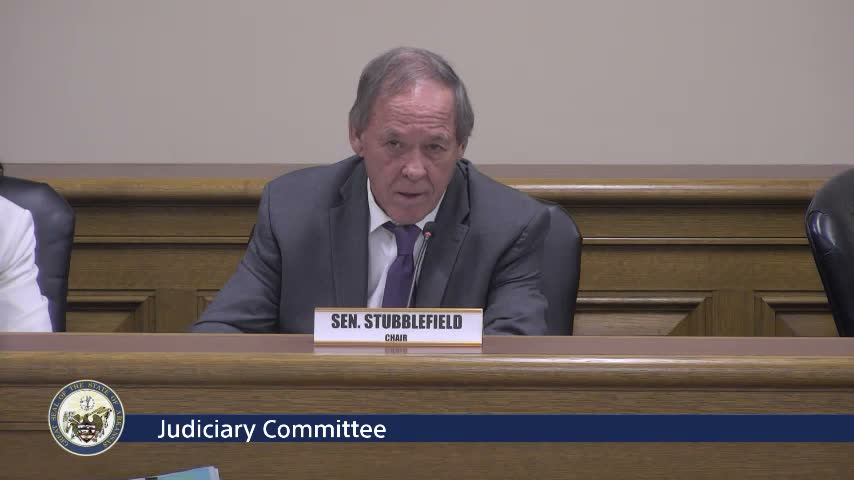
The Senate Judiciary Committee on [date] advanced two related measures aimed at curbing thefts of ATVs, farm equipment and other high-value items and at increasing penalties for unlawful entries.
Sen. Allen Clark, who presented SB237 and SB238 with Hot Spring County Sheriff Scott Finkbinder at the committee table, said the measures respond to a sharp rise in thefts and to what law enforcement describes as an organized industry that alters serial numbers. “When you can’t run the VIN,” Clark said, “that’s not a felony currently — they basically get away with the theft.” Sheriff Finkbinder told the committee he had personally been a victim of ATV theft and described recent arrests where serial numbers had been welded over or otherwise defaced.
SB237 would classify altering or possessing items with defaced serial numbers — including ATVs, trailers and certain farm equipment — as a class D felony, rather than a misdemeanor. SB238 would create an aggravated criminal trespass offense, narrowly defined to apply to unlawful entry of occupied homes, vehicles or shop buildings, and make it a class D felony in those circumstances.
Prosecuting attorney Theresa Howell told lawmakers the change addresses a gap prosecutors encounter when a person unlawfully enters a residence or other structure but there is insufficient evidence to charge burglary or other felonies tied to intent. “We have seen situations where criminal trespass does not seem to be sufficient,” Howell said, describing incidents in which occupants were frightened by intruders who were later removed but not charged with a felony under current law.
Criminal-defense representatives urged caution. Jeff Rosenzweig of the Arkansas Association of Criminal Defense Lawyers said the trespass bill risks turning commonplace or innocent conduct into a felony in some cases — for example, a person taking shelter in an open outbuilding during severe weather. “You could make a felony out of failure to vacate,” Rosenzweig said, and he urged narrower language or clarified intent requirements.
Committee members discussed whether existing chop-shop language and earlier passed measures provided sufficient tools and whether SB238’s mental-state wording should explicitly require purposeful or knowing conduct. Senator Clark said he would work with prosecutors on possible extenuating-circumstance language but urged colleagues to give law enforcement stronger tools.
After debate and an offer to consult on amendments, the committee passed both bills by voice vote.
What’s next: The bills now move to the full Senate for further consideration. Committee members who raised questions said they expect follow-up drafting on intent language and exceptions to avoid penalizing inadvertent or emergency conduct.
Sen. Allen Clark, who presented SB237 and SB238 with Hot Spring County Sheriff Scott Finkbinder at the committee table, said the measures respond to a sharp rise in thefts and to what law enforcement describes as an organized industry that alters serial numbers. “When you can’t run the VIN,” Clark said, “that’s not a felony currently — they basically get away with the theft.” Sheriff Finkbinder told the committee he had personally been a victim of ATV theft and described recent arrests where serial numbers had been welded over or otherwise defaced.
SB237 would classify altering or possessing items with defaced serial numbers — including ATVs, trailers and certain farm equipment — as a class D felony, rather than a misdemeanor. SB238 would create an aggravated criminal trespass offense, narrowly defined to apply to unlawful entry of occupied homes, vehicles or shop buildings, and make it a class D felony in those circumstances.
Prosecuting attorney Theresa Howell told lawmakers the change addresses a gap prosecutors encounter when a person unlawfully enters a residence or other structure but there is insufficient evidence to charge burglary or other felonies tied to intent. “We have seen situations where criminal trespass does not seem to be sufficient,” Howell said, describing incidents in which occupants were frightened by intruders who were later removed but not charged with a felony under current law.
Criminal-defense representatives urged caution. Jeff Rosenzweig of the Arkansas Association of Criminal Defense Lawyers said the trespass bill risks turning commonplace or innocent conduct into a felony in some cases — for example, a person taking shelter in an open outbuilding during severe weather. “You could make a felony out of failure to vacate,” Rosenzweig said, and he urged narrower language or clarified intent requirements.
Committee members discussed whether existing chop-shop language and earlier passed measures provided sufficient tools and whether SB238’s mental-state wording should explicitly require purposeful or knowing conduct. Senator Clark said he would work with prosecutors on possible extenuating-circumstance language but urged colleagues to give law enforcement stronger tools.
After debate and an offer to consult on amendments, the committee passed both bills by voice vote.
What’s next: The bills now move to the full Senate for further consideration. Committee members who raised questions said they expect follow-up drafting on intent language and exceptions to avoid penalizing inadvertent or emergency conduct.
Don't Miss a Word: See the Full Meeting!
Go beyond summaries. Unlock every video, transcript, and key insight with a Founder Membership.
✓
Get instant access to full meeting videos
✓
Search and clip any phrase from complete transcripts
✓
Receive AI-powered summaries & custom alerts
✓
Enjoy lifetime, unrestricted access to government data
30-day money-back guarantee
