Senate Judiciary Committee advances sweeping corrections overhaul after hours of testimony
March 29, 2023 | JUDICIARY COMMITTEE - SENATE, Senate, Committees, Legislative, Arkansas
This article was created by AI summarizing key points discussed. AI makes mistakes, so for full details and context, please refer to the video of the full meeting. Please report any errors so we can fix them. Report an error »
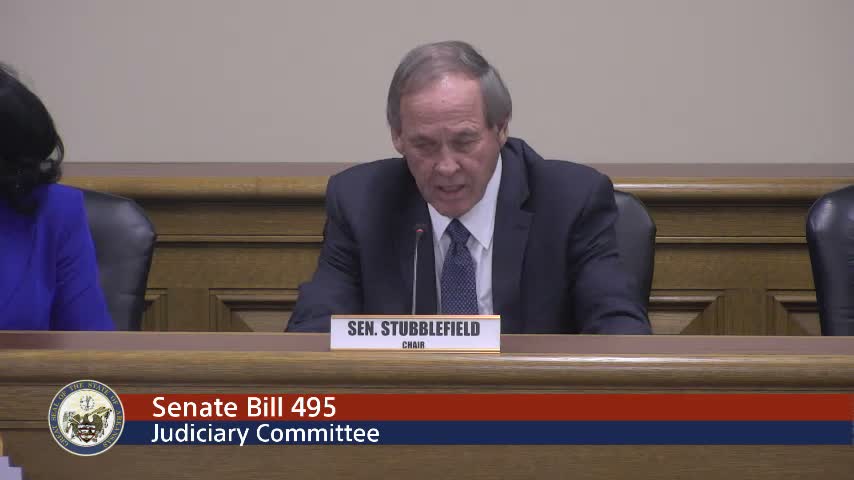
Senate Judiciary Committee members voted to pass Senate Bill 495 after a day of testimony that split prosecutors, corrections officials and criminal‑justice advocates.
Proponents — including a group of elected prosecuting attorneys who said all 28 support the measure — told the committee the bill gives juries, prosecutors and victims clearer information about how long people will actually serve, and includes recidivism‑reduction programs and mental‑health components. "There's an old saw in law enforcement and the law itself that it is not the severity of the punishment that deters crime, it's the certainty," said a prosecuting attorney who testified in support.
Opponents warned the bill could worsen prison overcrowding and disproportionately harm poor people of color. Connor Thompson, an attorney and criminal‑justice researcher who testified in opposition, said Arkansas already ranks among the highest incarceration rates in the country and argued the state should invest surplus dollars into prevention and social services rather than longer sentences. "We are deciding categorically that some people are unredeemable," Thompson said in his testimony.
Other testimony ranged from conditional support to pointed concerns. Dubs Byers, a member of the Board of Correction, said he supports many bill provisions but urged scrutiny of language he said would diminish the board's authority and shift power to the secretary of the Department of Corrections. Saline County Sheriff Rodney Wright urged the state to build more capacity, saying county jails hold people awaiting ADC beds and county resources are strained. "We need to build additional prison," Wright said.
Witnesses for the bill told the committee the measure also includes provisions to incentivize programming, establish recidivism‑reduction efforts and account for victims. Several committee members asked whether clarified parole‑eligibility and truth‑in‑sentencing provisions would change prosecutors' plea strategies; prosecutors answered they expect plea offers to reflect the law as written, and that clearer sentencing rules would, in many cases, produce more predictable plea conversations.
Senator Gilmore, the bill sponsor, closed by saying the bill "brings order to chaos" and asked the committee for a favorable vote. The committee moved the bill and, by voice vote, reported SB 495 favorably from committee.
The committee record shows extensive public comment and technical questions about risk‑and‑needs assessments, program evaluation, fines and fees timelines, the legal relationship between the board of corrections and the department secretary, and the timetable for additional prison capacity. The committee's action in committee is a procedural step; the bill will need floor consideration and further votes before becoming law.
What happens next: SB 495 has cleared the Judiciary Committee and will go to the Senate calendar for consideration; sponsors and opponents agreed it will likely be amended as it moves through later stages.
Proponents — including a group of elected prosecuting attorneys who said all 28 support the measure — told the committee the bill gives juries, prosecutors and victims clearer information about how long people will actually serve, and includes recidivism‑reduction programs and mental‑health components. "There's an old saw in law enforcement and the law itself that it is not the severity of the punishment that deters crime, it's the certainty," said a prosecuting attorney who testified in support.
Opponents warned the bill could worsen prison overcrowding and disproportionately harm poor people of color. Connor Thompson, an attorney and criminal‑justice researcher who testified in opposition, said Arkansas already ranks among the highest incarceration rates in the country and argued the state should invest surplus dollars into prevention and social services rather than longer sentences. "We are deciding categorically that some people are unredeemable," Thompson said in his testimony.
Other testimony ranged from conditional support to pointed concerns. Dubs Byers, a member of the Board of Correction, said he supports many bill provisions but urged scrutiny of language he said would diminish the board's authority and shift power to the secretary of the Department of Corrections. Saline County Sheriff Rodney Wright urged the state to build more capacity, saying county jails hold people awaiting ADC beds and county resources are strained. "We need to build additional prison," Wright said.
Witnesses for the bill told the committee the measure also includes provisions to incentivize programming, establish recidivism‑reduction efforts and account for victims. Several committee members asked whether clarified parole‑eligibility and truth‑in‑sentencing provisions would change prosecutors' plea strategies; prosecutors answered they expect plea offers to reflect the law as written, and that clearer sentencing rules would, in many cases, produce more predictable plea conversations.
Senator Gilmore, the bill sponsor, closed by saying the bill "brings order to chaos" and asked the committee for a favorable vote. The committee moved the bill and, by voice vote, reported SB 495 favorably from committee.
The committee record shows extensive public comment and technical questions about risk‑and‑needs assessments, program evaluation, fines and fees timelines, the legal relationship between the board of corrections and the department secretary, and the timetable for additional prison capacity. The committee's action in committee is a procedural step; the bill will need floor consideration and further votes before becoming law.
What happens next: SB 495 has cleared the Judiciary Committee and will go to the Senate calendar for consideration; sponsors and opponents agreed it will likely be amended as it moves through later stages.
View the Full Meeting & All Its Details
This article offers just a summary. Unlock complete video, transcripts, and insights as a Founder Member.
✓
Watch full, unedited meeting videos
✓
Search every word spoken in unlimited transcripts
✓
AI summaries & real-time alerts (all government levels)
✓
Permanent access to expanding government content
30-day money-back guarantee
