Senate panel hears lengthy debate on truth-in-sentencing bill that would lengthen terms for serious offenders and change parole mechanics
March 29, 2023 | JUDICIARY COMMITTEE - SENATE, Senate, Committees, Legislative, Arkansas
This article was created by AI summarizing key points discussed. AI makes mistakes, so for full details and context, please refer to the video of the full meeting. Please report any errors so we can fix them. Report an error »
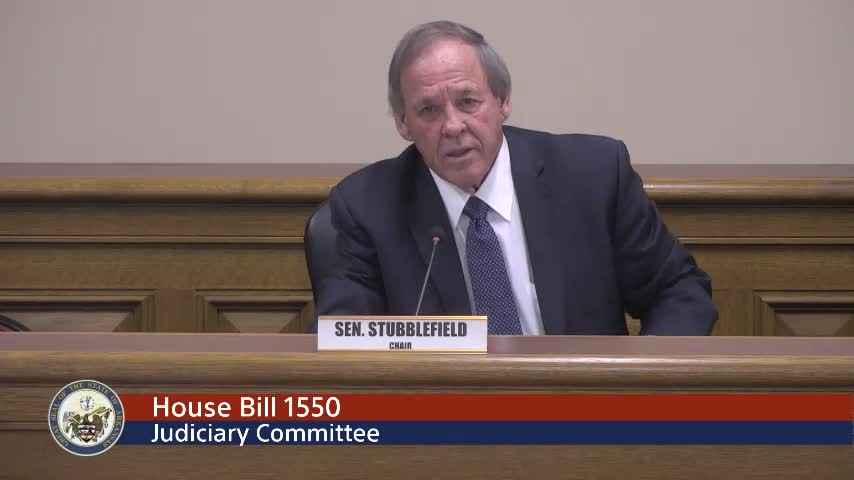
The Senate Judiciary Committee spent most of its session on Senate Bill 495, a sweeping criminal-justice package presented by Senator Hunter Gilmore that proposes to change parole eligibility, expand specialty courts and reentry programs, and adjust how inmates earn early release.
Gilmore described the bill as an effort to ‘bring order to chaos’ in Arkansas’s criminal justice system. "This is going to be a game changer for our state," he said, arguing the measure will require the most dangerous offenders to serve a larger portion of their sentences while creating incentives—through earned-release credits—for other inmates to complete vocational training, educational programs and other rehabilitative activities.
Attorney General Tim Griffin, who attended the hearing and addressed the committee, framed the package as an effort to prioritize public safety by incapacitating repeat violent offenders. "Common sense is when you've got people killing and doing all kind of violent things, the number one goal is to incapacitate them," Griffin said, arguing that Arkansas’s current parole culture too often produces early releases.
Key provisions described during the hearing include:
- Truth-in-sentencing categories that would set different baseline proportions of sentences to be served (the bill identifies tiers such as 100%, 85%, 50% and 25%) and relies on rulemaking and the sentencing commission to place offenses in appropriate tiers.
- Renaming and retooling the current parole board as a "post prison transfer board," with new rules established through the Administrative Procedures Act (ALC review) and Department of Corrections (DOC) implementation details addressed in rulemaking.
- An expanded earned-release credits system that replaces aspects of current good-time/meritorious-good-time mechanics with positive-point opportunities for job training, certificates and volunteer work to encourage rehabilitation and earlier supervised release for eligible inmates.
- Funding authorizations and programming expansions for specialty courts and a mental-health pilot; Gilmore and staff estimated roughly $4,000,000 for specialty-court expansion, about $2,000,000 in start-up costs for the mental-health pilot, and roughly $600,000 for an expansion of a courthouse dog program for victims.
- Provisions intended to expand use of reentry beds and increase coordination between DOC, the state workforce office and community-based organizations to make in-prison programming align with labor-market needs.
Committee members pressed authors and witnesses on several fronts. Senator Stephanie Flowers asked whether the proposal would simply rename the parole board and who would write the new rules; Gilmore replied the board membership remains appointed but the rules governing earned credits and eligibility would be promulgated through the Administrative Procedures Act and come before ALC for oversight. Tawny Rowell of the Arkansas Sentencing Commission said much of the supervision language is ported from existing law but noted the bill broadens opportunities to earn positive credits and requires a doctoral-level reviewer or qualified contractor to assess program efficacy.
On fiscal and capacity questions, sentencing-commission staff presented a 10-year model included with the bill. Committee members were told the measure would increase the prison population compared with baseline projections—staff referenced an increase that the paper lists around 41,465 additional prisoners by 2033 attributable to provisions of the bill (the commission said the projection is built from offense-date applicability and other assumptions). The paper also lists an annual inmate-cost estimate of about $34 million in 2033 and an approximate 10-year fiscal impact of roughly $163 million attributable to the bill. Gilmore acknowledged that new capacity may be necessary but said prison construction and appropriation decisions would be handled through the executive branch and separate budget processes; he noted the governor had announced intent to add capacity but that construction funding was not part of this bill.
Members repeatedly debated policy tradeoffs: Senator Tucker and others questioned whether a 100% requirement for some offenders removes incentives for good behavior, while proponents said the highest-tier crimes are the most violent and require proportionate incarceration. Gilmore emphasized that earned-release credits and post-release supervision remain tools to incentivize rehabilitation for many offenders while reserving the highest thresholds for "the worst of the worst." Several senators also pressed the authors on evidence-based programming, who will evaluate current programs and whether doctoral-level reviewers would replace existing, peer-reviewed curricula; Rowell said the goal is not to discard effective programming but to ensure what is funded and provided actually reduces recidivism.
No final committee vote on SB 495 occurred during the session. The committee recessed and planned to take public testimony for and against the bill when it reconvened.
Ending: The committee recessed after extended questioning and scheduled public testimony; senators signaled significant additional debate ahead as advocates and opponents prepare to testify.
Gilmore described the bill as an effort to ‘bring order to chaos’ in Arkansas’s criminal justice system. "This is going to be a game changer for our state," he said, arguing the measure will require the most dangerous offenders to serve a larger portion of their sentences while creating incentives—through earned-release credits—for other inmates to complete vocational training, educational programs and other rehabilitative activities.
Attorney General Tim Griffin, who attended the hearing and addressed the committee, framed the package as an effort to prioritize public safety by incapacitating repeat violent offenders. "Common sense is when you've got people killing and doing all kind of violent things, the number one goal is to incapacitate them," Griffin said, arguing that Arkansas’s current parole culture too often produces early releases.
Key provisions described during the hearing include:
- Truth-in-sentencing categories that would set different baseline proportions of sentences to be served (the bill identifies tiers such as 100%, 85%, 50% and 25%) and relies on rulemaking and the sentencing commission to place offenses in appropriate tiers.
- Renaming and retooling the current parole board as a "post prison transfer board," with new rules established through the Administrative Procedures Act (ALC review) and Department of Corrections (DOC) implementation details addressed in rulemaking.
- An expanded earned-release credits system that replaces aspects of current good-time/meritorious-good-time mechanics with positive-point opportunities for job training, certificates and volunteer work to encourage rehabilitation and earlier supervised release for eligible inmates.
- Funding authorizations and programming expansions for specialty courts and a mental-health pilot; Gilmore and staff estimated roughly $4,000,000 for specialty-court expansion, about $2,000,000 in start-up costs for the mental-health pilot, and roughly $600,000 for an expansion of a courthouse dog program for victims.
- Provisions intended to expand use of reentry beds and increase coordination between DOC, the state workforce office and community-based organizations to make in-prison programming align with labor-market needs.
Committee members pressed authors and witnesses on several fronts. Senator Stephanie Flowers asked whether the proposal would simply rename the parole board and who would write the new rules; Gilmore replied the board membership remains appointed but the rules governing earned credits and eligibility would be promulgated through the Administrative Procedures Act and come before ALC for oversight. Tawny Rowell of the Arkansas Sentencing Commission said much of the supervision language is ported from existing law but noted the bill broadens opportunities to earn positive credits and requires a doctoral-level reviewer or qualified contractor to assess program efficacy.
On fiscal and capacity questions, sentencing-commission staff presented a 10-year model included with the bill. Committee members were told the measure would increase the prison population compared with baseline projections—staff referenced an increase that the paper lists around 41,465 additional prisoners by 2033 attributable to provisions of the bill (the commission said the projection is built from offense-date applicability and other assumptions). The paper also lists an annual inmate-cost estimate of about $34 million in 2033 and an approximate 10-year fiscal impact of roughly $163 million attributable to the bill. Gilmore acknowledged that new capacity may be necessary but said prison construction and appropriation decisions would be handled through the executive branch and separate budget processes; he noted the governor had announced intent to add capacity but that construction funding was not part of this bill.
Members repeatedly debated policy tradeoffs: Senator Tucker and others questioned whether a 100% requirement for some offenders removes incentives for good behavior, while proponents said the highest-tier crimes are the most violent and require proportionate incarceration. Gilmore emphasized that earned-release credits and post-release supervision remain tools to incentivize rehabilitation for many offenders while reserving the highest thresholds for "the worst of the worst." Several senators also pressed the authors on evidence-based programming, who will evaluate current programs and whether doctoral-level reviewers would replace existing, peer-reviewed curricula; Rowell said the goal is not to discard effective programming but to ensure what is funded and provided actually reduces recidivism.
No final committee vote on SB 495 occurred during the session. The committee recessed and planned to take public testimony for and against the bill when it reconvened.
Ending: The committee recessed after extended questioning and scheduled public testimony; senators signaled significant additional debate ahead as advocates and opponents prepare to testify.
View the Full Meeting & All Its Details
This article offers just a summary. Unlock complete video, transcripts, and insights as a Founder Member.
✓
Watch full, unedited meeting videos
✓
Search every word spoken in unlimited transcripts
✓
AI summaries & real-time alerts (all government levels)
✓
Permanent access to expanding government content
30-day money-back guarantee
