Senate Judiciary Committee advances 'death by delivery' and fentanyl-exposure bills after emotional public testimony
April 05, 2023 | JUDICIARY COMMITTEE - SENATE, Senate, Committees, Legislative, Arkansas
This article was created by AI summarizing key points discussed. AI makes mistakes, so for full details and context, please refer to the video of the full meeting. Please report any errors so we can fix them. Report an error »
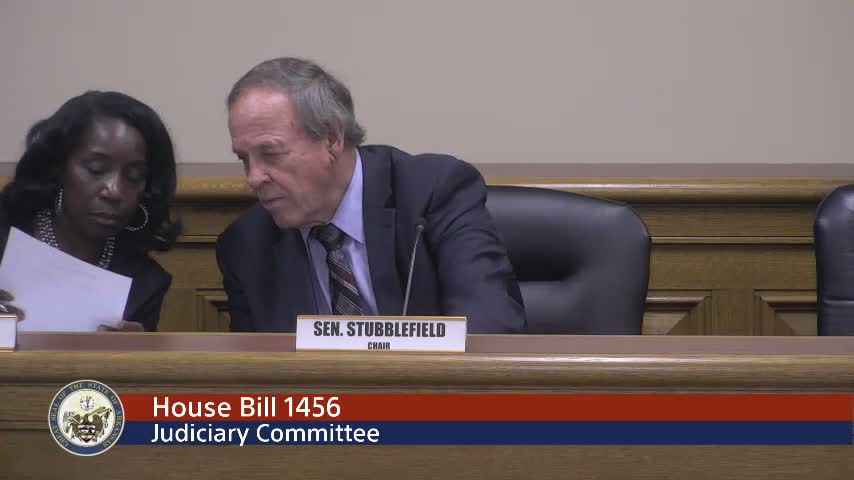
The Senate Judiciary Committee on Monday advanced two companion bills aimed at tightening criminal penalties tied to fentanyl-related deaths and exposures. Senator Gilmore, sponsor of House Bill 14 56, told the committee the measure adds a "death by delivery" subsection to homicide law and creates aggravated and first-degree death-by-delivery offenses, along with trafficking and marketing-to-minors enhancements and a provision decriminalizing fentanyl test strips.
"This bill creates death by delivery," Senator Gilmore said while outlining the penalties included on the bill's pages, noting the governor has publicly endorsed the legislation. Tony Ryle, director of the Sentencing Commission, told the panel the projected sentencing impact is uncertain because fentanyl offenses are not consistently reported separately but cautioned that underlying penalties can be severe.
During public comment, Matthew Collins, who identified himself as a concerned citizen and said his brother died of a fentanyl overdose, urged lawmakers to consider unintended consequences. "This bill claims to target dealers, but that's simply not the case," Collins testified, warning the proposal could sweep in friends or family and undermine Arkansas' Good Samaritan protections (referred to in testimony as the Joshua Ashley Polley Act), discouraging people from calling for emergency medical help.
Collins pointed to research and anecdotal experience to argue that prosecutions under similar laws in other states sometimes targeted acquaintances of the deceased rather than commercial dealers and said the prospect of greater criminal exposure could "make it more likely for people to not call the ambulance." He asked lawmakers to prioritize health-based measures and funding for treatment rather than expanding prison terms for people who use drugs.
Prosecuting Attorney Daniel Hsu, testifying for a related measure, described a separate bill (House Bill 16 63) that criminalizes knowingly exposing another person to fentanyl, including in circumstances that endanger first responders. Hsu recounted a Sebastian County detention-center incident in which multiple inmates and deputies required medical transport after coming into contact with fentanyl, and he stressed the danger of small amounts. "Fentanyl, as we all know, is the plutonium of the drug world," Hsu told the committee, describing exposure pathways such as skin contact, inhalation and needle sticks.
Sponsors said both bills include mitigating factors and family exceptions. Senator Gilmore told members the text references Good Samaritan protections and contains language meant to protect family members and non-dealers, while also seeking to deter traffickers and protect emergency personnel.
After questions and brief discussion, committee members moved both bills and advanced them by voice vote with no roll-call recorded. House Bill 14 56 and House Bill 16 63 passed the committee and will proceed to the next legislative stage for further consideration.
The committee did not produce a roll-call tally in the hearing; both measures advanced by voice vote.
"This bill creates death by delivery," Senator Gilmore said while outlining the penalties included on the bill's pages, noting the governor has publicly endorsed the legislation. Tony Ryle, director of the Sentencing Commission, told the panel the projected sentencing impact is uncertain because fentanyl offenses are not consistently reported separately but cautioned that underlying penalties can be severe.
During public comment, Matthew Collins, who identified himself as a concerned citizen and said his brother died of a fentanyl overdose, urged lawmakers to consider unintended consequences. "This bill claims to target dealers, but that's simply not the case," Collins testified, warning the proposal could sweep in friends or family and undermine Arkansas' Good Samaritan protections (referred to in testimony as the Joshua Ashley Polley Act), discouraging people from calling for emergency medical help.
Collins pointed to research and anecdotal experience to argue that prosecutions under similar laws in other states sometimes targeted acquaintances of the deceased rather than commercial dealers and said the prospect of greater criminal exposure could "make it more likely for people to not call the ambulance." He asked lawmakers to prioritize health-based measures and funding for treatment rather than expanding prison terms for people who use drugs.
Prosecuting Attorney Daniel Hsu, testifying for a related measure, described a separate bill (House Bill 16 63) that criminalizes knowingly exposing another person to fentanyl, including in circumstances that endanger first responders. Hsu recounted a Sebastian County detention-center incident in which multiple inmates and deputies required medical transport after coming into contact with fentanyl, and he stressed the danger of small amounts. "Fentanyl, as we all know, is the plutonium of the drug world," Hsu told the committee, describing exposure pathways such as skin contact, inhalation and needle sticks.
Sponsors said both bills include mitigating factors and family exceptions. Senator Gilmore told members the text references Good Samaritan protections and contains language meant to protect family members and non-dealers, while also seeking to deter traffickers and protect emergency personnel.
After questions and brief discussion, committee members moved both bills and advanced them by voice vote with no roll-call recorded. House Bill 14 56 and House Bill 16 63 passed the committee and will proceed to the next legislative stage for further consideration.
The committee did not produce a roll-call tally in the hearing; both measures advanced by voice vote.
Don't Miss a Word: See the Full Meeting!
Go beyond summaries. Unlock every video, transcript, and key insight with a Founder Membership.
✓
Get instant access to full meeting videos
✓
Search and clip any phrase from complete transcripts
✓
Receive AI-powered summaries & custom alerts
✓
Enjoy lifetime, unrestricted access to government data
30-day money-back guarantee
