Committee adopts interim study to explore aggravated-assault offense for public transit employees
November 01, 2023 | JUDICIARY COMMITTEE - SENATE, Senate, Committees, Legislative, Arkansas
This article was created by AI summarizing key points discussed. AI makes mistakes, so for full details and context, please refer to the video of the full meeting. Please report any errors so we can fix them. Report an error »
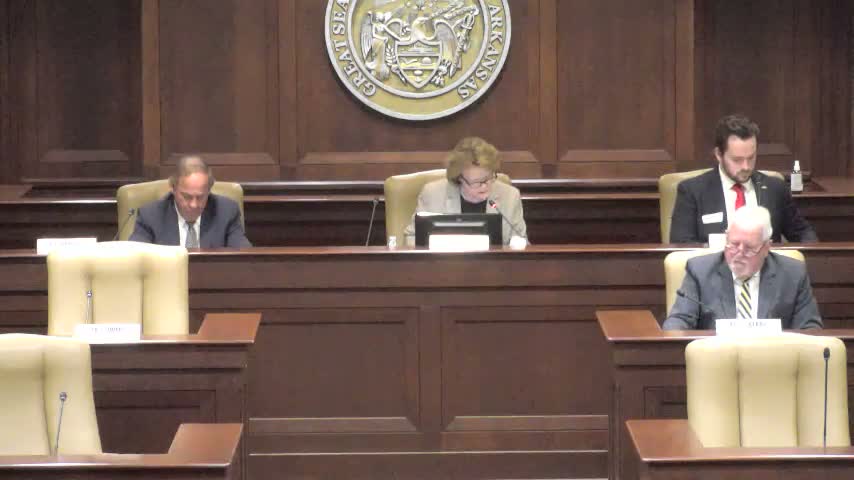
The joint House and Senate Judiciary Committee on the morning session adopted an interim study to examine a proposal creating an aggravated-assault offense specifically aimed at attacks on public transit employees, Representative Dean Hodges said.
Representative Dean Hodges introduced the measure as House Bill 1839 and asked the committee to authorize staff and sponsors to work through statutory language and possible alternate code sections. "This is a bill that I put into interim study during session, on the request of a constituent of mine, Ozark Regional Transit," Hodges said.
Witnesses from Arkansas transit agencies told the committee they have seen an increase in assaults and that current rider-behavior rules and misdemeanor charges often do not deter repeat offenders. Joel Gardner, executive director of Ozark Regional Transit, testified that "we see a perpetual increase in assault against transit officials" and that existing protocols have "very little teeth." He said agencies want a clearer statutory label aimed at transit workers so they can publicize penalties and deter bad actors.
Adam Waddell, director of Razorback Transit at the University of Arkansas, said operators now face more incidents than in earlier decades and offered to provide documentation. "Transit operators are no longer just bus drivers. They're professionals expected to perform a wide array of necessary tasks by themselves," Waddell said, adding that some recent events have led to injuries and days off work.
Prosecutor Bob McMahon, prosecutor coordinator for the prosecutors association, cautioned that the proposal must be compared with existing law. He told the committee the regular aggravated-assault statute differs in elements and that a targeted statute modeled on prior first-responder enhancements would increase the penalty range: "The regular aggravated assault statute is a D felony ... this penalty is increased because it is a C felony rather than the regular aggravated assault D felony," McMahon said.
Members asked whether enhanced penalties already on the books (referenced during the hearing as Act 955 of 2017 and Arkansas Code §5‑47‑705/5‑47‑05 as discussed orally) cover assaults on transit employees and whether signs notifying riders of enhanced penalties could be posted under current law. Several legislators recommended that sponsors compare the proposed language with the existing 2017 enhancement and consider signage and targeted public notices before or while drafting statutory changes.
After discussion, the committee adopted the interim study to allow Representative Hodges to continue refining the proposal and to consult with prosecutors and transit agencies. The motion to adopt passed on a voice vote with ayes recorded and no opposing votes. The committee did not adopt final statutory language; the ISP will allow additional work and follow-up testimony.
What happens next: The adoption authorizes the study phase; sponsors and staff said they will collect statistics and consult prosecutors and, if necessary, amend the language before returning to committee for any proposed bill.
Representative Dean Hodges introduced the measure as House Bill 1839 and asked the committee to authorize staff and sponsors to work through statutory language and possible alternate code sections. "This is a bill that I put into interim study during session, on the request of a constituent of mine, Ozark Regional Transit," Hodges said.
Witnesses from Arkansas transit agencies told the committee they have seen an increase in assaults and that current rider-behavior rules and misdemeanor charges often do not deter repeat offenders. Joel Gardner, executive director of Ozark Regional Transit, testified that "we see a perpetual increase in assault against transit officials" and that existing protocols have "very little teeth." He said agencies want a clearer statutory label aimed at transit workers so they can publicize penalties and deter bad actors.
Adam Waddell, director of Razorback Transit at the University of Arkansas, said operators now face more incidents than in earlier decades and offered to provide documentation. "Transit operators are no longer just bus drivers. They're professionals expected to perform a wide array of necessary tasks by themselves," Waddell said, adding that some recent events have led to injuries and days off work.
Prosecutor Bob McMahon, prosecutor coordinator for the prosecutors association, cautioned that the proposal must be compared with existing law. He told the committee the regular aggravated-assault statute differs in elements and that a targeted statute modeled on prior first-responder enhancements would increase the penalty range: "The regular aggravated assault statute is a D felony ... this penalty is increased because it is a C felony rather than the regular aggravated assault D felony," McMahon said.
Members asked whether enhanced penalties already on the books (referenced during the hearing as Act 955 of 2017 and Arkansas Code §5‑47‑705/5‑47‑05 as discussed orally) cover assaults on transit employees and whether signs notifying riders of enhanced penalties could be posted under current law. Several legislators recommended that sponsors compare the proposed language with the existing 2017 enhancement and consider signage and targeted public notices before or while drafting statutory changes.
After discussion, the committee adopted the interim study to allow Representative Hodges to continue refining the proposal and to consult with prosecutors and transit agencies. The motion to adopt passed on a voice vote with ayes recorded and no opposing votes. The committee did not adopt final statutory language; the ISP will allow additional work and follow-up testimony.
What happens next: The adoption authorizes the study phase; sponsors and staff said they will collect statistics and consult prosecutors and, if necessary, amend the language before returning to committee for any proposed bill.
Don't Miss a Word: See the Full Meeting!
Go beyond summaries. Unlock every video, transcript, and key insight with a Founder Membership.
✓
Get instant access to full meeting videos
✓
Search and clip any phrase from complete transcripts
✓
Receive AI-powered summaries & custom alerts
✓
Enjoy lifetime, unrestricted access to government data
30-day money-back guarantee
