Joint Judiciary Committee launches Act 38 study into district court funding, cites AOJ shortfalls
December 05, 2023 | JUDICIARY COMMITTEE - SENATE, Senate, Committees, Legislative, Arkansas
This article was created by AI summarizing key points discussed. AI makes mistakes, so for full details and context, please refer to the video of the full meeting. Please report any errors so we can fix them. Report an error »
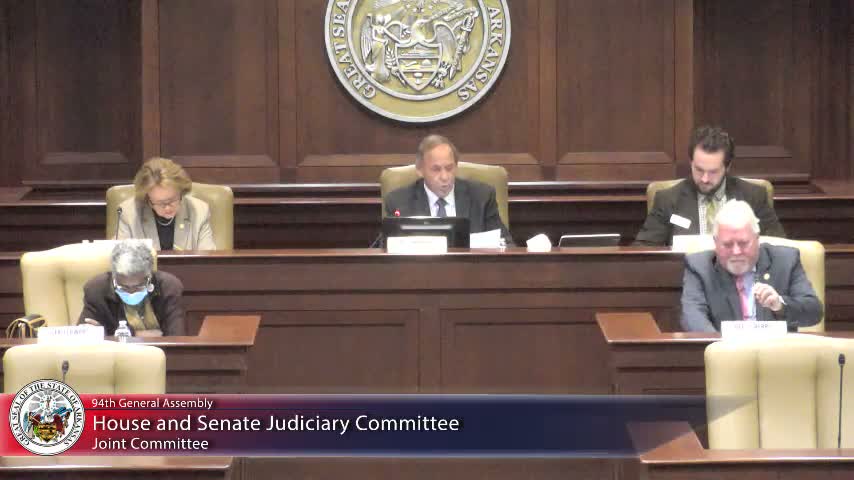
The joint House and Senate Judiciary Committee opened a meeting to begin an Act 38 study into how Arkansas funds its district courts, with witnesses telling lawmakers the state’s system of court costs and special fees is unstable and burdensome for misdemeanor defendants.
John Wilkerson, general counsel and legislative director for the Arkansas Municipal League, thanked committee chairs for sponsoring the study and described the work as aimed at sorting statutory ambiguity and identifying equitable changes to city, county and state funding responsibilities. Mark Whitmore of the Association of Arkansas Counties told lawmakers the core problem is structural: the Administration of Justice (AOJ) fund is split across 24 designated buckets while roughly 30 miscellaneous fees are imposed on defendants, producing complexity and unpredictable revenue.
"You cannot fund the justice system off court cost," Whitmore said, adding that the AOJ fund’s collection rate has fallen to about 30 percent from historical collection rates near 60 percent and that the shortfall leaves counties only partially reimbursed for expenses such as juror pay.
The witnesses described historical shifts that moved many court-related positions — including public defenders and prosecutors — to state employment, while counties continue to pay portions of some deputy prosecutor costs or supplement positions when the state did not create them. Wilkerson and Whitmore said the study team has contacted all 75 county seats seeking written cost‑sharing agreements between cities and counties and plans to work with Legislative Audit to gather statewide data.
Committee members asked for specifics the study will need to address. Representative Dolby requested that the team identify how many of the 24 AOJ buckets are statutorily required to be "court related," asked for analysis of installment (time‑payment) fees and their effect on defendants, and sought clarity on whether written cost‑sharing agreements exist. Witnesses described an installment fee structure that includes a $5 state fee and a comparable local fee on time payments, which can accumulate and reduce net collection while imposing ongoing costs on defendants.
Legislators also debated the broader policy question of how much "skin in the game" cities and counties should retain, with some members warning the study could conclude the state must assume greater funding responsibility while others urged exploring efficiency measures and regional inequities between rural and urban counties.
Members emphasized geographic representation in the study, asking that judges and officials from South and Southeast Arkansas and other underrepresented areas be included; witnesses said they would broaden the internal study group and that Legislative Audit would collect information from across the state.
As a procedural matter the committee approved Nov. 1 meeting minutes by voice vote. Chairs Dolby and Stubblefield said they will ask the Legislative Audit executive committee to undertake an audit-style study similar to the 2015 circuit court review and provided members with a tentative timeline for the district court study.
The meeting concluded after witnesses and members agreed on the next steps and outreach; no final policy decisions were made at the session.
John Wilkerson, general counsel and legislative director for the Arkansas Municipal League, thanked committee chairs for sponsoring the study and described the work as aimed at sorting statutory ambiguity and identifying equitable changes to city, county and state funding responsibilities. Mark Whitmore of the Association of Arkansas Counties told lawmakers the core problem is structural: the Administration of Justice (AOJ) fund is split across 24 designated buckets while roughly 30 miscellaneous fees are imposed on defendants, producing complexity and unpredictable revenue.
"You cannot fund the justice system off court cost," Whitmore said, adding that the AOJ fund’s collection rate has fallen to about 30 percent from historical collection rates near 60 percent and that the shortfall leaves counties only partially reimbursed for expenses such as juror pay.
The witnesses described historical shifts that moved many court-related positions — including public defenders and prosecutors — to state employment, while counties continue to pay portions of some deputy prosecutor costs or supplement positions when the state did not create them. Wilkerson and Whitmore said the study team has contacted all 75 county seats seeking written cost‑sharing agreements between cities and counties and plans to work with Legislative Audit to gather statewide data.
Committee members asked for specifics the study will need to address. Representative Dolby requested that the team identify how many of the 24 AOJ buckets are statutorily required to be "court related," asked for analysis of installment (time‑payment) fees and their effect on defendants, and sought clarity on whether written cost‑sharing agreements exist. Witnesses described an installment fee structure that includes a $5 state fee and a comparable local fee on time payments, which can accumulate and reduce net collection while imposing ongoing costs on defendants.
Legislators also debated the broader policy question of how much "skin in the game" cities and counties should retain, with some members warning the study could conclude the state must assume greater funding responsibility while others urged exploring efficiency measures and regional inequities between rural and urban counties.
Members emphasized geographic representation in the study, asking that judges and officials from South and Southeast Arkansas and other underrepresented areas be included; witnesses said they would broaden the internal study group and that Legislative Audit would collect information from across the state.
As a procedural matter the committee approved Nov. 1 meeting minutes by voice vote. Chairs Dolby and Stubblefield said they will ask the Legislative Audit executive committee to undertake an audit-style study similar to the 2015 circuit court review and provided members with a tentative timeline for the district court study.
The meeting concluded after witnesses and members agreed on the next steps and outreach; no final policy decisions were made at the session.
View the Full Meeting & All Its Details
This article offers just a summary. Unlock complete video, transcripts, and insights as a Founder Member.
✓
Watch full, unedited meeting videos
✓
Search every word spoken in unlimited transcripts
✓
AI summaries & real-time alerts (all government levels)
✓
Permanent access to expanding government content
30-day money-back guarantee
