Committee holds interim study on child-support modifications tied to parole after agency concerns
November 01, 2023 | JUDICIARY COMMITTEE - SENATE, Senate, Committees, Legislative, Arkansas
This article was created by AI summarizing key points discussed. AI makes mistakes, so for full details and context, please refer to the video of the full meeting. Please report any errors so we can fix them. Report an error »
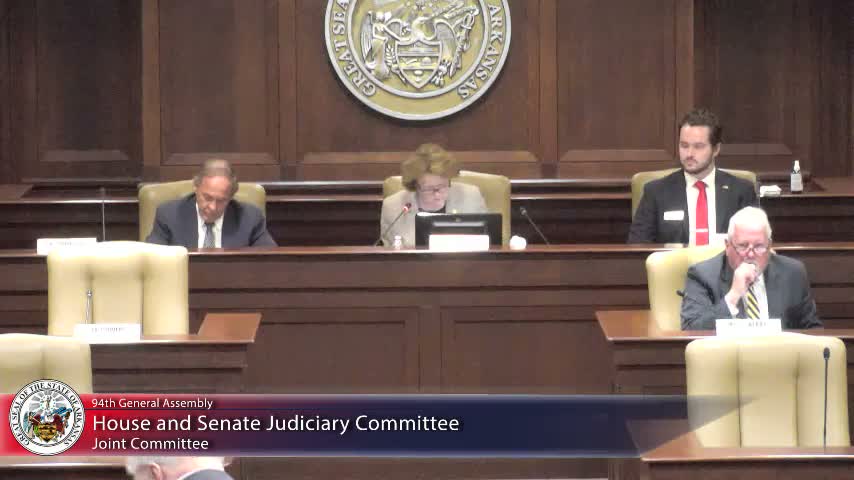
Representative Lanny Fite introduced an interim study (originally filed as House Bill 1699) to explore whether parole or probation contacts could be used to serve child-support modification paperwork and improve coordination between the Department of Corrections/Community Corrections and the Office of Child Support Enforcement.
Selena Davis, who described a multi-year personal struggle to get modification paperwork served after a parolee's release, urged legislative or operational changes to allow modifications to be handled at the time an individual meets with parole officers. "If there is a way to catch this in the beginning and collaborate across the agencies, we can make such a difference," Davis said, describing lengthy delays and roughly $50,000 in economic impacts to her family over several years (approximate figure provided as personal estimate).
Barbara Williams, administrator for the Office of Child Support Enforcement, told the committee the office already receives an automated data match from the Department of Corrections and Community Corrections that identifies individuals who are incarcerated or under supervision; that match is updated roughly every two weeks, she said. Williams also raised a statutory and regulatory problem: a bill provision that would require the office to share child-support data back to corrections could run afoul of federal confidentiality rules. She cited federal safeguarding regulations (45 C.F.R. §303.21) and said the agency had consulted federal representatives who warned such disclosure could violate federal law.
Members asked whether the practical problems Davis described could be fixed by better use of existing data matches, more frequent coordination, or by directing DOC to ensure parole officers receive publicly filed court information. Several lawmakers urged trying signage and administrative fixes before creating mandatory statutory exchanges that may trigger federal restrictions. Representative Collins and others asked staff to consider more frequent data matching or narrow drafting that avoids impermissible disclosure.
After closing remarks from the sponsor, the committee elected not to adopt the interim study at this meeting and instead held it for further work by the sponsor and agency staff so potential federal-regulatory conflicts can be resolved and nonlegislative options can be explored.
Selena Davis, who described a multi-year personal struggle to get modification paperwork served after a parolee's release, urged legislative or operational changes to allow modifications to be handled at the time an individual meets with parole officers. "If there is a way to catch this in the beginning and collaborate across the agencies, we can make such a difference," Davis said, describing lengthy delays and roughly $50,000 in economic impacts to her family over several years (approximate figure provided as personal estimate).
Barbara Williams, administrator for the Office of Child Support Enforcement, told the committee the office already receives an automated data match from the Department of Corrections and Community Corrections that identifies individuals who are incarcerated or under supervision; that match is updated roughly every two weeks, she said. Williams also raised a statutory and regulatory problem: a bill provision that would require the office to share child-support data back to corrections could run afoul of federal confidentiality rules. She cited federal safeguarding regulations (45 C.F.R. §303.21) and said the agency had consulted federal representatives who warned such disclosure could violate federal law.
Members asked whether the practical problems Davis described could be fixed by better use of existing data matches, more frequent coordination, or by directing DOC to ensure parole officers receive publicly filed court information. Several lawmakers urged trying signage and administrative fixes before creating mandatory statutory exchanges that may trigger federal restrictions. Representative Collins and others asked staff to consider more frequent data matching or narrow drafting that avoids impermissible disclosure.
After closing remarks from the sponsor, the committee elected not to adopt the interim study at this meeting and instead held it for further work by the sponsor and agency staff so potential federal-regulatory conflicts can be resolved and nonlegislative options can be explored.
Don't Miss a Word: See the Full Meeting!
Go beyond summaries. Unlock every video, transcript, and key insight with a Founder Membership.
✓
Get instant access to full meeting videos
✓
Search and clip any phrase from complete transcripts
✓
Receive AI-powered summaries & custom alerts
✓
Enjoy lifetime, unrestricted access to government data
30-day money-back guarantee
