AOC tells task force court security is uneven: staffing, facilities and training drive risk
March 04, 2024 | JUDICIARY COMMITTEE - SENATE, Senate, Committees, Legislative, Arkansas
This article was created by AI summarizing key points discussed. AI makes mistakes, so for full details and context, please refer to the video of the full meeting. Please report any errors so we can fix them. Report an error »
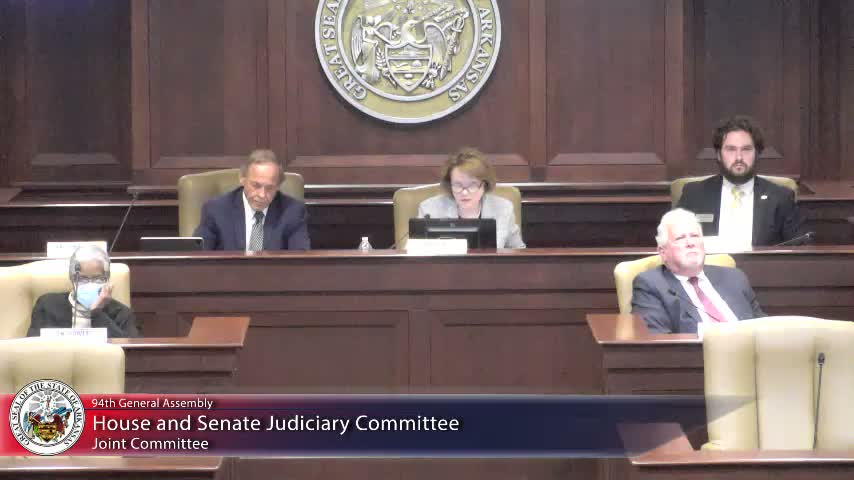
A joint Judiciary task force heard on March 1 that court security across district court departments in Arkansas varies widely and is primarily a local responsibility.
Ben Barham, an AOC staff attorney focused on district courts, told legislators that security in district courts is provided by city or county law enforcement (police or sheriff) under existing statutory language and that arrangements differ by community. He said district courts in some areas are held in dedicated courtrooms with secure entry points; in many others they operate out of city halls or meeting rooms without conventional courtroom security features.
Barham highlighted three core factors that determine security levels: available security personnel, the physical facilities used for court, and local government relationships and planning. He referenced the Court Security Act passed in 2007, which established a curriculum and a statutory committee structure; the law requires certain actors to serve on county court security committees, though those committees often focus on circuit court needs and may not adequately coordinate multi‑county state district court arrangements.
Barham said common security equipment funded by an AOC grant program includes metal detectors, cameras and key‑card entry systems, but cautioned that equipment without staffing can be ineffective: "you can have a metal detector in the hallway when you can walk around it or it's not constantly manned, can be an issue." He said many departments lack consistent full‑time security personnel and that training and recordkeeping vary.
Committee members asked about incident reporting and the prevalence of security events. Barham said AOC's director of security and emergency preparedness receives incident reports that are sent to AOC but that reporting likely undercounts incidents because local reporting practices differ; he agreed to provide available incident data to the committee.
Members also asked whether the Supreme Court has authority to set statewide security rules for multi‑county state district courts. Barham said the Supreme Court's administrative orders address some requirements (for example, which matters require a verbatim record), but that day‑to‑day provision of security is largely a local function established by statute and local arrangements.
The task force requested follow‑up data on reported security incidents and clarity on county security committee participation by district court representatives.
Ben Barham, an AOC staff attorney focused on district courts, told legislators that security in district courts is provided by city or county law enforcement (police or sheriff) under existing statutory language and that arrangements differ by community. He said district courts in some areas are held in dedicated courtrooms with secure entry points; in many others they operate out of city halls or meeting rooms without conventional courtroom security features.
Barham highlighted three core factors that determine security levels: available security personnel, the physical facilities used for court, and local government relationships and planning. He referenced the Court Security Act passed in 2007, which established a curriculum and a statutory committee structure; the law requires certain actors to serve on county court security committees, though those committees often focus on circuit court needs and may not adequately coordinate multi‑county state district court arrangements.
Barham said common security equipment funded by an AOC grant program includes metal detectors, cameras and key‑card entry systems, but cautioned that equipment without staffing can be ineffective: "you can have a metal detector in the hallway when you can walk around it or it's not constantly manned, can be an issue." He said many departments lack consistent full‑time security personnel and that training and recordkeeping vary.
Committee members asked about incident reporting and the prevalence of security events. Barham said AOC's director of security and emergency preparedness receives incident reports that are sent to AOC but that reporting likely undercounts incidents because local reporting practices differ; he agreed to provide available incident data to the committee.
Members also asked whether the Supreme Court has authority to set statewide security rules for multi‑county state district courts. Barham said the Supreme Court's administrative orders address some requirements (for example, which matters require a verbatim record), but that day‑to‑day provision of security is largely a local function established by statute and local arrangements.
The task force requested follow‑up data on reported security incidents and clarity on county security committee participation by district court representatives.
Don't Miss a Word: See the Full Meeting!
Go beyond summaries. Unlock every video, transcript, and key insight with a Founder Membership.
✓
Get instant access to full meeting videos
✓
Search and clip any phrase from complete transcripts
✓
Receive AI-powered summaries & custom alerts
✓
Enjoy lifetime, unrestricted access to government data
30-day money-back guarantee
