Utah House circles film production incentive bill after hours of debate
March 02, 2022 | 2022 Utah Legislature, Utah Legislature, Utah Legislative Branch, Utah
This article was created by AI summarizing key points discussed. AI makes mistakes, so for full details and context, please refer to the video of the full meeting. Please report any errors so we can fix them. Report an error »
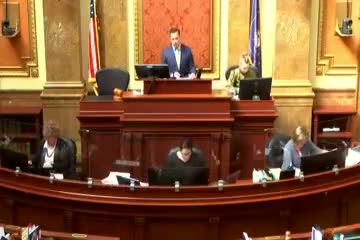
Rep. Randy Handy, the House sponsor, described Senate Bill 49 as an effort to preserve and expand an industry that brings jobs and spending to rural Utah, and to ensure federal and state incentives "are spent in a way that considers a statewide interest rather than just the narrow interest of special interest groups or individual communities." Handy emphasized rural economic benefits and cited an industry study: "For every $1 spent of incentive spent, $7 is returned to the Utah economy," he said.
Opponents raised fiscal and policy concerns. Rep. Hawkes said independent research questions the long‑term return on investment for film incentives and warned that benefits "don't stay home," calling the proposals "little more than handouts for Hollywood." He and other critics pointed to studies and examples of states that have scaled back incentives after finding limited lasting economic impact.
Supporters countered that incentives are a competitive necessity and a targeted tool to help rural counties. Rep. Winder and Rep. Ballard framed the measure as a way to bring jobs and workforce opportunities to parts of the state losing legacy industries, while Rep. Snow and Rep. Carol Moss highlighted local workforce and higher‑education pipeline benefits for students and production professionals who want to remain in Utah.
Several members asked for more detail about how the bill would direct dollars to truly rural economies. Rep. Dunnegan and Rep. Schultz highlighted language that defines "rural production" as a majority (51%) of production activity occurring in certain county classes and said that threshold could fail to direct the majority of spending into rural communities. That point prompted a motion to circle the bill for further work and clarification.
Representative Schultz moved the motion to circle SB 49, arguing the body needed to resolve distribution and fiscal‑note questions. The motion carried on the floor and the bill was circled for further consideration, allowing members and staff to refine eligibility thresholds and fiscal details before bringing it back for a later vote.
The House took no final action on SB 49 on the floor today; circling preserves the bill for future debate rather than killing it or passing it on this calendar.
Opponents raised fiscal and policy concerns. Rep. Hawkes said independent research questions the long‑term return on investment for film incentives and warned that benefits "don't stay home," calling the proposals "little more than handouts for Hollywood." He and other critics pointed to studies and examples of states that have scaled back incentives after finding limited lasting economic impact.
Supporters countered that incentives are a competitive necessity and a targeted tool to help rural counties. Rep. Winder and Rep. Ballard framed the measure as a way to bring jobs and workforce opportunities to parts of the state losing legacy industries, while Rep. Snow and Rep. Carol Moss highlighted local workforce and higher‑education pipeline benefits for students and production professionals who want to remain in Utah.
Several members asked for more detail about how the bill would direct dollars to truly rural economies. Rep. Dunnegan and Rep. Schultz highlighted language that defines "rural production" as a majority (51%) of production activity occurring in certain county classes and said that threshold could fail to direct the majority of spending into rural communities. That point prompted a motion to circle the bill for further work and clarification.
Representative Schultz moved the motion to circle SB 49, arguing the body needed to resolve distribution and fiscal‑note questions. The motion carried on the floor and the bill was circled for further consideration, allowing members and staff to refine eligibility thresholds and fiscal details before bringing it back for a later vote.
The House took no final action on SB 49 on the floor today; circling preserves the bill for future debate rather than killing it or passing it on this calendar.
Don't Miss a Word: See the Full Meeting!
Go beyond summaries. Unlock every video, transcript, and key insight with a Founder Membership.
✓
Get instant access to full meeting videos
✓
Search and clip any phrase from complete transcripts
✓
Receive AI-powered summaries & custom alerts
✓
Enjoy lifetime, unrestricted access to government data
30-day money-back guarantee
