House amends indigent defense grant language after floor debate over 'meet or exceed' standard
February 17, 2022 | 2022 Utah Legislature, Utah Legislature, Utah Legislative Branch, Utah
This article was created by AI summarizing key points discussed. AI makes mistakes, so for full details and context, please refer to the video of the full meeting. Please report any errors so we can fix them. Report an error »
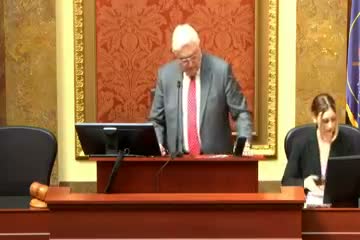
The Utah House on Feb. 16 adopted amendments to Senate Bill 108, a measure revising indigent defense grant eligibility, after an extended floor discussion about whether the bill’s language would create inconsistent statutory standards or unintended spending incentives.
Representative Ferri, the House sponsor, said SB108 expands what the grant program may support—moving away from a historically exhaustive list of eligible practices so that local jurisdictions can cover services needed to provide an effective defense. Representative Nelson questioned language in the bill that would require indigent defense services to 'meet or exceed' the commission’s core principles, asking whether requiring them to 'exceed' the principles could create legal inconsistency with other statutory sections that require only meeting the standards and could invite unnecessary additional spending by defense counsel.
Ferri responded that the bill intended 'meet' as a minimum and that practices that exceed the baseline should also remain eligible. Representative Ballard moved to reinstate explicit language listing allowable costs (including investigators, expert witnesses, scientific or medical testing and transcripts), arguing that the list would ensure those items are explicitly covered; Representative Ferri opposed that amendment on grounds it would be unduly prescriptive and could contradict the bill’s broader purpose. A point of order raised about the 15-word limit for floor changes briefly delayed the amendment debate; after parliamentary review, a related motion to delete the words 'or exceed' on several lines (including lines identified as 160, 184, 100 and 801 in the floor discussion) was offered by Representative Kristofferson and carried.
Representative Ballard’s attempted reinstatement of the specific-cost list was ultimately ruled to fail on the floor; sponsors said the grant program is intentionally nonexclusive so that local indigent defense systems can adapt to jurisdictional needs, including hiring social workers or other personnel not enumerated in a fixed list. The House returned SB108 as amended to the Senate for further action.
Key floor quotes:
"Why are we now trying to exceed core principles?" — Representative Nelson, questioning the 'meet or exceed' phrasing.
"...it has to at a minimum meet, and if it exceeds it, that's okay as well." — Representative Ferri, sponsor.
What changed: The House removed specific 'or exceed' phrasing in multiple locations and rejected a reinstatement of an explicit list of reimbursable costs, preserving a more flexible grant eligibility structure while clarifying the bill’s minimum standards.
Next steps: SB108 was returned to the Senate as amended and will require any further concurrence or conference if the Senate takes different action.
Source: Floor proceedings, Utah House of Representatives, Feb. 16, 2022.
Representative Ferri, the House sponsor, said SB108 expands what the grant program may support—moving away from a historically exhaustive list of eligible practices so that local jurisdictions can cover services needed to provide an effective defense. Representative Nelson questioned language in the bill that would require indigent defense services to 'meet or exceed' the commission’s core principles, asking whether requiring them to 'exceed' the principles could create legal inconsistency with other statutory sections that require only meeting the standards and could invite unnecessary additional spending by defense counsel.
Ferri responded that the bill intended 'meet' as a minimum and that practices that exceed the baseline should also remain eligible. Representative Ballard moved to reinstate explicit language listing allowable costs (including investigators, expert witnesses, scientific or medical testing and transcripts), arguing that the list would ensure those items are explicitly covered; Representative Ferri opposed that amendment on grounds it would be unduly prescriptive and could contradict the bill’s broader purpose. A point of order raised about the 15-word limit for floor changes briefly delayed the amendment debate; after parliamentary review, a related motion to delete the words 'or exceed' on several lines (including lines identified as 160, 184, 100 and 801 in the floor discussion) was offered by Representative Kristofferson and carried.
Representative Ballard’s attempted reinstatement of the specific-cost list was ultimately ruled to fail on the floor; sponsors said the grant program is intentionally nonexclusive so that local indigent defense systems can adapt to jurisdictional needs, including hiring social workers or other personnel not enumerated in a fixed list. The House returned SB108 as amended to the Senate for further action.
Key floor quotes:
"Why are we now trying to exceed core principles?" — Representative Nelson, questioning the 'meet or exceed' phrasing.
"...it has to at a minimum meet, and if it exceeds it, that's okay as well." — Representative Ferri, sponsor.
What changed: The House removed specific 'or exceed' phrasing in multiple locations and rejected a reinstatement of an explicit list of reimbursable costs, preserving a more flexible grant eligibility structure while clarifying the bill’s minimum standards.
Next steps: SB108 was returned to the Senate as amended and will require any further concurrence or conference if the Senate takes different action.
Source: Floor proceedings, Utah House of Representatives, Feb. 16, 2022.
Don't Miss a Word: See the Full Meeting!
Go beyond summaries. Unlock every video, transcript, and key insight with a Founder Membership.
✓
Get instant access to full meeting videos
✓
Search and clip any phrase from complete transcripts
✓
Receive AI-powered summaries & custom alerts
✓
Enjoy lifetime, unrestricted access to government data
30-day money-back guarantee
