House creates 'massage assistant' license with disclosure, testing and training rules
March 04, 2022 | 2022 Utah Legislature, Utah Legislature, Utah Legislative Branch, Utah
This article was created by AI summarizing key points discussed. AI makes mistakes, so for full details and context, please refer to the video of the full meeting. Please report any errors so we can fix them. Report an error »
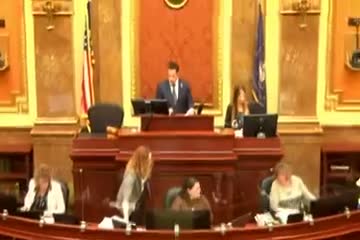
The Utah House passed a third substitute to Senate Bill 180 on March 4, establishing a new limited license for massage assistants and an assistant-in-training pathway. The bill passed the House by a vote of 56 yes and 15 no and will be returned to the Senate for further consideration.
Sponsor Representative Perucci said the bill responds to workforce shortages in the massage industry and is narrowly scoped to lower-intensity services such as Swedish massage, chair massage, reflexology and aromatherapy. The floor amendment adopted before final passage requires clear disclosure to clients—both on-premises signage and direct notification when an appointment is made or before service begins—so consumers know whether a licensee is an assistant or a fully licensed massage therapist.
Perucci described training and supervision thresholds during floor questioning: an assistant-in-training would complete around 300 hours before interacting with the public — “after 300 hours,” the sponsor said — with the first 150 hours directed training and the remaining hours involving friends and family supervised practice. Sponsors estimated the assistant route would cost substantially less than full therapist training ($3,000–$5,000 versus $15,000–$20,000 for a full license), an argument proponents used to support pipeline growth.
Opponents voiced concerns about public safety and scope-of-practice, but the sponsor told the body the attorney general’s office reviewed the bill and remained neutral; law-enforcement stakeholders indicated they saw the measure as improving transparency and accountability. Representative Ballard, who introduced the disclosure amendment, said the requirement protects consumers who might otherwise be unaware of an assistant’s status.
The bill passed on a roll call and now moves back to the Senate for concurrence on House floor amendments.
Sponsor Representative Perucci said the bill responds to workforce shortages in the massage industry and is narrowly scoped to lower-intensity services such as Swedish massage, chair massage, reflexology and aromatherapy. The floor amendment adopted before final passage requires clear disclosure to clients—both on-premises signage and direct notification when an appointment is made or before service begins—so consumers know whether a licensee is an assistant or a fully licensed massage therapist.
Perucci described training and supervision thresholds during floor questioning: an assistant-in-training would complete around 300 hours before interacting with the public — “after 300 hours,” the sponsor said — with the first 150 hours directed training and the remaining hours involving friends and family supervised practice. Sponsors estimated the assistant route would cost substantially less than full therapist training ($3,000–$5,000 versus $15,000–$20,000 for a full license), an argument proponents used to support pipeline growth.
Opponents voiced concerns about public safety and scope-of-practice, but the sponsor told the body the attorney general’s office reviewed the bill and remained neutral; law-enforcement stakeholders indicated they saw the measure as improving transparency and accountability. Representative Ballard, who introduced the disclosure amendment, said the requirement protects consumers who might otherwise be unaware of an assistant’s status.
The bill passed on a roll call and now moves back to the Senate for concurrence on House floor amendments.
View the Full Meeting & All Its Details
This article offers just a summary. Unlock complete video, transcripts, and insights as a Founder Member.
✓
Watch full, unedited meeting videos
✓
Search every word spoken in unlimited transcripts
✓
AI summaries & real-time alerts (all government levels)
✓
Permanent access to expanding government content
30-day money-back guarantee
