Utah House approves congressional map after rejecting multiple substitute plans
November 09, 2021 | 2021 Utah Legislature, Utah Legislature, Utah Legislative Branch, Utah
This article was created by AI summarizing key points discussed. AI makes mistakes, so for full details and context, please refer to the video of the full meeting. Please report any errors so we can fix them. Report an error »
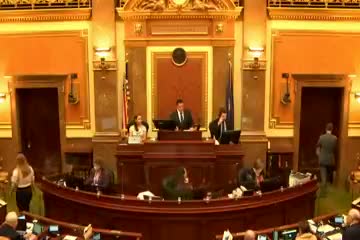
The Utah House voted to approve House Bill 2004, the bill that sets the state’s four congressional districts, after a day of debate and several failed substitute motions. The bill passed and will be sent to the Senate with a recorded tally of 50 yes votes and 22 no votes.
Representative Ray, who presented the chamber’s proposed map, said the plan follows a strict population standard: “our deviations … 0% deviation” so that districts meet a one-person, one-vote standard, and that population shifts over the past decade—growth in northern Utah near Eagle Mountain and in parts of Salt Lake and Washington counties—required moving population northward. He summarized geographic changes and noted local landmarks and representatives to illustrate how lines shifted.
An opponent of the sponsor’s first substitute said the goal should include preserving at least one competitive or "swing" district so that voters have choices in some districts. “There needs to be places where people know it might go either way, depending on how that party governs,” a Representative who moved the substitute said while asking colleagues to support a map that would retain at least one swing seat. The sponsor responded that the presented map keeps districts equal in population and that deviations are "less than 10 people per district."
During the debate the House considered multiple alternate maps, including a motion to replace the proposed map with the Utah Independent Redistricting Commission’s “purple” map. A representative moving that fourth substitute argued the commission map keeps communities whole and provides “fair and equal representation,” but the House rejected the substitute. The body also approved a motion to end debate (the previous question) before the final vote.
The final approval concludes House consideration of congressional boundaries for now; the bill will be transmitted to the Utah Senate for further action.
The House also took a procedural step to "circle" the bill later in the session, a routine action used to manage the calendar.
Next steps: HB 2004 will be transmitted to the Senate for its consideration and possible further amendment.
Representative Ray, who presented the chamber’s proposed map, said the plan follows a strict population standard: “our deviations … 0% deviation” so that districts meet a one-person, one-vote standard, and that population shifts over the past decade—growth in northern Utah near Eagle Mountain and in parts of Salt Lake and Washington counties—required moving population northward. He summarized geographic changes and noted local landmarks and representatives to illustrate how lines shifted.
An opponent of the sponsor’s first substitute said the goal should include preserving at least one competitive or "swing" district so that voters have choices in some districts. “There needs to be places where people know it might go either way, depending on how that party governs,” a Representative who moved the substitute said while asking colleagues to support a map that would retain at least one swing seat. The sponsor responded that the presented map keeps districts equal in population and that deviations are "less than 10 people per district."
During the debate the House considered multiple alternate maps, including a motion to replace the proposed map with the Utah Independent Redistricting Commission’s “purple” map. A representative moving that fourth substitute argued the commission map keeps communities whole and provides “fair and equal representation,” but the House rejected the substitute. The body also approved a motion to end debate (the previous question) before the final vote.
The final approval concludes House consideration of congressional boundaries for now; the bill will be transmitted to the Utah Senate for further action.
The House also took a procedural step to "circle" the bill later in the session, a routine action used to manage the calendar.
Next steps: HB 2004 will be transmitted to the Senate for its consideration and possible further amendment.
View the Full Meeting & All Its Details
This article offers just a summary. Unlock complete video, transcripts, and insights as a Founder Member.
✓
Watch full, unedited meeting videos
✓
Search every word spoken in unlimited transcripts
✓
AI summaries & real-time alerts (all government levels)
✓
Permanent access to expanding government content
30-day money-back guarantee
