House clears slate of Senate bills on third reading; measures on 911 business names, records protections, air quality study among items passed
March 04, 2022 | 2022 Utah Legislature, Utah Legislature, Utah Legislative Branch, Utah
This article was created by AI summarizing key points discussed. AI makes mistakes, so for full details and context, please refer to the video of the full meeting. Please report any errors so we can fix them. Report an error »
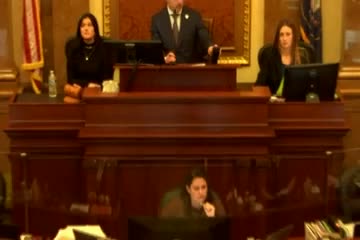
The Utah House on Feb. 20 cleared a package of Senate bills on third reading, adopting measures on business-name restrictions, background-check use limits, a voluntary construction registry, school-support cohort changes, and protections for water-system records.
First Substitute Senate Bill 213, sponsored in the House by Representative Tuscher, would prohibit future businesses from using "911" in their names while grandfathering existing companies until May 5. "This essentially prohibits a business from using 9 1 1 in its name," Representative Tuscher said, saying emergency dispatch centers support the change because it reduces confusion when people seek emergency services. The House passed the substitute 55-15.
Senate Bill 248 (BCI background check amendments), explained by House sponsor Representative Lizenby, restricts uses of criminal-history information to statutorily enumerated purposes (criminal justice agencies, qualifying employers, foreign-travel clearances, adoptive studies, and certain state agency employee screenings), requires a signed waiver notifying individuals how their records will be used, and makes unauthorized access a Class B misdemeanor. The bill passed the House 74-0.
Second Substitute Senate Bill 148 would create a voluntary construction contractor registry, hosted by the Department of Commerce and the Division of Professional Licensing, enabling contractors to list license numbers and basic information for a $5 fee every other year; the House adopted a second substitute to clarify fiscal notes and passed it 73-0.
Senate Bill 245 revises the school turnaround program by fixing the number of schools eligible for support per cohort, creating a voluntary "Elevate" cohort between mandatory cohorts, and replacing the "turnaround" label with "Springboard" and "Elevate" terminology; Representative Last said the change also opens the program to volunteer schools. The bill passed 73-0.
Senate Bill 254 would protect sensitive records related to drinking water and wastewater systems under GRAMA to reduce security risks from malicious actors seeking schematic or engineering drawings, Representative Snow said. The bill passed 71-0.
First Substitute Senate Bill 136 directs the Division of Air Quality to study diesel emissions reduction and to use the Texas Emissions Reduction Program as a framework, with a report due in 2023. Representative Schultz successfully moved a second substitute removing inland-port language while keeping the study requirement; the bill passed 64-7.
Second Substitute Senate Bill 250 creates a mineral exploration tax credit intended for new mining operations that proceed to develop a working mine (not mere exploration). Representative Lund said the severance tax generated would help offset credits; he offered an illustrative example (spend $20,000 -> get a $7,000 credit). The bill passed 59-11.
Votes and formal outcomes taken on the floor were reflected in the House journal and will be returned to the Senate for that body's further consideration and signature where required. Later in the day, procedural motions were adopted to notify the governor and the senate that the House had completed business and was prepared to adjourn; Governor Cox addressed the chamber and the House adjourned sine die.
First Substitute Senate Bill 213, sponsored in the House by Representative Tuscher, would prohibit future businesses from using "911" in their names while grandfathering existing companies until May 5. "This essentially prohibits a business from using 9 1 1 in its name," Representative Tuscher said, saying emergency dispatch centers support the change because it reduces confusion when people seek emergency services. The House passed the substitute 55-15.
Senate Bill 248 (BCI background check amendments), explained by House sponsor Representative Lizenby, restricts uses of criminal-history information to statutorily enumerated purposes (criminal justice agencies, qualifying employers, foreign-travel clearances, adoptive studies, and certain state agency employee screenings), requires a signed waiver notifying individuals how their records will be used, and makes unauthorized access a Class B misdemeanor. The bill passed the House 74-0.
Second Substitute Senate Bill 148 would create a voluntary construction contractor registry, hosted by the Department of Commerce and the Division of Professional Licensing, enabling contractors to list license numbers and basic information for a $5 fee every other year; the House adopted a second substitute to clarify fiscal notes and passed it 73-0.
Senate Bill 245 revises the school turnaround program by fixing the number of schools eligible for support per cohort, creating a voluntary "Elevate" cohort between mandatory cohorts, and replacing the "turnaround" label with "Springboard" and "Elevate" terminology; Representative Last said the change also opens the program to volunteer schools. The bill passed 73-0.
Senate Bill 254 would protect sensitive records related to drinking water and wastewater systems under GRAMA to reduce security risks from malicious actors seeking schematic or engineering drawings, Representative Snow said. The bill passed 71-0.
First Substitute Senate Bill 136 directs the Division of Air Quality to study diesel emissions reduction and to use the Texas Emissions Reduction Program as a framework, with a report due in 2023. Representative Schultz successfully moved a second substitute removing inland-port language while keeping the study requirement; the bill passed 64-7.
Second Substitute Senate Bill 250 creates a mineral exploration tax credit intended for new mining operations that proceed to develop a working mine (not mere exploration). Representative Lund said the severance tax generated would help offset credits; he offered an illustrative example (spend $20,000 -> get a $7,000 credit). The bill passed 59-11.
Votes and formal outcomes taken on the floor were reflected in the House journal and will be returned to the Senate for that body's further consideration and signature where required. Later in the day, procedural motions were adopted to notify the governor and the senate that the House had completed business and was prepared to adjourn; Governor Cox addressed the chamber and the House adjourned sine die.
Don't Miss a Word: See the Full Meeting!
Go beyond summaries. Unlock every video, transcript, and key insight with a Founder Membership.
✓
Get instant access to full meeting videos
✓
Search and clip any phrase from complete transcripts
✓
Receive AI-powered summaries & custom alerts
✓
Enjoy lifetime, unrestricted access to government data
30-day money-back guarantee
