Utah Senate moves more than two dozen bills under suspension of rules; package includes health, tax, retirement and board sunsets
January 16, 2024 | 2024 Utah Legislature, Utah Legislature, Utah Legislative Branch, Utah
This article was created by AI summarizing key points discussed. AI makes mistakes, so for full details and context, please refer to the video of the full meeting. Please report any errors so we can fix them. Report an error »
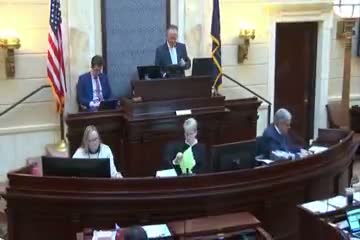
Under suspension of the rules, the Utah Senate advanced and passed a large package of bills spanning governance, tax, health and administrative cleanup.
On a largely noncontroversial floor, senators used a suspension of the one‑day calendar and the state Constitution's three‑reading requirement to accelerate final passage of numerous measures. Several bills were described as technical cleanups or sunset extensions; others made substantive policy changes.
Key items and floor outcomes included:
• SB 15 (Concealed Firearm Review Board): Sponsor Senator Grover said the bill extends the board’s sunset to July 1, 2029; the Senate recorded 27 yea, 0 nay, 2 absent and passed the bill to the House.
• SB 17 (Safe Drinking Water Act): Senator Sandel said the bill extends the Act’s sunset to 2029; the Senate passed the bill and will send it to the House.
• SB 21 (State Tax Commission public‑meeting rule changes): Senator McKay said removing the sunset on a pilot will let the Tax Commission handle certain employee and administrative matters without triggering public‑meeting quorums; the bill passed under suspension (28 yea, 0 nay, 1 absent).
• SB 34 (Utah State Retirement Systems revisions): Senator Harper moved and the Senate adopted a substitute containing technical actuarial and record‑keeping changes, employer‑penalty clarifications and conforming surviving‑spouse language; the substituted bill passed and will be transmitted to the House.
• SB 35 (Infertility treatment coverage): Senator Escamilla said the committee made the expanded pilot a permanent program; the Senate passed the bill 27‑0 and sent it to the House.
• SB 42 (Health and Human Services reporting): Sponsor Senator Kennedy said the bill consolidates and eliminates multiple reports, saving an estimated 609 staff hours and yielding a small positive fiscal note of $7,500; it passed under suspension.
Most measures advanced without extended floor debate; several were described by sponsors as either technical corrections or straightforward sunset extensions for boards and advisory councils. Where senators sought or received clarifications—on governance problems at an authority, on prior reforms, or on exactly what the tax‑commission changes permit—sponsors summarized committee work and prior fixes.
All bills reported here that recorded final passage on the floor were transmitted to the House for further action; recorded roll‑call tallies are included in the Senate clerk’s floor entries. No formal amendments to the substance of the bills were recorded on the floor in the segments reviewed.
The House will consider the transmitted bills next; timing and further amendment opportunities remain in that chamber.
On a largely noncontroversial floor, senators used a suspension of the one‑day calendar and the state Constitution's three‑reading requirement to accelerate final passage of numerous measures. Several bills were described as technical cleanups or sunset extensions; others made substantive policy changes.
Key items and floor outcomes included:
• SB 15 (Concealed Firearm Review Board): Sponsor Senator Grover said the bill extends the board’s sunset to July 1, 2029; the Senate recorded 27 yea, 0 nay, 2 absent and passed the bill to the House.
• SB 17 (Safe Drinking Water Act): Senator Sandel said the bill extends the Act’s sunset to 2029; the Senate passed the bill and will send it to the House.
• SB 21 (State Tax Commission public‑meeting rule changes): Senator McKay said removing the sunset on a pilot will let the Tax Commission handle certain employee and administrative matters without triggering public‑meeting quorums; the bill passed under suspension (28 yea, 0 nay, 1 absent).
• SB 34 (Utah State Retirement Systems revisions): Senator Harper moved and the Senate adopted a substitute containing technical actuarial and record‑keeping changes, employer‑penalty clarifications and conforming surviving‑spouse language; the substituted bill passed and will be transmitted to the House.
• SB 35 (Infertility treatment coverage): Senator Escamilla said the committee made the expanded pilot a permanent program; the Senate passed the bill 27‑0 and sent it to the House.
• SB 42 (Health and Human Services reporting): Sponsor Senator Kennedy said the bill consolidates and eliminates multiple reports, saving an estimated 609 staff hours and yielding a small positive fiscal note of $7,500; it passed under suspension.
Most measures advanced without extended floor debate; several were described by sponsors as either technical corrections or straightforward sunset extensions for boards and advisory councils. Where senators sought or received clarifications—on governance problems at an authority, on prior reforms, or on exactly what the tax‑commission changes permit—sponsors summarized committee work and prior fixes.
All bills reported here that recorded final passage on the floor were transmitted to the House for further action; recorded roll‑call tallies are included in the Senate clerk’s floor entries. No formal amendments to the substance of the bills were recorded on the floor in the segments reviewed.
The House will consider the transmitted bills next; timing and further amendment opportunities remain in that chamber.
View the Full Meeting & All Its Details
This article offers just a summary. Unlock complete video, transcripts, and insights as a Founder Member.
✓
Watch full, unedited meeting videos
✓
Search every word spoken in unlimited transcripts
✓
AI summaries & real-time alerts (all government levels)
✓
Permanent access to expanding government content
30-day money-back guarantee
