Utah Senate approves a string of bills and returns measures to the House
February 02, 2024 | 2024 Utah Legislature, Utah Legislature, Utah Legislative Branch, Utah
This article was created by AI summarizing key points discussed. AI makes mistakes, so for full details and context, please refer to the video of the full meeting. Please report any errors so we can fix them. Report an error »
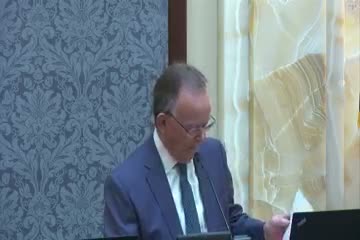
The Utah Senate on Feb. 2, 2024, moved a large group of bills through concurrence and third reading, approving measures that Senate leaders said were technical fixes, policy clarifications or implementations of prior audits. Several bills were returned to the House for signature after unanimous or near‑unanimous roll‑call votes.
Senate leadership had the chamber consider a series of House and Senate measures. Sen. Wilson explained the changes to First Substitute Senate Bill 11, saying the Sentencing Commission raised concerns and “we tweaked just some of the language, and, we’re good with the bill.” The Senate concurred with House amendments and passed the bill on a roll‑call vote (24 yea, 0 nay, 5 absent), and it was returned to the House for the Speaker’s signature.
Other measures handled included: First Substitute Senate Bill 29 (taxation modifications) to allow the Tax Commission to recover revenue shortfalls caused by a computer error; Senate Bill 16 (motor vehicle idling/warm‑up times) with House edits; Senate Bill 38 (property tax appeals modifications); First Substitute House Bill 50 (State Highway Designation Amendments) to add the West Davis Corridor to the state highway system; and multiple House bills addressing areas such as social‑work licensure, fatality review procedures, landowner liability and targeted tax relief programs. Where recorded, votes were unanimous or overwhelmingly in favor (for example, HB 50 passed 27‑0 with two senators absent; HB 116 passed 27‑0 with two absent).
Several procedural moves were also taken: the Senate voted to table First Substitute House Bill 73 (rehabilitation services amendments) because of workload, and it ‘circled’ House Bill 34 (tax refund claim amendments) to pause further action while additional information is gathered.
Most measures had brief or no floor debate. Senators identified the principal effects on policy or administration: changes to confidentiality language in employment agreements were intended to prevent serial offenders from repeatedly concealing misconduct; the Tax Commission’s fix was described as necessary to restore funds to affected taxing entities after a software error; and transportation and resource‑management bills updated designations or technical provisions.
The Senate recessed for lunch after completing the morning’s business; bills that received final passage were returned to the House for the Speaker’s consideration, and tabling or circling actions pause items for later committee or calendar work.
Senate leadership had the chamber consider a series of House and Senate measures. Sen. Wilson explained the changes to First Substitute Senate Bill 11, saying the Sentencing Commission raised concerns and “we tweaked just some of the language, and, we’re good with the bill.” The Senate concurred with House amendments and passed the bill on a roll‑call vote (24 yea, 0 nay, 5 absent), and it was returned to the House for the Speaker’s signature.
Other measures handled included: First Substitute Senate Bill 29 (taxation modifications) to allow the Tax Commission to recover revenue shortfalls caused by a computer error; Senate Bill 16 (motor vehicle idling/warm‑up times) with House edits; Senate Bill 38 (property tax appeals modifications); First Substitute House Bill 50 (State Highway Designation Amendments) to add the West Davis Corridor to the state highway system; and multiple House bills addressing areas such as social‑work licensure, fatality review procedures, landowner liability and targeted tax relief programs. Where recorded, votes were unanimous or overwhelmingly in favor (for example, HB 50 passed 27‑0 with two senators absent; HB 116 passed 27‑0 with two absent).
Several procedural moves were also taken: the Senate voted to table First Substitute House Bill 73 (rehabilitation services amendments) because of workload, and it ‘circled’ House Bill 34 (tax refund claim amendments) to pause further action while additional information is gathered.
Most measures had brief or no floor debate. Senators identified the principal effects on policy or administration: changes to confidentiality language in employment agreements were intended to prevent serial offenders from repeatedly concealing misconduct; the Tax Commission’s fix was described as necessary to restore funds to affected taxing entities after a software error; and transportation and resource‑management bills updated designations or technical provisions.
The Senate recessed for lunch after completing the morning’s business; bills that received final passage were returned to the House for the Speaker’s consideration, and tabling or circling actions pause items for later committee or calendar work.
Don't Miss a Word: See the Full Meeting!
Go beyond summaries. Unlock every video, transcript, and key insight with a Founder Membership.
✓
Get instant access to full meeting videos
✓
Search and clip any phrase from complete transcripts
✓
Receive AI-powered summaries & custom alerts
✓
Enjoy lifetime, unrestricted access to government data
30-day money-back guarantee
