Utah Senate advances dozens of measures; several bills cleared for third reading or sent to the House
February 12, 2024 | 2024 Utah Legislature, Utah Legislature, Utah Legislative Branch, Utah
This article was created by AI summarizing key points discussed. AI makes mistakes, so for full details and context, please refer to the video of the full meeting. Please report any errors so we can fix them. Report an error »
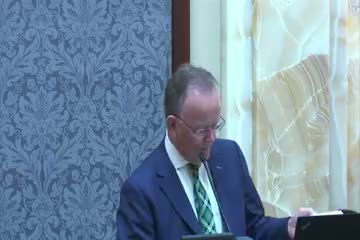
The Utah State Senate on the floor approved a broad slate of bills and resolutions, sending many measures either to third reading or to the House for consideration.
The session began with the Rules Committee report and a set of interchamber communications that included House-passed substitutes and bills transmitted for the president's signature. Floor action moved quickly through committee reports and a long series of third-reading motions and roll-call votes.
Why this matters: The bills advanced on this floor day touch regulatory, budgetary and administrative policy across the state — from municipal incorporation financing to consumer and health-care regulation — and several changes will affect how state boards are structured and how certain programs are funded.
Key outcomes and votes: second substitute Senate Bill 167 (court-reporter fees) passed on a roll call reported as 21 yea, 0 nay, 8 absent; first substitute Senate Bill 79 (estate-planning recodification) passed 21–0 with 8 absent; Senate Bill 201 (municipal incorporation modifications) was read for a third time after the sponsor said the upfront feasibility study cost is typically “about $20,000.” Senate Bill 149 (Artificial Intelligence Amendments) was read for a third time with a roll-call result reported as 22–0, 7 absent. Several other bills (including SB152, SB177, SB188, SB197, SB199, SB145 and SB183) were also advanced, with most recorded as unanimous or near-unanimous votes on third reading.
Debate highlights: A handful of bills drew extended discussion. Sponsor explanations ranged from technical cleanups to substantive policy shifts; for example, bills that restructure the Governor's Office of Economic Opportunity and change board composition prompted sustained concern from members about removing political-affiliation language and ensuring geographic representation for rural areas.
A leader's note: Senator Wyler, discussing a code recodification and delay to implementation dates, said, “I'm I'm introducing a delayed implementation date from May 1 to September 1,” describing the change as intended to give stakeholders additional time to update forms and practices.
What happens next: Bills passed on third reading will be enrolled and transmitted as provided by chamber rules or sent to the House for concurrence. Several circled items remain on the calendar pending substitutes or fiscal notes. The Senate adjourned until 10 a.m. the next day.
Reported votes, third readings and referrals described in this report are drawn from the day's roll-call announcements on the Senate floor and from committee and sponsor presentations given during the session.
The session began with the Rules Committee report and a set of interchamber communications that included House-passed substitutes and bills transmitted for the president's signature. Floor action moved quickly through committee reports and a long series of third-reading motions and roll-call votes.
Why this matters: The bills advanced on this floor day touch regulatory, budgetary and administrative policy across the state — from municipal incorporation financing to consumer and health-care regulation — and several changes will affect how state boards are structured and how certain programs are funded.
Key outcomes and votes: second substitute Senate Bill 167 (court-reporter fees) passed on a roll call reported as 21 yea, 0 nay, 8 absent; first substitute Senate Bill 79 (estate-planning recodification) passed 21–0 with 8 absent; Senate Bill 201 (municipal incorporation modifications) was read for a third time after the sponsor said the upfront feasibility study cost is typically “about $20,000.” Senate Bill 149 (Artificial Intelligence Amendments) was read for a third time with a roll-call result reported as 22–0, 7 absent. Several other bills (including SB152, SB177, SB188, SB197, SB199, SB145 and SB183) were also advanced, with most recorded as unanimous or near-unanimous votes on third reading.
Debate highlights: A handful of bills drew extended discussion. Sponsor explanations ranged from technical cleanups to substantive policy shifts; for example, bills that restructure the Governor's Office of Economic Opportunity and change board composition prompted sustained concern from members about removing political-affiliation language and ensuring geographic representation for rural areas.
A leader's note: Senator Wyler, discussing a code recodification and delay to implementation dates, said, “I'm I'm introducing a delayed implementation date from May 1 to September 1,” describing the change as intended to give stakeholders additional time to update forms and practices.
What happens next: Bills passed on third reading will be enrolled and transmitted as provided by chamber rules or sent to the House for concurrence. Several circled items remain on the calendar pending substitutes or fiscal notes. The Senate adjourned until 10 a.m. the next day.
Reported votes, third readings and referrals described in this report are drawn from the day's roll-call announcements on the Senate floor and from committee and sponsor presentations given during the session.
Don't Miss a Word: See the Full Meeting!
Go beyond summaries. Unlock every video, transcript, and key insight with a Founder Membership.
✓
Get instant access to full meeting videos
✓
Search and clip any phrase from complete transcripts
✓
Receive AI-powered summaries & custom alerts
✓
Enjoy lifetime, unrestricted access to government data
30-day money-back guarantee
