Senate approves public education budget; amendment to shift $20M to school fee relief fails
February 27, 2024 | 2024 Utah Legislature, Utah Legislature, Utah Legislative Branch, Utah
This article was created by AI summarizing key points discussed. AI makes mistakes, so for full details and context, please refer to the video of the full meeting. Please report any errors so we can fix them. Report an error »
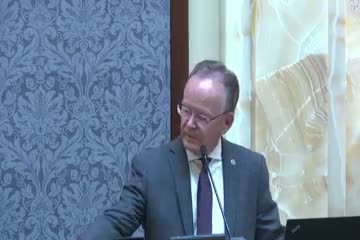
Senate Bill 2, the public education budget amendment package, passed the Utah Senate under a suspension of the three-reading rule after floor debate on the bill’s funding priorities. Senator Fillmore, sponsor of the budget motion, described the package as completing the majority of public education funding when combined with the base budget, saying the bill includes an “additional 1.2% of WPU funding” and that the WPU value will “increase to almost $4,500 for 2025.”
The bill adds recurring and one-time investments: a total 5% increase in education funding overall (including the WPU increase), restoration of withheld funds for digital teaching and dual-immersion programs, continued phase-in funding for at-risk programs, $100 million one-time for K–12 property insurance to blunt projected premium increases, and $74 million for educator professional time intended to provide additional professional development days.
The Senate considered Amendment 1, offered by Senator Reby, which would have reduced ongoing funding for the Utah Fits All scholarship by $20 million and reallocated that amount to a school fee revenue-loss subsidy to help districts absorb the loss of extracurricular and classroom fees. Senator Reby argued smaller districts would be disproportionately harmed if fees were absorbed without ongoing support, saying the amendment would ensure “our schools can provide all of these classes.” Senator Fillmore opposed the amendment, warning it would double‑fund a program that already has separate planned appropriations and emphasizing that the budget bills reflect negotiated compromises approved by the Executive Appropriations Committee.
The amendment was put to a vote and failed. The Senate then voted on final passage of SB2 under suspension of the rules; the roll call produced 25 ayes and 1 nay, and Senate Bill 2 was transmitted to the House for consideration.
What’s next: SB2 will go to the Utah House for its consideration; floor sponsors said the bill implements subcommittee recommendations and statutory tweaks needed to carry out the appropriations.
The bill adds recurring and one-time investments: a total 5% increase in education funding overall (including the WPU increase), restoration of withheld funds for digital teaching and dual-immersion programs, continued phase-in funding for at-risk programs, $100 million one-time for K–12 property insurance to blunt projected premium increases, and $74 million for educator professional time intended to provide additional professional development days.
The Senate considered Amendment 1, offered by Senator Reby, which would have reduced ongoing funding for the Utah Fits All scholarship by $20 million and reallocated that amount to a school fee revenue-loss subsidy to help districts absorb the loss of extracurricular and classroom fees. Senator Reby argued smaller districts would be disproportionately harmed if fees were absorbed without ongoing support, saying the amendment would ensure “our schools can provide all of these classes.” Senator Fillmore opposed the amendment, warning it would double‑fund a program that already has separate planned appropriations and emphasizing that the budget bills reflect negotiated compromises approved by the Executive Appropriations Committee.
The amendment was put to a vote and failed. The Senate then voted on final passage of SB2 under suspension of the rules; the roll call produced 25 ayes and 1 nay, and Senate Bill 2 was transmitted to the House for consideration.
What’s next: SB2 will go to the Utah House for its consideration; floor sponsors said the bill implements subcommittee recommendations and statutory tweaks needed to carry out the appropriations.
Don't Miss a Word: See the Full Meeting!
Go beyond summaries. Unlock every video, transcript, and key insight with a Founder Membership.
✓
Get instant access to full meeting videos
✓
Search and clip any phrase from complete transcripts
✓
Receive AI-powered summaries & custom alerts
✓
Enjoy lifetime, unrestricted access to government data
30-day money-back guarantee
