Senate rejects seismic commission bill after tense floor debate
February 26, 2024 | 2024 Utah Legislature, Utah Legislature, Utah Legislative Branch, Utah
This article was created by AI summarizing key points discussed. AI makes mistakes, so for full details and context, please refer to the video of the full meeting. Please report any errors so we can fix them. Report an error »
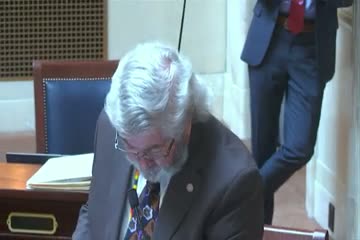
The Utah Senate on the floor rejected Second Substitute House Bill 47, a measure to continue and formalize the Utah Seismic Safety Commission (USSC), after extended floor debate about seismic risk, scope and state responsibility. The motion to pass the bill failed on a roll-call vote: 10 yeas, 18 nays and 1 absent. The Senate recorded that the bill would be sent back to the House for further consideration/filing.
Senator Hinkins opened debate for proponents, describing the USSC’s role in assessing and prioritizing seismic-mitigation actions and warning of substantial earthquake risk. "There is a greater than a 43% chance of a magnitude of 6.75 to a 7.6 earthquake on the Wasatch Fault in the next 50 years," Hinkins told the chamber, urging continued work to prioritize mitigation and public education. He framed the commission as a nonregulatory, expert advisory body that helps state and local governments focus limited resources.
Supporters emphasized the commission’s advisory membership from state agencies, technical experts and associations and said the USSC helps prioritize mitigation that could reduce loss of life and infrastructure damage. Senator Reby urged colleagues to support the measure, calling attention to public-safety and infrastructure risks and asking why the state would not pursue available mitigation and educational efforts.
Opponents questioned whether creating or continuing the commission would duplicate existing work, whether the state would incur ongoing costs, and how the commission’s recommendations would be implemented across diverse local jurisdictions. Several senators noted there was not a fiscal note allocating substantial new funds. After nearly an hour of discussion and several emotional appeals, the motion failed.
Because the House-originated bill did not pass the Senate, it will be returned to the House for further consideration. The record reflects that debate centered on balancing technical seismic risk assessments with concerns about cost, scope and the limits of legislative authority to require action by local governments.
Senator Hinkins opened debate for proponents, describing the USSC’s role in assessing and prioritizing seismic-mitigation actions and warning of substantial earthquake risk. "There is a greater than a 43% chance of a magnitude of 6.75 to a 7.6 earthquake on the Wasatch Fault in the next 50 years," Hinkins told the chamber, urging continued work to prioritize mitigation and public education. He framed the commission as a nonregulatory, expert advisory body that helps state and local governments focus limited resources.
Supporters emphasized the commission’s advisory membership from state agencies, technical experts and associations and said the USSC helps prioritize mitigation that could reduce loss of life and infrastructure damage. Senator Reby urged colleagues to support the measure, calling attention to public-safety and infrastructure risks and asking why the state would not pursue available mitigation and educational efforts.
Opponents questioned whether creating or continuing the commission would duplicate existing work, whether the state would incur ongoing costs, and how the commission’s recommendations would be implemented across diverse local jurisdictions. Several senators noted there was not a fiscal note allocating substantial new funds. After nearly an hour of discussion and several emotional appeals, the motion failed.
Because the House-originated bill did not pass the Senate, it will be returned to the House for further consideration. The record reflects that debate centered on balancing technical seismic risk assessments with concerns about cost, scope and the limits of legislative authority to require action by local governments.
View the Full Meeting & All Its Details
This article offers just a summary. Unlock complete video, transcripts, and insights as a Founder Member.
✓
Watch full, unedited meeting videos
✓
Search every word spoken in unlimited transcripts
✓
AI summaries & real-time alerts (all government levels)
✓
Permanent access to expanding government content
30-day money-back guarantee
