Utah Senate clears long list of bills on consent and third readings
February 10, 2023 | 2023 Utah Legislature, Utah Legislature, Utah Legislative Branch, Utah
This article was created by AI summarizing key points discussed. AI makes mistakes, so for full details and context, please refer to the video of the full meeting. Please report any errors so we can fix them. Report an error »
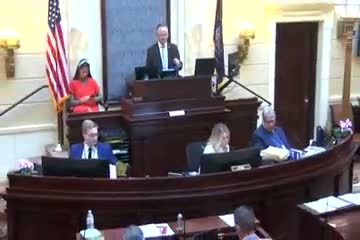
The Utah Senate passed a string of House and Senate measures on Feb. 10 as it worked through a lengthy third‑reading calendar.
Among the bills approved were first substitute House Bill 33, which shields irrigation canal owners and operators from liability for damage or injury caused by third parties; the chamber recorded a unanimous chamber vote in favor and returned the measure to the House (President Adams announced a recorded tally of 23 yeas, 0 nays, 6 absent). The Senate also concurred with a House change to First Substitute Senate Bill 44, allowing local education agencies flexibility to select reading software, which passed on a roll call vote (President Adams recorded 23 yeas, 0 nays, 6 absent).
Other measures the Senate passed included House Bill 65, clarifying the role of the Department of Technology Services in approving technology acquisitions while agencies manage contracts (24 yeas, 0 nays, 5 absent); first substitute House Bill 167, which creates a contracting process for third‑party childcare centers in state agency facilities (26 yeas, 0 nays, 3 absent); and House Bill 141, which allows certain driver‑license tests to be administered in a non‑English language when the Driver License Division has the language capacity (26 yeas, 0 nays, 3 absent).
The chamber also advanced bills affecting criminal procedure and public safety: Second Substitute House Bill 174 (conviction reduction amendments) passed (25 yeas, 0 nays, 4 absent). First Substitute House Bill 62, which authorizes a DPS‑administered ignition interlock option for some DUI‑convicted drivers, passed 24–0 with five absent.
Several administrative and local government items also cleared the chamber, including bills to prioritize funding for regional outdoor recreation projects, to allow unregistered off‑road vehicles to be trailered under certain conditions (House Bill 200, 27 yeas, 0 nays, 2 absent), and to address governance of nonfunctioning improvement districts (Second Substitute House Bill 22, 27 yeas, 0 nays, 2 absent).
Most measures were noncontroversial on the floor and drew limited debate. Sponsors described implementation mechanics and, where applicable, emphasized there was no direct new appropriations in the bills. The Senate adjourned after completing its business and returned several measures to the House for further consideration or signature.
The bills mentioned above were recorded on the Feb. 10 Senate calendar; final enrollment and signatures were announced from the presiding officer as measures passed the chamber.
Among the bills approved were first substitute House Bill 33, which shields irrigation canal owners and operators from liability for damage or injury caused by third parties; the chamber recorded a unanimous chamber vote in favor and returned the measure to the House (President Adams announced a recorded tally of 23 yeas, 0 nays, 6 absent). The Senate also concurred with a House change to First Substitute Senate Bill 44, allowing local education agencies flexibility to select reading software, which passed on a roll call vote (President Adams recorded 23 yeas, 0 nays, 6 absent).
Other measures the Senate passed included House Bill 65, clarifying the role of the Department of Technology Services in approving technology acquisitions while agencies manage contracts (24 yeas, 0 nays, 5 absent); first substitute House Bill 167, which creates a contracting process for third‑party childcare centers in state agency facilities (26 yeas, 0 nays, 3 absent); and House Bill 141, which allows certain driver‑license tests to be administered in a non‑English language when the Driver License Division has the language capacity (26 yeas, 0 nays, 3 absent).
The chamber also advanced bills affecting criminal procedure and public safety: Second Substitute House Bill 174 (conviction reduction amendments) passed (25 yeas, 0 nays, 4 absent). First Substitute House Bill 62, which authorizes a DPS‑administered ignition interlock option for some DUI‑convicted drivers, passed 24–0 with five absent.
Several administrative and local government items also cleared the chamber, including bills to prioritize funding for regional outdoor recreation projects, to allow unregistered off‑road vehicles to be trailered under certain conditions (House Bill 200, 27 yeas, 0 nays, 2 absent), and to address governance of nonfunctioning improvement districts (Second Substitute House Bill 22, 27 yeas, 0 nays, 2 absent).
Most measures were noncontroversial on the floor and drew limited debate. Sponsors described implementation mechanics and, where applicable, emphasized there was no direct new appropriations in the bills. The Senate adjourned after completing its business and returned several measures to the House for further consideration or signature.
The bills mentioned above were recorded on the Feb. 10 Senate calendar; final enrollment and signatures were announced from the presiding officer as measures passed the chamber.
Don't Miss a Word: See the Full Meeting!
Go beyond summaries. Unlock every video, transcript, and key insight with a Founder Membership.
✓
Get instant access to full meeting videos
✓
Search and clip any phrase from complete transcripts
✓
Receive AI-powered summaries & custom alerts
✓
Enjoy lifetime, unrestricted access to government data
30-day money-back guarantee
