Utah chief justice urges investment in court technology, staff pay and new access programs
January 18, 2022 | 2022 Utah Legislature, Utah Legislature, Utah Legislative Branch, Utah
This article was created by AI summarizing key points discussed. AI makes mistakes, so for full details and context, please refer to the video of the full meeting. Please report any errors so we can fix them. Report an error »
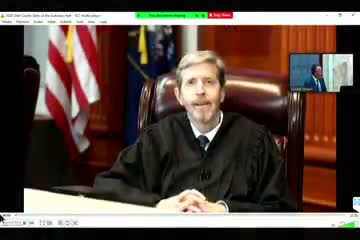
Chief Justice Durant addressed the Utah Legislature in a virtual State of the Judiciary, praising long-serving Justice Dino Jimenez and outlining efforts to expand access to justice through technology and new offices.
Durant said the judiciary relied heavily on virtual hearing technology during the pandemic, noting virtual court appearances "brought court to the people," reduced travel expenses for rural residents and increased participation. He also warned that remote proceedings created new operational burdens — more work for judicial assistants and IT staff — that require continued investment.
The chief justice highlighted several programs designed to improve access and efficiency. He described MyCase, a free online portal that lets parties view case histories, most filed documents and (in some case types) file documents online; the courts' self-help center handled more than 23,000 contacts statewide in February 2021. He reported the online dispute-resolution program (ODR) had been operating for three years and will be expanded to more justice courts, with a goal of system-wide access for small-claims litigants by mid-2022.
Durant also described a newly created Office of Fairness and Accountability focused on building public trust among historically marginalized communities, and an Office of Legal Services Innovation that runs a regulatory "sandbox." Through that sandbox the courts have approved 31 entities that, under regulatory waivers, can offer some services using nonlawyer staff supervised by lawyers, low-cost brick-and-mortar service points, document-generation platforms, AI-enabled drafting tools and other innovations. "Innovation and entrepreneurship offer the potential for making real progress in narrowing the access to justice gap," he said.
Turning to workforce concerns, Durant said judicial assistants make up about 40% of court employees but that average pay for those positions is "more than 20% below market value," and turnover has climbed from a three-year average of roughly 8.65% a decade ago to about 25% as of the February report cited in his remarks. The Judicial Council has made securing funding to increase judicial-assistant compensation its top budget priority and is asking the Legislature for $3,900,000 in ongoing funds to recruit and retain experienced staff.
Durant also requested converting prior one-time IT appropriations into ongoing funding and listed other ongoing needs, including a public outreach coordinator, a second juvenile court judge in the Sixth Judicial District and a statewide treatment-court coordinator. He said many of the access improvements are grant-funded and noted that the judiciary appreciates federal ARPA funds previously authorized for technology.
After the address the Senate moved to "spread the text" of the remarks on the Senate Journal and dissolved the Committee of the Whole. The Senate acknowledged the judiciary's efforts and said it would review the budget requests when they appear before the appropriations subcommittee.
Durant said the judiciary relied heavily on virtual hearing technology during the pandemic, noting virtual court appearances "brought court to the people," reduced travel expenses for rural residents and increased participation. He also warned that remote proceedings created new operational burdens — more work for judicial assistants and IT staff — that require continued investment.
The chief justice highlighted several programs designed to improve access and efficiency. He described MyCase, a free online portal that lets parties view case histories, most filed documents and (in some case types) file documents online; the courts' self-help center handled more than 23,000 contacts statewide in February 2021. He reported the online dispute-resolution program (ODR) had been operating for three years and will be expanded to more justice courts, with a goal of system-wide access for small-claims litigants by mid-2022.
Durant also described a newly created Office of Fairness and Accountability focused on building public trust among historically marginalized communities, and an Office of Legal Services Innovation that runs a regulatory "sandbox." Through that sandbox the courts have approved 31 entities that, under regulatory waivers, can offer some services using nonlawyer staff supervised by lawyers, low-cost brick-and-mortar service points, document-generation platforms, AI-enabled drafting tools and other innovations. "Innovation and entrepreneurship offer the potential for making real progress in narrowing the access to justice gap," he said.
Turning to workforce concerns, Durant said judicial assistants make up about 40% of court employees but that average pay for those positions is "more than 20% below market value," and turnover has climbed from a three-year average of roughly 8.65% a decade ago to about 25% as of the February report cited in his remarks. The Judicial Council has made securing funding to increase judicial-assistant compensation its top budget priority and is asking the Legislature for $3,900,000 in ongoing funds to recruit and retain experienced staff.
Durant also requested converting prior one-time IT appropriations into ongoing funding and listed other ongoing needs, including a public outreach coordinator, a second juvenile court judge in the Sixth Judicial District and a statewide treatment-court coordinator. He said many of the access improvements are grant-funded and noted that the judiciary appreciates federal ARPA funds previously authorized for technology.
After the address the Senate moved to "spread the text" of the remarks on the Senate Journal and dissolved the Committee of the Whole. The Senate acknowledged the judiciary's efforts and said it would review the budget requests when they appear before the appropriations subcommittee.
Don't Miss a Word: See the Full Meeting!
Go beyond summaries. Unlock every video, transcript, and key insight with a Founder Membership.
✓
Get instant access to full meeting videos
✓
Search and clip any phrase from complete transcripts
✓
Receive AI-powered summaries & custom alerts
✓
Enjoy lifetime, unrestricted access to government data
30-day money-back guarantee
