Utah Senate approves plumbing-fixture efficiency bill, sponsor cites 16,000 acre-feet annual savings
January 26, 2022 | 2022 Utah Legislature, Utah Legislature, Utah Legislative Branch, Utah
This article was created by AI summarizing key points discussed. AI makes mistakes, so for full details and context, please refer to the video of the full meeting. Please report any errors so we can fix them. Report an error »
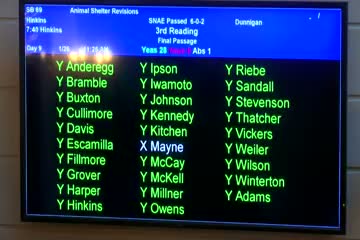
The Utah Senate on day 9 passed Senate Bill 73, a measure that changes flow-rate and quantity standards for certain plumbing fixtures with the goal of conserving water across the state.
Senator Iwamoto, the bill sponsor, told the Senate the changes are intended to "create significant water savings for the state, improved resilience," and that the changes align with recommendations in the State of Utah regional water conservation goals report (February 2019). "It's estimated that 16,000 acre feet can be saved per year, 4,500,000,000 gallons, roughly the equivalent of 4 gallons per person per day, or enough water to support the indoor-outdoor needs of 30,000 Utah households at this current usage rate," Iwamoto said during floor remarks.
Senator Davis pressed the sponsor on economic and housing implications, asking how the water savings would affect housing availability and the number of homes that could be supported. Iwamoto responded that water managers and districts see this as a constructive step, repeating the estimate that the measure would help preserve water to "support indoor-outdoor needs of 30,000 Utah households" and noting that some Utah cities have paused building permits because of water constraints.
Senator Weiler offered a brief, lighthearted endorsement of the bill, saying he was "literally flushed with excitement" to help conserve water.
Supporters described SB 73 as a targeted code change limited to plumbing-fixture standards; one senator noted a preference for broader adoption via the International Building Code but did not oppose the bill on that basis. The Senate held a roll-call vote and President Adams announced SB 73 received 23 "yay" votes, 5 "nay" votes and 1 absent; the bill passed and will be transmitted to the House for consideration.
The bill sponsor and other senators framed the measure as a water-conservation step that, according to state conservation reporting cited on the floor, could modestly reduce per-capita indoor water use. The next step is House consideration; no amendments or implementation details were finalized on the Senate floor.
Senator Iwamoto, the bill sponsor, told the Senate the changes are intended to "create significant water savings for the state, improved resilience," and that the changes align with recommendations in the State of Utah regional water conservation goals report (February 2019). "It's estimated that 16,000 acre feet can be saved per year, 4,500,000,000 gallons, roughly the equivalent of 4 gallons per person per day, or enough water to support the indoor-outdoor needs of 30,000 Utah households at this current usage rate," Iwamoto said during floor remarks.
Senator Davis pressed the sponsor on economic and housing implications, asking how the water savings would affect housing availability and the number of homes that could be supported. Iwamoto responded that water managers and districts see this as a constructive step, repeating the estimate that the measure would help preserve water to "support indoor-outdoor needs of 30,000 Utah households" and noting that some Utah cities have paused building permits because of water constraints.
Senator Weiler offered a brief, lighthearted endorsement of the bill, saying he was "literally flushed with excitement" to help conserve water.
Supporters described SB 73 as a targeted code change limited to plumbing-fixture standards; one senator noted a preference for broader adoption via the International Building Code but did not oppose the bill on that basis. The Senate held a roll-call vote and President Adams announced SB 73 received 23 "yay" votes, 5 "nay" votes and 1 absent; the bill passed and will be transmitted to the House for consideration.
The bill sponsor and other senators framed the measure as a water-conservation step that, according to state conservation reporting cited on the floor, could modestly reduce per-capita indoor water use. The next step is House consideration; no amendments or implementation details were finalized on the Senate floor.
View the Full Meeting & All Its Details
This article offers just a summary. Unlock complete video, transcripts, and insights as a Founder Member.
✓
Watch full, unedited meeting videos
✓
Search every word spoken in unlimited transcripts
✓
AI summaries & real-time alerts (all government levels)
✓
Permanent access to expanding government content
30-day money-back guarantee
