Civil grand jury urges steps to speed hiring; city officials point to measurable progress
December 07, 2023 | San Francisco County, California
This article was created by AI summarizing key points discussed. AI makes mistakes, so for full details and context, please refer to the video of the full meeting. Please report any errors so we can fix them. Report an error »
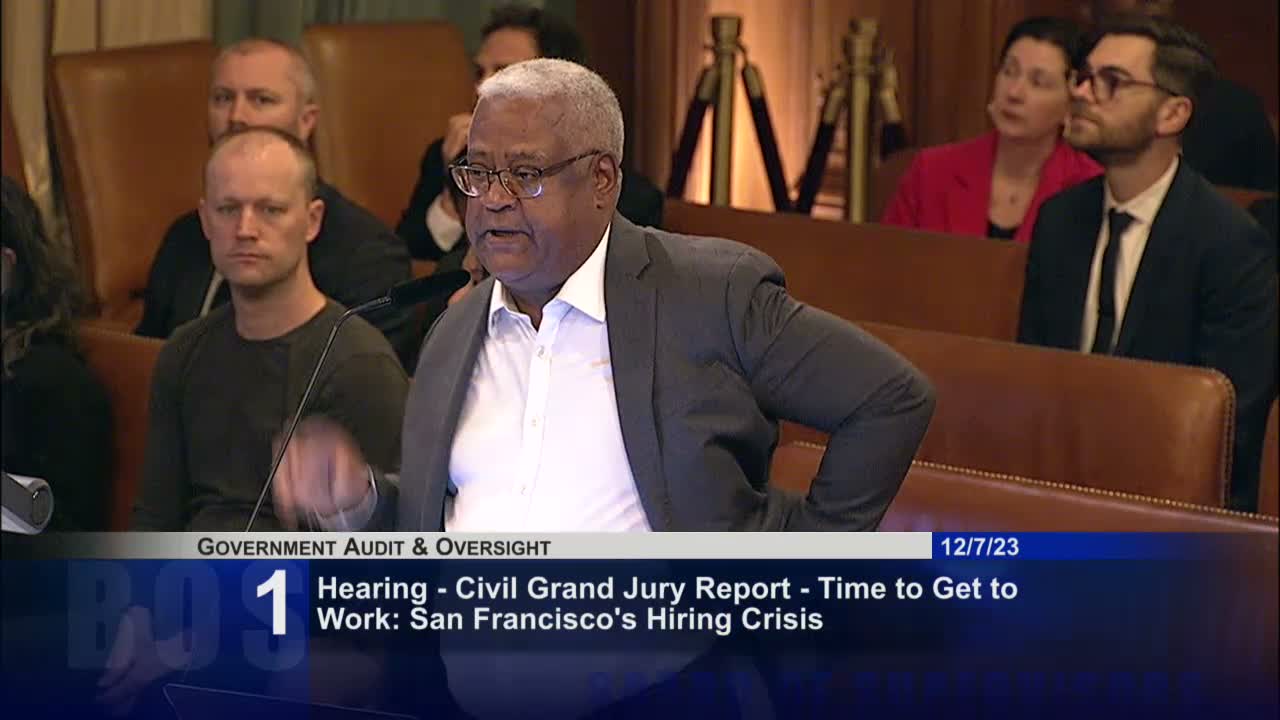
The Government Audit and Oversight Committee on Dec. 19 heard a civil grand jury report that called San Francisco’s hiring process “Time to Get to Work,” detailing delays that the jury said are impeding delivery of city services.
Marvin Norman, who presented the report, told the committee the jury’s investigation produced eight findings and 17 recommendations aimed at shortening hiring timelines, reducing unnecessary job classifications and improving succession planning. “Our investigation concluded with a report containing 8 findings and 17 recommendations,” Norman said.
Department of Human Resources Director Carol Eisen told the committee the city is already seeing improvement on several metrics the jury reviewed. “Our applications are up substantially,” Eisen said, and she cited a year‑over‑year increase in applications and more hires. DHR reported a drop in the permanent full‑time equivalent vacancy rate from roughly 14 percent a year earlier to 10.2 percent and said the time to fill permanent civil‑service positions fell from about 255 days to about 197 days.
DHR described a multi‑pronged reform effort that includes: revising civil‑service rules in coordination with the Civil Service Commission to allow more tailored timelines; expanding online, on‑demand testing to avoid mass in‑person exam bottlenecks; standardizing interview panels and question banks; automating reference and background checks; and launching a people‑analytics portal and public dashboards to track progress.
Supervisors pressed DHR for clearer public timelines. Supervisor Connie Chan asked whether candidates received consistent communication about next steps; Kate Howard of DHR said the new applicant‑tracking platform supports automated notifications and that the department can provide guidance to departments so applicants know when to expect exams and results. Chair Dean Preston urged the department to provide supervisors with outreach materials the offices can share with constituents.
The civil grand jury had recommended an aspirational 60‑day hiring goal; DHR said that number is challenging to commit to as a single, citywide target because hiring timelines interact with budgeting, attrition, and different occupational requirements. DHR said its rough historical benchmark before the pandemic had been around 7 percent attrition and that the department would report additional benchmarking and analysis to the committee if requested.
Public comment aligned with the urgency of the report. Omar Fall, a field director who addressed the committee, said the hiring timelines remain “too long” and urged that the city avoid reliance on temporary or contractor hires that worsen retention.
After the presentations and public comment, Chair Preston moved to file the grand jury report. The committee voted to accept the recommendation to file the report.
What’s next: DHR told the committee it will continue to work with the Civil Service Commission and labor partners on rule changes and implementation, complete development of the people analytics portal and related dashboards, and provide periodic updates to the Board as the recommended reforms are phased in.
Marvin Norman, who presented the report, told the committee the jury’s investigation produced eight findings and 17 recommendations aimed at shortening hiring timelines, reducing unnecessary job classifications and improving succession planning. “Our investigation concluded with a report containing 8 findings and 17 recommendations,” Norman said.
Department of Human Resources Director Carol Eisen told the committee the city is already seeing improvement on several metrics the jury reviewed. “Our applications are up substantially,” Eisen said, and she cited a year‑over‑year increase in applications and more hires. DHR reported a drop in the permanent full‑time equivalent vacancy rate from roughly 14 percent a year earlier to 10.2 percent and said the time to fill permanent civil‑service positions fell from about 255 days to about 197 days.
DHR described a multi‑pronged reform effort that includes: revising civil‑service rules in coordination with the Civil Service Commission to allow more tailored timelines; expanding online, on‑demand testing to avoid mass in‑person exam bottlenecks; standardizing interview panels and question banks; automating reference and background checks; and launching a people‑analytics portal and public dashboards to track progress.
Supervisors pressed DHR for clearer public timelines. Supervisor Connie Chan asked whether candidates received consistent communication about next steps; Kate Howard of DHR said the new applicant‑tracking platform supports automated notifications and that the department can provide guidance to departments so applicants know when to expect exams and results. Chair Dean Preston urged the department to provide supervisors with outreach materials the offices can share with constituents.
The civil grand jury had recommended an aspirational 60‑day hiring goal; DHR said that number is challenging to commit to as a single, citywide target because hiring timelines interact with budgeting, attrition, and different occupational requirements. DHR said its rough historical benchmark before the pandemic had been around 7 percent attrition and that the department would report additional benchmarking and analysis to the committee if requested.
Public comment aligned with the urgency of the report. Omar Fall, a field director who addressed the committee, said the hiring timelines remain “too long” and urged that the city avoid reliance on temporary or contractor hires that worsen retention.
After the presentations and public comment, Chair Preston moved to file the grand jury report. The committee voted to accept the recommendation to file the report.
What’s next: DHR told the committee it will continue to work with the Civil Service Commission and labor partners on rule changes and implementation, complete development of the people analytics portal and related dashboards, and provide periodic updates to the Board as the recommended reforms are phased in.
Don't Miss a Word: See the Full Meeting!
Go beyond summaries. Unlock every video, transcript, and key insight with a Founder Membership.
✓
Get instant access to full meeting videos
✓
Search and clip any phrase from complete transcripts
✓
Receive AI-powered summaries & custom alerts
✓
Enjoy lifetime, unrestricted access to government data
30-day money-back guarantee
