Committee backs two Mills Act contracts amid larger policy review on tax‑exempt historic rehabs
December 07, 2023 | San Francisco County, California
This article was created by AI summarizing key points discussed. AI makes mistakes, so for full details and context, please refer to the video of the full meeting. Please report any errors so we can fix them. Report an error »
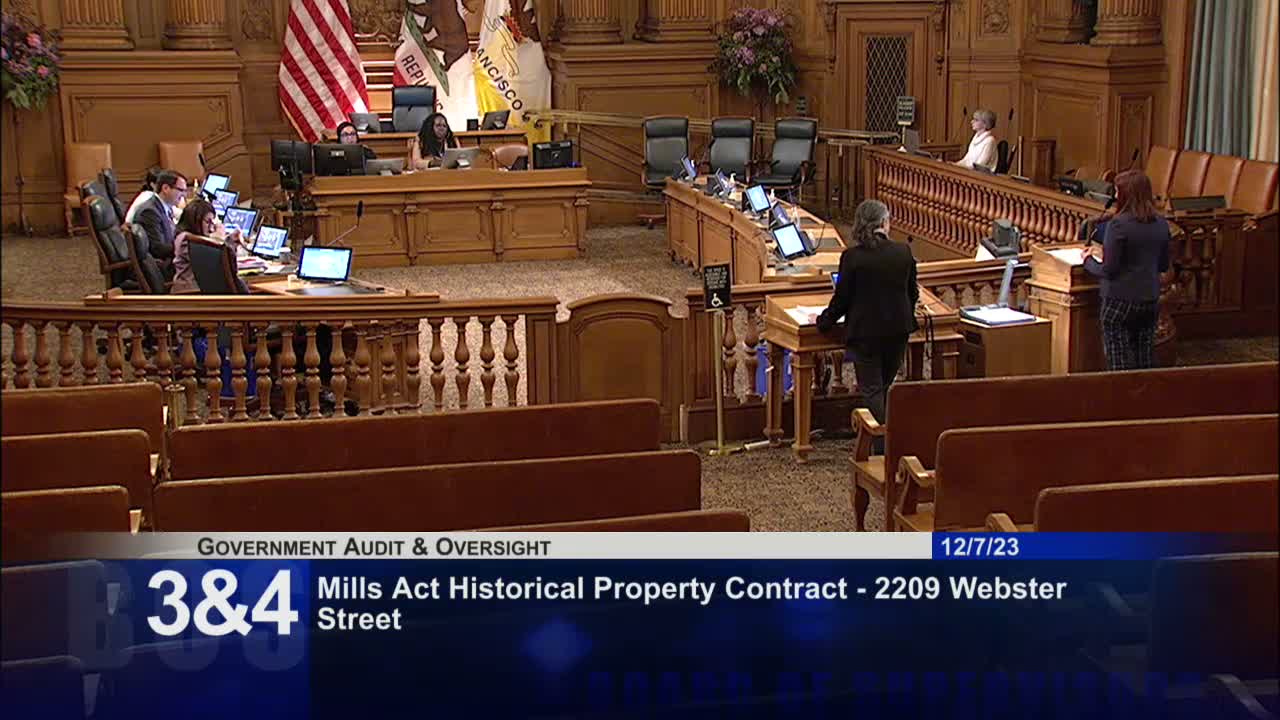
The Government Audit and Oversight Committee voted to send two Mills Act resolutions to the full Board with a positive committee recommendation.
Planning staff described the Mills Act program, which authorizes local governments to enter into 10‑year rolling contracts with owners of qualified historic properties in exchange for property tax reductions; owners must complete and maintain agreed rehabilitation and maintenance plans. Shannon Ferguson of the Planning Department noted the department’s recent audit of the Mills Act program and plans to bring ten recommended policy changes to the Historic Preservation Commission.
One contract would cover a large, eight‑story office building at 988 Market Street proposed for conversion to 45 residential units. The applicants have committed to invest $576,259 in rehabilitation and $20,000 per year in ongoing historic maintenance for façade and interior public spaces. The planning staff said the Board may grant an exception to the commercial‑property assessed‑value limit to allow this contract because of the building’s significance and the applicant’s restoration commitments.
The second contract would cover 2209 Webster Street, an Italianate single‑family residence that applicants say was designed by Henry Henkel circa 1878; the current owners described the building as an abandoned office that they plan to restore to a single‑family home and to invest in exterior repairs and ongoing maintenance. The owners addressed the committee and described the project as a long‑term rehabilitation consistent with the Mills Act’s preservation goals.
Assessor’s Office representative Michael Jain explained the Mills Act valuation method: the assessor compares (1) the current assessed value, (2) a restricted‑income valuation, and (3) market value, and enrolls the lowest of the three as the taxable value for the first year of the contract. Jain presented restricted‑income valuations and first‑year taxable estimates for the two properties as calculated for recordation and said the values and tax savings will be recalculated annually under the statutory procedure.
Supervisors used the hearing to flag larger policy questions. Chair Preston and others noted that Mills Act contracts can result in substantial tax savings — especially when applied to higher‑value commercial conversions — and said the Board will review options including nonrenewal rules, phase‑out timing, and stronger criteria for eligibility and evidence of need. Supervisor Stephanie said she is preparing legislation and expects to return proposals to committee; Planning staff and the Historic Preservation Commission will present Mills Act audit recommendations in January.
What’s next: The committee’s positive recommendation advances the two contracts to the full Board, while staff prepare the Mills Act audit and commissioners consider proposed program policy changes in early 2024.
Planning staff described the Mills Act program, which authorizes local governments to enter into 10‑year rolling contracts with owners of qualified historic properties in exchange for property tax reductions; owners must complete and maintain agreed rehabilitation and maintenance plans. Shannon Ferguson of the Planning Department noted the department’s recent audit of the Mills Act program and plans to bring ten recommended policy changes to the Historic Preservation Commission.
One contract would cover a large, eight‑story office building at 988 Market Street proposed for conversion to 45 residential units. The applicants have committed to invest $576,259 in rehabilitation and $20,000 per year in ongoing historic maintenance for façade and interior public spaces. The planning staff said the Board may grant an exception to the commercial‑property assessed‑value limit to allow this contract because of the building’s significance and the applicant’s restoration commitments.
The second contract would cover 2209 Webster Street, an Italianate single‑family residence that applicants say was designed by Henry Henkel circa 1878; the current owners described the building as an abandoned office that they plan to restore to a single‑family home and to invest in exterior repairs and ongoing maintenance. The owners addressed the committee and described the project as a long‑term rehabilitation consistent with the Mills Act’s preservation goals.
Assessor’s Office representative Michael Jain explained the Mills Act valuation method: the assessor compares (1) the current assessed value, (2) a restricted‑income valuation, and (3) market value, and enrolls the lowest of the three as the taxable value for the first year of the contract. Jain presented restricted‑income valuations and first‑year taxable estimates for the two properties as calculated for recordation and said the values and tax savings will be recalculated annually under the statutory procedure.
Supervisors used the hearing to flag larger policy questions. Chair Preston and others noted that Mills Act contracts can result in substantial tax savings — especially when applied to higher‑value commercial conversions — and said the Board will review options including nonrenewal rules, phase‑out timing, and stronger criteria for eligibility and evidence of need. Supervisor Stephanie said she is preparing legislation and expects to return proposals to committee; Planning staff and the Historic Preservation Commission will present Mills Act audit recommendations in January.
What’s next: The committee’s positive recommendation advances the two contracts to the full Board, while staff prepare the Mills Act audit and commissioners consider proposed program policy changes in early 2024.
Don't Miss a Word: See the Full Meeting!
Go beyond summaries. Unlock every video, transcript, and key insight with a Founder Membership.
✓
Get instant access to full meeting videos
✓
Search and clip any phrase from complete transcripts
✓
Receive AI-powered summaries & custom alerts
✓
Enjoy lifetime, unrestricted access to government data
30-day money-back guarantee
