Board advances ordinance requiring city departments to post surveillance policies after COIT presentation and amendments
July 19, 2021 | San Francisco County, California
This article was created by AI summarizing key points discussed. AI makes mistakes, so for full details and context, please refer to the video of the full meeting. Please report any errors so we can fix them. Report an error »
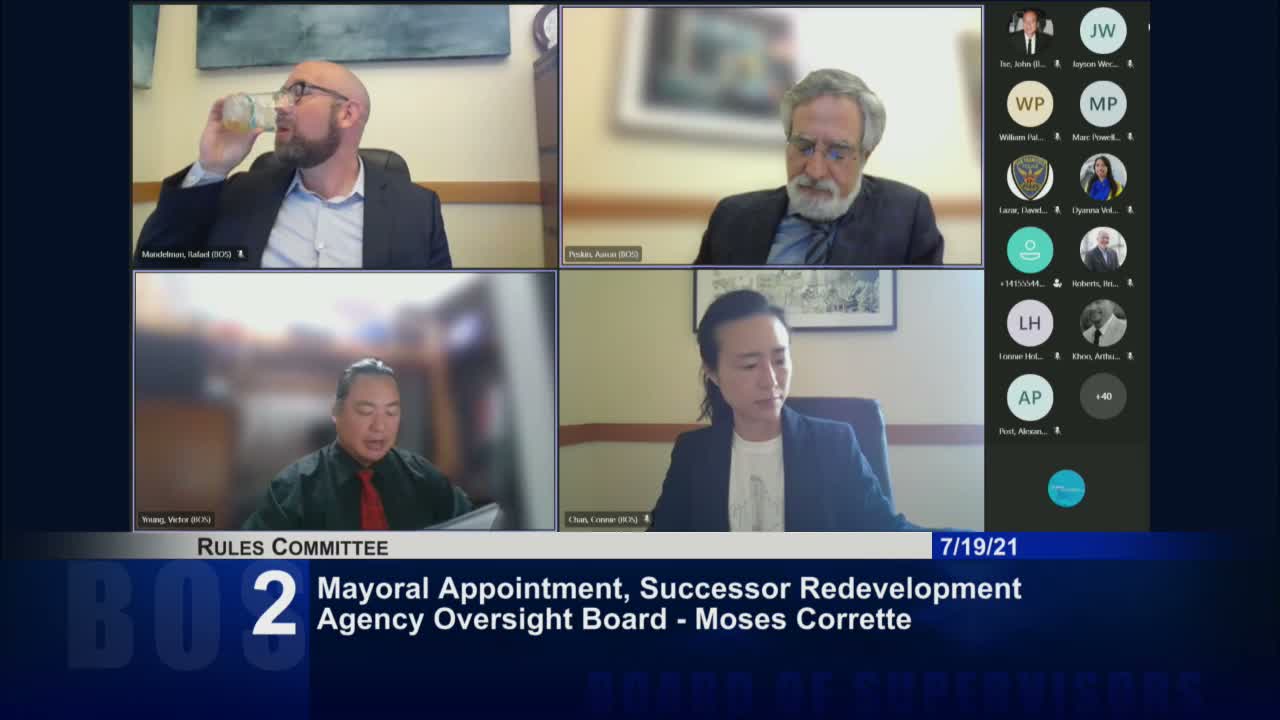
The San Francisco Board of Supervisors' Rules Committee on July 19 recommended an ordinance to require city departments to publish surveillance‑technology policies and impact reports and to adopt an inventory and annual reporting process.
The committee's presentation centered on work by the Committee on Information Technology (COIT), which posted a citywide surveillance inventory of 168 technologies and proposed a surveillance toolkit to streamline impact assessments. Matthias Jaime, COIT staff, told the committee the toolkit is intended to help departments assess privacy impacts — for instance dignity loss, discriminatory outcomes, economic harms and physical‑safety risks — and to identify mitigation measures such as shorter retention, access controls and technical safeguards.
Why it matters: the ordinance implements Proposition B and Administrative Code Chapter 19B, which the supervisors passed as a privacy‑first framework for city surveillance practices. Jaime and several department representatives said the rules aim to balance public‑safety uses with protections for residents who may be disproportionately harmed when surveillance is misused.
During the committee's question period, Supervisor Connie Chan pressed city and department staff for specifics about automated license‑plate readers (ALPRs) and camera deployments outside law enforcement. Rec and Park and Public Works described limited or pilot uses: Rec and Park has one fixed ALPR at the Palace of Fine Arts that staff only release to the police on request; Public Works said temporary, site‑specific ALPR deployments would be used to identify illegal‑dumping hot spots with a stated 30‑day retention period after which data would be wiped if no incident occurred. The Police Department said it currently operates one vehicle‑mounted ALPR and that it does not use facial recognition with its camera systems.
Several public commenters, including privacy advocates and practitioners, told supervisors they supported the policies while urging public transparency, a single public status list of department policies and care in defining what counts as surveillance technology. COIT agreed to host a consolidated status list for the inventory and policy drafts on its website.
Amendment and committee action: Chair Aaron Peskin moved a global amendment to add the phrase "and risks" after multiple references to "costs" in the ordinance findings and to remove a stray bracket in the draft. The amendment passed on roll call. The committee voted to send the ordinance, as amended, to the full board as a committee report so two readings can occur before the summer recess.
What's next: The ordinance will go to the full Board of Supervisors for further consideration. COIT officials said they will continue to refine impact reports, develop third‑party camera agreements and recommend whether a chief privacy officer role is needed to centralize expertise and procurement oversight.
The committee's presentation centered on work by the Committee on Information Technology (COIT), which posted a citywide surveillance inventory of 168 technologies and proposed a surveillance toolkit to streamline impact assessments. Matthias Jaime, COIT staff, told the committee the toolkit is intended to help departments assess privacy impacts — for instance dignity loss, discriminatory outcomes, economic harms and physical‑safety risks — and to identify mitigation measures such as shorter retention, access controls and technical safeguards.
Why it matters: the ordinance implements Proposition B and Administrative Code Chapter 19B, which the supervisors passed as a privacy‑first framework for city surveillance practices. Jaime and several department representatives said the rules aim to balance public‑safety uses with protections for residents who may be disproportionately harmed when surveillance is misused.
During the committee's question period, Supervisor Connie Chan pressed city and department staff for specifics about automated license‑plate readers (ALPRs) and camera deployments outside law enforcement. Rec and Park and Public Works described limited or pilot uses: Rec and Park has one fixed ALPR at the Palace of Fine Arts that staff only release to the police on request; Public Works said temporary, site‑specific ALPR deployments would be used to identify illegal‑dumping hot spots with a stated 30‑day retention period after which data would be wiped if no incident occurred. The Police Department said it currently operates one vehicle‑mounted ALPR and that it does not use facial recognition with its camera systems.
Several public commenters, including privacy advocates and practitioners, told supervisors they supported the policies while urging public transparency, a single public status list of department policies and care in defining what counts as surveillance technology. COIT agreed to host a consolidated status list for the inventory and policy drafts on its website.
Amendment and committee action: Chair Aaron Peskin moved a global amendment to add the phrase "and risks" after multiple references to "costs" in the ordinance findings and to remove a stray bracket in the draft. The amendment passed on roll call. The committee voted to send the ordinance, as amended, to the full board as a committee report so two readings can occur before the summer recess.
What's next: The ordinance will go to the full Board of Supervisors for further consideration. COIT officials said they will continue to refine impact reports, develop third‑party camera agreements and recommend whether a chief privacy officer role is needed to centralize expertise and procurement oversight.
View the Full Meeting & All Its Details
This article offers just a summary. Unlock complete video, transcripts, and insights as a Founder Member.
✓
Watch full, unedited meeting videos
✓
Search every word spoken in unlimited transcripts
✓
AI summaries & real-time alerts (all government levels)
✓
Permanent access to expanding government content
30-day money-back guarantee
