Rules Committee advances ordinance limiting behested payments and narrowings to interested-party definitions
December 06, 2021 | San Francisco County, California
This article was created by AI summarizing key points discussed. AI makes mistakes, so for full details and context, please refer to the video of the full meeting. Please report any errors so we can fix them. Report an error »
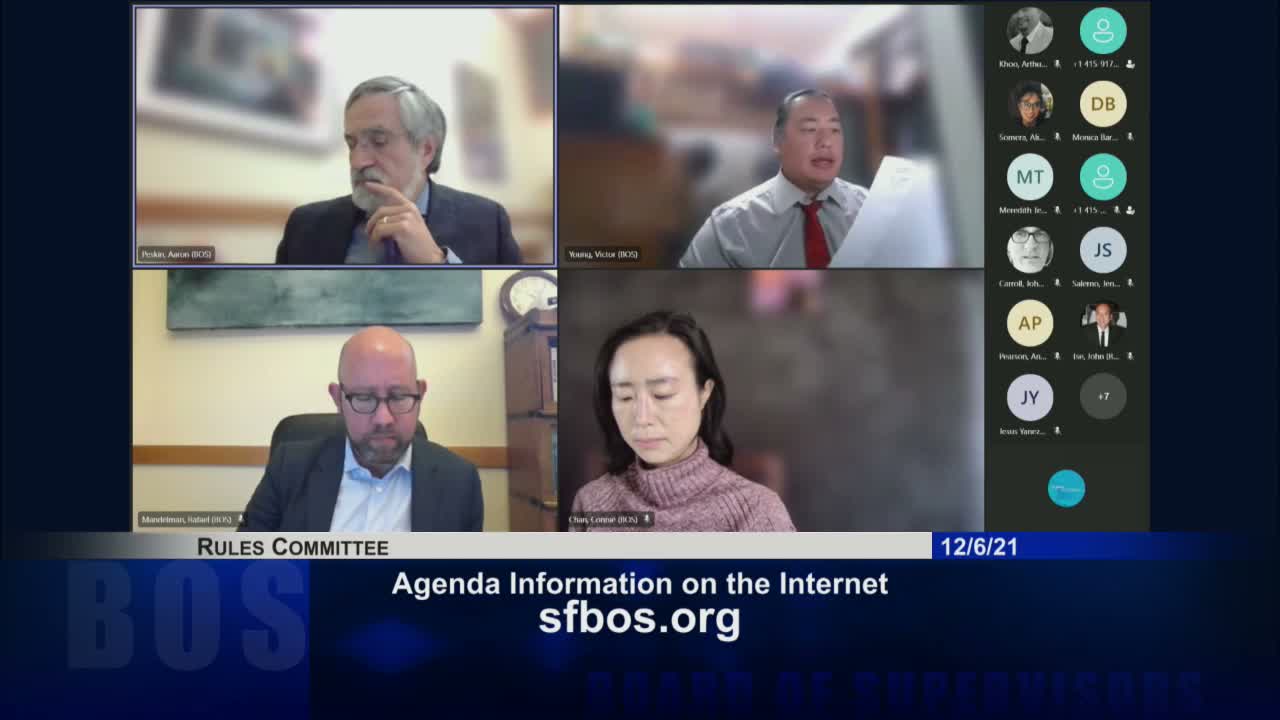
The San Francisco Board of Supervisors Rules Committee on Dec. 6 advanced an ordinance intended to curb "behested" payments and tighten rules on who counts as an "interested party" in city contracting and grant-making.
Chair Supervisor Aaron Peskin told the committee the ordinance responds to recommendations in the controller's public-integrity review following the Mohamed Nuru scandal and seeks to "address quid pro quo" by preventing city officials and designated employees from soliciting payments from parties seeking financial benefit from the city. Peskin said the change was intended to ensure "you can't be in the business of getting contracts with the city in exchange for giving money to the city."
The amendments the committee adopted clarify and narrow several definitions: organizations that only give grants to the city would not be treated as "interested parties" for purposes of the prohibition; individuals who attempt to influence via public speech would be excluded provided they have no financial interest; permit-consultant and indirect-solicitation prohibitions would be limited to parties with recent, identifiable contacts; and uncompensated nonprofit board members would be exempted. Peskin said these changes were largely non-substantive edits intended to make the policy enforceable.
Peskin also said he would place one substantive change efining as "interested parties" those contracting parties subject to Charter section 9.118 (contracts over specified dollar or duration thresholds)
nd move that language into a duplicated file for later consideration. He described that step as required because the city attorney had designated the change substantive.
Debbie Lerman of the Human Services Network urged caution on the "attempt to influence" language, saying it was "vague and overly broad" and could sweep in petition signers, rally participants or social-media authors. Bruce Wolf of the Sunshine Ordinance Task Force and other commenters generally supported the effort while urging narrow, enforceable language.
Vice Chair Supervisor Rafael Mandelmann pressed for limiting the contact-lobbyist prohibition to people who had recent, actual contacts with supervisors, a concern Peskin said could be addressed by mirroring the one-year contact limitation adopted for permit consultants.
The committee voted to adopt the non-substantive amendments, directed staff to duplicate the file and add the substantive Charter 9.118 change to that duplicated file, and sent the original, amended ordinance to the full Board as a committee report. The committee roll call passed with one dissent recorded in committee. The committee also noted the Ethics Commission may put a related measure on the ballot if local action does not proceed.
The ordinance will be considered by the full Board on the next available agenda; the duplicated file with the substantive contracting definition will return to committee for further consideration.
Chair Supervisor Aaron Peskin told the committee the ordinance responds to recommendations in the controller's public-integrity review following the Mohamed Nuru scandal and seeks to "address quid pro quo" by preventing city officials and designated employees from soliciting payments from parties seeking financial benefit from the city. Peskin said the change was intended to ensure "you can't be in the business of getting contracts with the city in exchange for giving money to the city."
The amendments the committee adopted clarify and narrow several definitions: organizations that only give grants to the city would not be treated as "interested parties" for purposes of the prohibition; individuals who attempt to influence via public speech would be excluded provided they have no financial interest; permit-consultant and indirect-solicitation prohibitions would be limited to parties with recent, identifiable contacts; and uncompensated nonprofit board members would be exempted. Peskin said these changes were largely non-substantive edits intended to make the policy enforceable.
Peskin also said he would place one substantive change efining as "interested parties" those contracting parties subject to Charter section 9.118 (contracts over specified dollar or duration thresholds)
nd move that language into a duplicated file for later consideration. He described that step as required because the city attorney had designated the change substantive.
Debbie Lerman of the Human Services Network urged caution on the "attempt to influence" language, saying it was "vague and overly broad" and could sweep in petition signers, rally participants or social-media authors. Bruce Wolf of the Sunshine Ordinance Task Force and other commenters generally supported the effort while urging narrow, enforceable language.
Vice Chair Supervisor Rafael Mandelmann pressed for limiting the contact-lobbyist prohibition to people who had recent, actual contacts with supervisors, a concern Peskin said could be addressed by mirroring the one-year contact limitation adopted for permit consultants.
The committee voted to adopt the non-substantive amendments, directed staff to duplicate the file and add the substantive Charter 9.118 change to that duplicated file, and sent the original, amended ordinance to the full Board as a committee report. The committee roll call passed with one dissent recorded in committee. The committee also noted the Ethics Commission may put a related measure on the ballot if local action does not proceed.
The ordinance will be considered by the full Board on the next available agenda; the duplicated file with the substantive contracting definition will return to committee for further consideration.
View the Full Meeting & All Its Details
This article offers just a summary. Unlock complete video, transcripts, and insights as a Founder Member.
✓
Watch full, unedited meeting videos
✓
Search every word spoken in unlimited transcripts
✓
AI summaries & real-time alerts (all government levels)
✓
Permanent access to expanding government content
30-day money-back guarantee
