Rules Committee adopts amendments, continues behested-payments ordinance for further drafting
November 29, 2021 | San Francisco County, California
This article was created by AI summarizing key points discussed. AI makes mistakes, so for full details and context, please refer to the video of the full meeting. Please report any errors so we can fix them. Report an error »
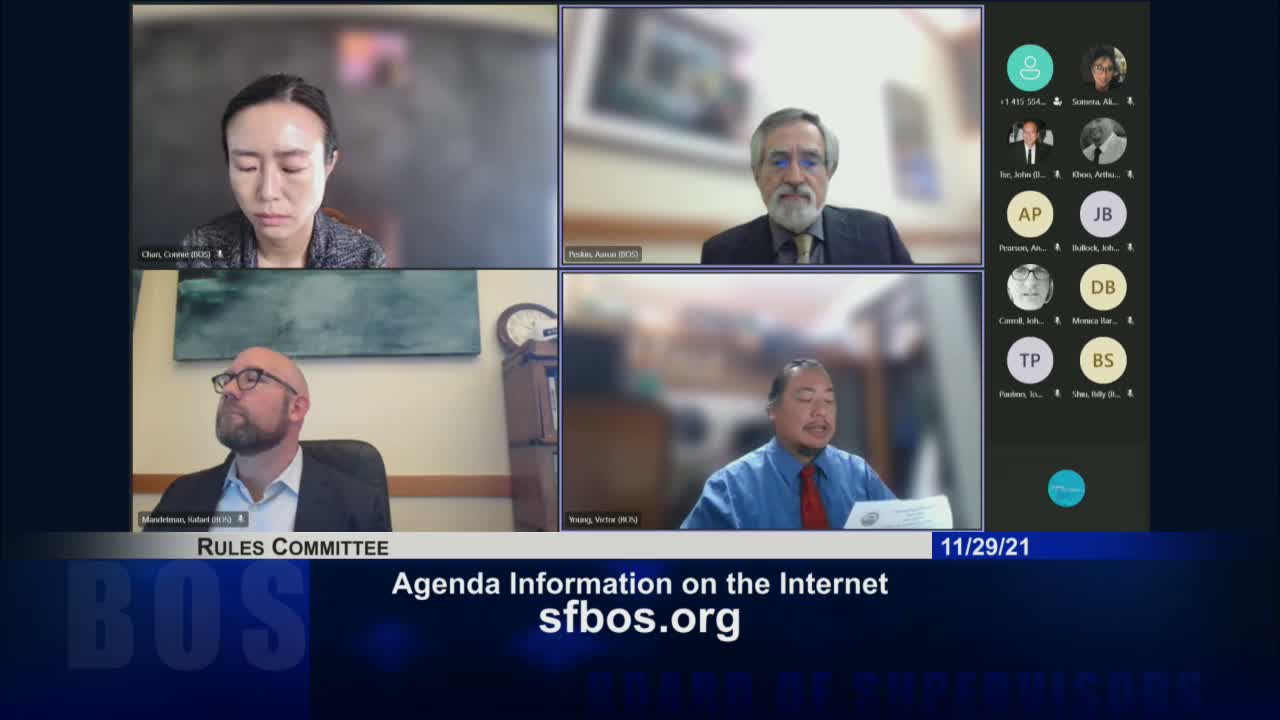
The Rules Committee of the San Francisco Board of Supervisors on Monday considered an ordinance to expand the campaign and government conduct code’s definition of 'interested parties' and to prohibit certain soliciting of behested payments by elected officials and designated employees, adopted several amendments and voted to continue the item one week for further drafting.
Chair Aaron Peskin, who introduced the amendments and moved to continue the matter, said the changes respond to Comptroller Rosenfield’s public-integrity recommendations following the Mohamed Nuru–related scandals. Peskin told colleagues he would codify an exemption for written and oral public comment so that someone speaking for or against legislation during public comment would not automatically become an "interested party." "As a policy matter, we want to encourage members of the public to weigh in," Peskin said.
Peskin described three substantive amendment areas he circulated: (1) an explicit exemption for written and oral public comment; (2) an exemption for federal and state government agencies to avoid hampering officials’ ability to seek relief funds; and (3) a clearer definition of "indirect solicitation," describing it as when a city officer "directly or otherwise urges another person to solicit" a behested payment from identifiable persons or groups. He also said additional amendments would be drafted to exempt uncompensated nonprofit board members and to clarify that contracts not approved by the Board of Supervisors or mayor would not be swept into the behested-payments prohibition.
Deputy City Attorney Anne Pearson said she needed to review other code provisions tied to public appeals and would look into whether existing reporting rules apply; Peskin and Pearson agreed to follow up. Peskin referenced San Francisco Administrative Code section 3605 in the discussion and said staff would return with clarifications.
Several public commenters urged caution. "This would be an implementation nightmare to include those folks," said Debbie Lerman of the San Francisco Human Services Network, who thanked supervisors for amendments that addressed some concerns but warned that a broad definition could sweep in grassroots advocates and uncompensated volunteers and create unworkable reporting burdens; she said the city’s nonprofit database lists over 600 nonprofits with contracts and a related database contains more than 33,000 affiliate and subcontractor entries. Linda Chapman urged the board to consult federal models for guidance, while David Pilpel recommended training and notice requirements for affected actors and asked the committee to define "public appeal" explicitly in the ordinance.
After public comment, Chair Peskin moved to adopt the four circulated amendments and to continue the item for one week for final drafting. The committee conducted a roll call and the clerk announced the motion "passes without objection." The committee adjourned.
The ordinance will return to the Rules Committee after staff incorporate the amendments and provide the clarifications Peskin and the deputy city attorney said they would supply. The record does not specify the exact December meeting date to which the item was continued.
Chair Aaron Peskin, who introduced the amendments and moved to continue the matter, said the changes respond to Comptroller Rosenfield’s public-integrity recommendations following the Mohamed Nuru–related scandals. Peskin told colleagues he would codify an exemption for written and oral public comment so that someone speaking for or against legislation during public comment would not automatically become an "interested party." "As a policy matter, we want to encourage members of the public to weigh in," Peskin said.
Peskin described three substantive amendment areas he circulated: (1) an explicit exemption for written and oral public comment; (2) an exemption for federal and state government agencies to avoid hampering officials’ ability to seek relief funds; and (3) a clearer definition of "indirect solicitation," describing it as when a city officer "directly or otherwise urges another person to solicit" a behested payment from identifiable persons or groups. He also said additional amendments would be drafted to exempt uncompensated nonprofit board members and to clarify that contracts not approved by the Board of Supervisors or mayor would not be swept into the behested-payments prohibition.
Deputy City Attorney Anne Pearson said she needed to review other code provisions tied to public appeals and would look into whether existing reporting rules apply; Peskin and Pearson agreed to follow up. Peskin referenced San Francisco Administrative Code section 3605 in the discussion and said staff would return with clarifications.
Several public commenters urged caution. "This would be an implementation nightmare to include those folks," said Debbie Lerman of the San Francisco Human Services Network, who thanked supervisors for amendments that addressed some concerns but warned that a broad definition could sweep in grassroots advocates and uncompensated volunteers and create unworkable reporting burdens; she said the city’s nonprofit database lists over 600 nonprofits with contracts and a related database contains more than 33,000 affiliate and subcontractor entries. Linda Chapman urged the board to consult federal models for guidance, while David Pilpel recommended training and notice requirements for affected actors and asked the committee to define "public appeal" explicitly in the ordinance.
After public comment, Chair Peskin moved to adopt the four circulated amendments and to continue the item for one week for final drafting. The committee conducted a roll call and the clerk announced the motion "passes without objection." The committee adjourned.
The ordinance will return to the Rules Committee after staff incorporate the amendments and provide the clarifications Peskin and the deputy city attorney said they would supply. The record does not specify the exact December meeting date to which the item was continued.
Don't Miss a Word: See the Full Meeting!
Go beyond summaries. Unlock every video, transcript, and key insight with a Founder Membership.
✓
Get instant access to full meeting videos
✓
Search and clip any phrase from complete transcripts
✓
Receive AI-powered summaries & custom alerts
✓
Enjoy lifetime, unrestricted access to government data
30-day money-back guarantee
