Supervisors Adopt Amendments to Public-Health Emergency Leave Measure; Continue Final Vote to Feb. 22
February 14, 2022 | San Francisco County, California
This article was created by AI summarizing key points discussed. AI makes mistakes, so for full details and context, please refer to the video of the full meeting. Please report any errors so we can fix them. Report an error »
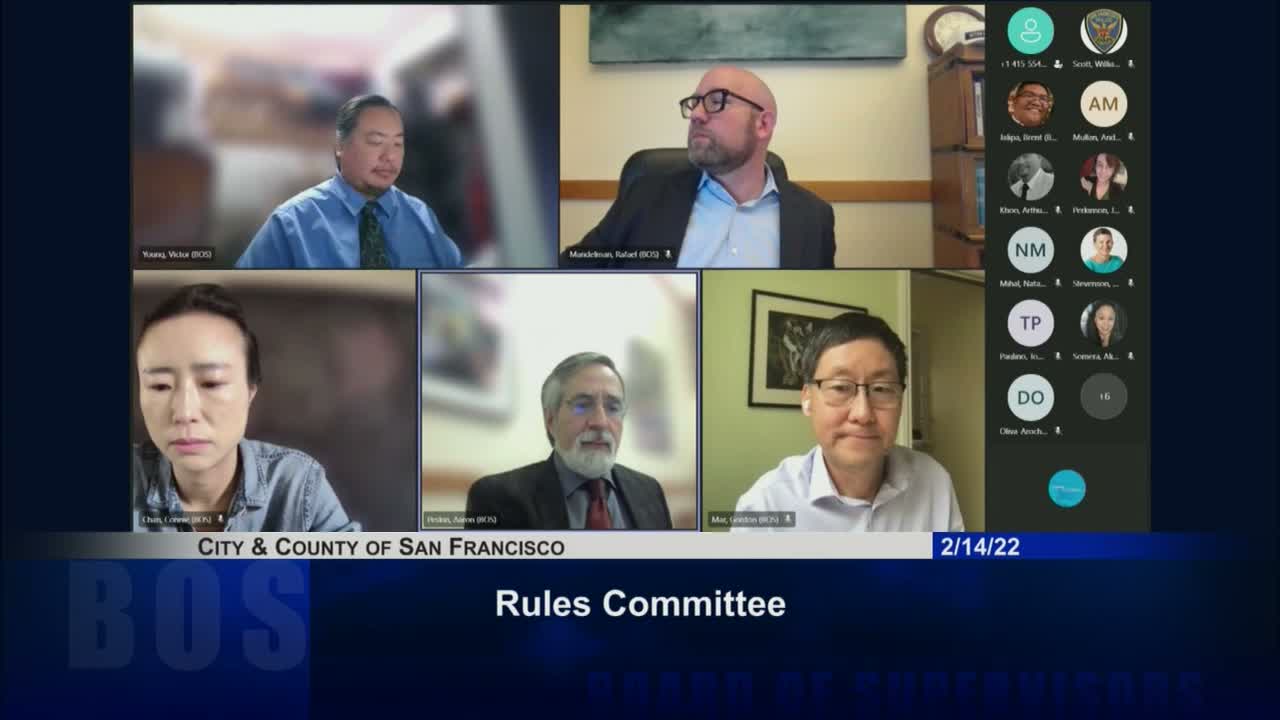
The San Francisco Rules Committee on Feb. 14 adopted a set of amendments to a citizen‑filed initiative that would require employers to provide public‑health emergency leave during declared public‑health emergencies and continued the measure for final consideration.
Supervisor Marr, the sponsor, told the committee the amendments were crafted with labor and business input and asked the committee to adopt four changes: extend the look‑back for part‑time workers from three to six months to align with state supplemental leave rules; allow the Office of Labor Standards Enforcement to recognize other employer‑provided supplemental leave in offsets; permit doctors’ notes to verify vulnerable status for air‑quality emergency leave; and allow the Board of Supervisors to amend substantive air‑quality provisions in the future.
The controller’s office, represented by Peg Stevenson of the Comptroller’s Performance Group, told the committee it had submitted a letter estimating likely staffing costs associated with the measure and classified the fiscal impact as a "moderate cost to government." Stevenson said such costs would be handled through normal Charter budgetary processes and that an ordinance does not bind future mayors or boards to a particular cost.
Members of the public who called in were split. Laurie Thomas of the Golden Gate Restaurant Association thanked Marr for engagement and said the association remained concerned about the measure’s size and urged more work on thresholds for covered employers. John Bouchard of Teamsters Local 350 called the amendments "helpful" and said more oversight for workers and ratepayers was needed. Other callers emphasized ventilation standards and frontline worker stress.
Chair Aaron Peskin moved to adopt the sponsor’s amendments; the committee recorded unanimous support from the three committee members present and the motion passed "without objection." Peskin said the item will almost certainly return to a special Rules Committee meeting on Feb. 22 at 10 a.m. for further action and noted that any item acted on Feb. 22 can be forwarded to the full Board in the normal course.
The committee’s action on the amendments does not finalize the measure. If the item is acted on at the Feb. 22 meeting, the Board will either forward the initiative to the voters or take legislative steps as allowed by the Charter. The controller’s and sponsor’s analyses will feed into budgetary decisions if the Board or voters approve the proposal.
Supervisor Marr, the sponsor, told the committee the amendments were crafted with labor and business input and asked the committee to adopt four changes: extend the look‑back for part‑time workers from three to six months to align with state supplemental leave rules; allow the Office of Labor Standards Enforcement to recognize other employer‑provided supplemental leave in offsets; permit doctors’ notes to verify vulnerable status for air‑quality emergency leave; and allow the Board of Supervisors to amend substantive air‑quality provisions in the future.
The controller’s office, represented by Peg Stevenson of the Comptroller’s Performance Group, told the committee it had submitted a letter estimating likely staffing costs associated with the measure and classified the fiscal impact as a "moderate cost to government." Stevenson said such costs would be handled through normal Charter budgetary processes and that an ordinance does not bind future mayors or boards to a particular cost.
Members of the public who called in were split. Laurie Thomas of the Golden Gate Restaurant Association thanked Marr for engagement and said the association remained concerned about the measure’s size and urged more work on thresholds for covered employers. John Bouchard of Teamsters Local 350 called the amendments "helpful" and said more oversight for workers and ratepayers was needed. Other callers emphasized ventilation standards and frontline worker stress.
Chair Aaron Peskin moved to adopt the sponsor’s amendments; the committee recorded unanimous support from the three committee members present and the motion passed "without objection." Peskin said the item will almost certainly return to a special Rules Committee meeting on Feb. 22 at 10 a.m. for further action and noted that any item acted on Feb. 22 can be forwarded to the full Board in the normal course.
The committee’s action on the amendments does not finalize the measure. If the item is acted on at the Feb. 22 meeting, the Board will either forward the initiative to the voters or take legislative steps as allowed by the Charter. The controller’s and sponsor’s analyses will feed into budgetary decisions if the Board or voters approve the proposal.
View the Full Meeting & All Its Details
This article offers just a summary. Unlock complete video, transcripts, and insights as a Founder Member.
✓
Watch full, unedited meeting videos
✓
Search every word spoken in unlimited transcripts
✓
AI summaries & real-time alerts (all government levels)
✓
Permanent access to expanding government content
30-day money-back guarantee
