Rules Committee Files Mayor’s Surveillance Proposal and Supervisors’ Countermeasure; Public Outcry Opposes Mayor’s Measure
February 14, 2022 | San Francisco County, California
This article was created by AI summarizing key points discussed. AI makes mistakes, so for full details and context, please refer to the video of the full meeting. Please report any errors so we can fix them. Report an error »
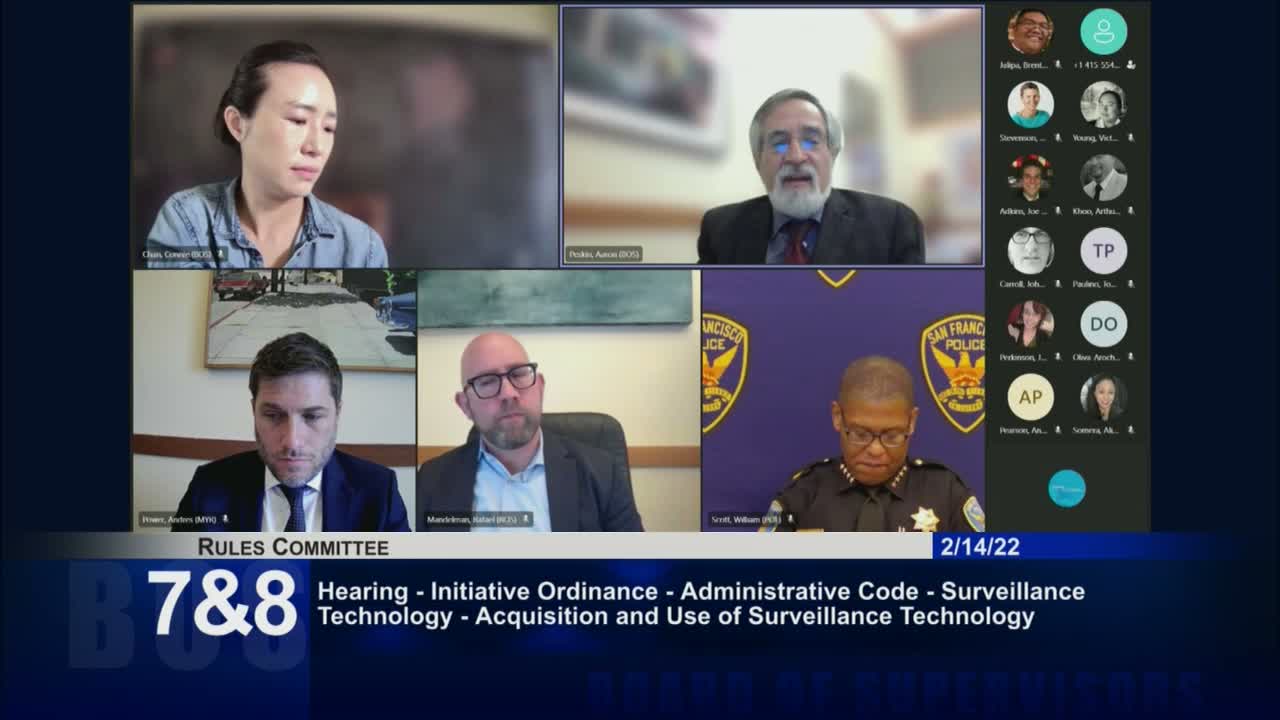
The Rules Committee on Feb. 14 filed both a mayoral initiative (Item 7) that would expand police access to certain surveillance technologies and a supervisors’ countermeasure (Item 8) intended to reinforce the city’s 2019 surveillance‑technology oversight law.
Chair Aaron Peskin recounted the 2019 ordinance’s goals—transparency, democratic control and the city’s earlier ban on facial recognition—and urged legislative negotiation before resorting to the ballot. Andres Power from the Mayor’s Office said the administration prefers to move the issue legislatively but wants realistic tools for police in specified critical events. Chief Scott of the San Francisco Police Department said the department seeks limited real‑time access to camera feeds in serious/crisis circumstances (citing an incident in Union Square on Nov. 19) and framed the proposal as aiming for "smart, thoughtful, balanced use of technology."
Public commenters were overwhelmingly opposed to the mayor’s proposal. Representatives from Glide, the ACLU of Northern California, the Electronic Frontier Foundation, the Council on American‑Islamic Relations, Asian Law Caucus and dozens of other civil‑rights and privacy groups urged the mayor to withdraw her measure and called on supervisors to support the countermeasure. Speakers repeatedly cited SFPD’s past unlawful surveillance of activists, racial disparities in police interactions with Black residents, and risks that expanded surveillance would disproportionately harm marginalized communities.
Tim Kingston of the Public Defender’s racial‑justice committee and others told the committee the 2019 ordinance already allows emergency access when necessary and said granting broader realtime access would undermine the ordinance’s safeguards. Advocates warned that the mayor’s proposal would "reward" SFPD for past noncompliance and remove public oversight.
Chair Peskin said he hopes the parties will resolve differences legislatively; March 4 was noted as the last day to remove measures from the ballot. The committee filed both measures by unanimous procedural vote.
Chair Aaron Peskin recounted the 2019 ordinance’s goals—transparency, democratic control and the city’s earlier ban on facial recognition—and urged legislative negotiation before resorting to the ballot. Andres Power from the Mayor’s Office said the administration prefers to move the issue legislatively but wants realistic tools for police in specified critical events. Chief Scott of the San Francisco Police Department said the department seeks limited real‑time access to camera feeds in serious/crisis circumstances (citing an incident in Union Square on Nov. 19) and framed the proposal as aiming for "smart, thoughtful, balanced use of technology."
Public commenters were overwhelmingly opposed to the mayor’s proposal. Representatives from Glide, the ACLU of Northern California, the Electronic Frontier Foundation, the Council on American‑Islamic Relations, Asian Law Caucus and dozens of other civil‑rights and privacy groups urged the mayor to withdraw her measure and called on supervisors to support the countermeasure. Speakers repeatedly cited SFPD’s past unlawful surveillance of activists, racial disparities in police interactions with Black residents, and risks that expanded surveillance would disproportionately harm marginalized communities.
Tim Kingston of the Public Defender’s racial‑justice committee and others told the committee the 2019 ordinance already allows emergency access when necessary and said granting broader realtime access would undermine the ordinance’s safeguards. Advocates warned that the mayor’s proposal would "reward" SFPD for past noncompliance and remove public oversight.
Chair Peskin said he hopes the parties will resolve differences legislatively; March 4 was noted as the last day to remove measures from the ballot. The committee filed both measures by unanimous procedural vote.
View the Full Meeting & All Its Details
This article offers just a summary. Unlock complete video, transcripts, and insights as a Founder Member.
✓
Watch full, unedited meeting videos
✓
Search every word spoken in unlimited transcripts
✓
AI summaries & real-time alerts (all government levels)
✓
Permanent access to expanding government content
30-day money-back guarantee
