Rules Committee advances ordinance to bar storing victims' DNA in local non‑CODIS databases beyond 60 days
April 11, 2022 | San Francisco County, California
This article was created by AI summarizing key points discussed. AI makes mistakes, so for full details and context, please refer to the video of the full meeting. Please report any errors so we can fix them. Report an error »
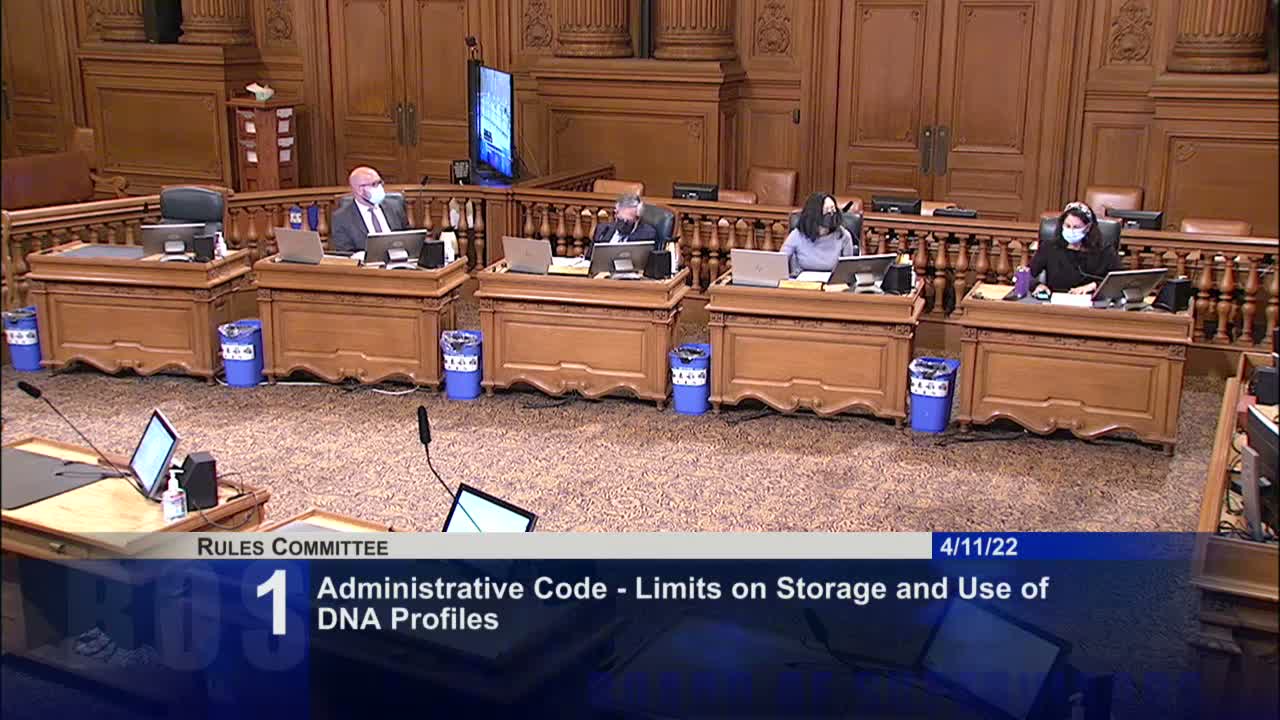
Supervisor Hillary Ronan asked the Rules Committee to forward an ordinance to the full Board of Supervisors that would prohibit the San Francisco Police Department and other city departments from uploading or storing DNA profiles known to belong to crime victims in any non‑CODIS DNA database for longer than 60 days. Ronan said the proposal responds to a district attorney disclosure that a victim's DNA from a kit submitted years earlier was later used to identify the same person as a suspect in another case.
Ronan outlined three core provisions: ban local storage of victim DNA in non‑CODIS systems beyond a 60‑day quality‑assurance period; prohibit investigative use of data retained during that 60‑day window; and require the police department to purge evidentiary DNA profiles stored longer than 60 days and victim DNA profiles of any length by 07/01/2022 (or 15 days after the ordinance's effective date). She also proposed two non‑substantive amendments to require a controller audit of the crime lab's evidentiary database and a public notice about evidence handling within two months of the law taking effect.
Acting forensic services director Mark Powell told the committee the crime lab has already purged reference samples from its contamination‑assessment database and said the lab now applies a 60‑day retention policy for contamination monitoring, reflecting much faster case turnaround times. "We've already purged the database of any reference samples," Powell said. Deputy City Attorney Anne Pearson said the submitted amendments "largely recite what state and federal law already do," but that the city attorney's office needed more time to confirm that characterization before approving the language "to form." Diana Oliva Rocher, identified as the Police Department's director of policy and public affairs, said the department was moving forward to align its protocols with the ordinance and emphasized balancing victim trust with public safety.
A remote public commenter urged caution, referencing the lab's history at Hunters Point and warning against treating a rare statistical occurrence as routine. After discussion the committee adopted the sponsor's amendments as described and, on a roll call of committee members present (Chan, Mandelmann, Peskin), voted to send the ordinance to the full Board with a positive recommendation; the motion passed without objection.
The ordinance would next be considered by the full Board of Supervisors; the clerk said items acted on would appear at the board on April 19 unless otherwise stated.
Ronan outlined three core provisions: ban local storage of victim DNA in non‑CODIS systems beyond a 60‑day quality‑assurance period; prohibit investigative use of data retained during that 60‑day window; and require the police department to purge evidentiary DNA profiles stored longer than 60 days and victim DNA profiles of any length by 07/01/2022 (or 15 days after the ordinance's effective date). She also proposed two non‑substantive amendments to require a controller audit of the crime lab's evidentiary database and a public notice about evidence handling within two months of the law taking effect.
Acting forensic services director Mark Powell told the committee the crime lab has already purged reference samples from its contamination‑assessment database and said the lab now applies a 60‑day retention policy for contamination monitoring, reflecting much faster case turnaround times. "We've already purged the database of any reference samples," Powell said. Deputy City Attorney Anne Pearson said the submitted amendments "largely recite what state and federal law already do," but that the city attorney's office needed more time to confirm that characterization before approving the language "to form." Diana Oliva Rocher, identified as the Police Department's director of policy and public affairs, said the department was moving forward to align its protocols with the ordinance and emphasized balancing victim trust with public safety.
A remote public commenter urged caution, referencing the lab's history at Hunters Point and warning against treating a rare statistical occurrence as routine. After discussion the committee adopted the sponsor's amendments as described and, on a roll call of committee members present (Chan, Mandelmann, Peskin), voted to send the ordinance to the full Board with a positive recommendation; the motion passed without objection.
The ordinance would next be considered by the full Board of Supervisors; the clerk said items acted on would appear at the board on April 19 unless otherwise stated.
Don't Miss a Word: See the Full Meeting!
Go beyond summaries. Unlock every video, transcript, and key insight with a Founder Membership.
✓
Get instant access to full meeting videos
✓
Search and clip any phrase from complete transcripts
✓
Receive AI-powered summaries & custom alerts
✓
Enjoy lifetime, unrestricted access to government data
30-day money-back guarantee
