Rules Committee considers Supervisor Chan’s Affordable Housing Production Act amid competing ballot measures
June 29, 2022 | San Francisco County, California
This article was created by AI summarizing key points discussed. AI makes mistakes, so for full details and context, please refer to the video of the full meeting. Please report any errors so we can fix them. Report an error »
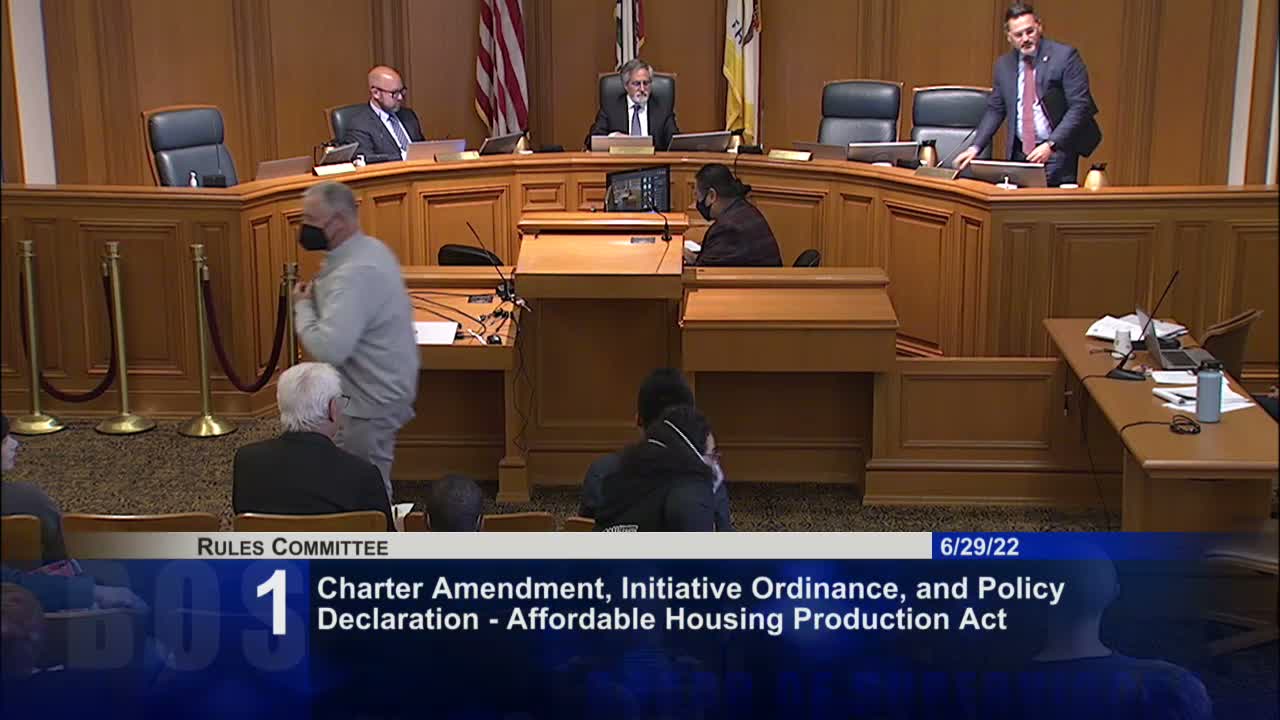
Supervisor Connie Chan introduced the Affordable Housing Production Act, a charter first‑draft to speed ministerial review for eligible 100% affordable housing, educator housing and certain market‑rate projects that provide substantial affordability. Chan said the measure would clarify project eligibility (referencing Planning Code §401), require reporting by the Mayor’s Office of Housing and Community Development, and allow the Board to create an advisory body; she also proposed prevailing wage and skilled‑and‑trained provisions for specific project sizes.
Controller Janice Levy told the committee the measure’s effect on the cost of government would likely be modest but said shortened approvals could reduce project timelines and costs; she noted a potential, though modest, future loss of property tax revenues if the measure increases affordable projects in lieu of market rate ones.
Public comment was extensive and divided. Building trades and labor voices largely supported the concept of accelerating affordable housing but urged robust prevailing wage and skilled‑and‑trained standards; many union speakers backed the competing marquee measure (Affordable Homes Now) that unions and housing advocates have been circulating for signatures and criticized the Chan measure as potentially confusing to voters. Several community organizations, affordable‑housing developers, and parents urged the committee to advance Chan’s measure to the full Board, arguing it prioritizes deep affordability and accountability for spending affordable housing dollars.
Supervisor Chan moved to amend the draft (clarifying Planning Code references, adding reporting requirements, specifying eligible affordable project definitions and skilled‑and‑trained thresholds for certain size bands) and to continue the item to July 6 for additional amendments; the committee adopted the amendments and continued the matter for further work.
The item remains in committee with promised technical edits and additional outreach to labor and other stakeholders; the proponents and many labor organizations signaled continued negotiations before a final Board recommendation.
Controller Janice Levy told the committee the measure’s effect on the cost of government would likely be modest but said shortened approvals could reduce project timelines and costs; she noted a potential, though modest, future loss of property tax revenues if the measure increases affordable projects in lieu of market rate ones.
Public comment was extensive and divided. Building trades and labor voices largely supported the concept of accelerating affordable housing but urged robust prevailing wage and skilled‑and‑trained standards; many union speakers backed the competing marquee measure (Affordable Homes Now) that unions and housing advocates have been circulating for signatures and criticized the Chan measure as potentially confusing to voters. Several community organizations, affordable‑housing developers, and parents urged the committee to advance Chan’s measure to the full Board, arguing it prioritizes deep affordability and accountability for spending affordable housing dollars.
Supervisor Chan moved to amend the draft (clarifying Planning Code references, adding reporting requirements, specifying eligible affordable project definitions and skilled‑and‑trained thresholds for certain size bands) and to continue the item to July 6 for additional amendments; the committee adopted the amendments and continued the matter for further work.
The item remains in committee with promised technical edits and additional outreach to labor and other stakeholders; the proponents and many labor organizations signaled continued negotiations before a final Board recommendation.
View the Full Meeting & All Its Details
This article offers just a summary. Unlock complete video, transcripts, and insights as a Founder Member.
✓
Watch full, unedited meeting videos
✓
Search every word spoken in unlimited transcripts
✓
AI summaries & real-time alerts (all government levels)
✓
Permanent access to expanding government content
30-day money-back guarantee
