Rules committee pauses SFPD plan to tap private cameras after hours of public opposition
July 11, 2022 | San Francisco County, California
This article was created by AI summarizing key points discussed. AI makes mistakes, so for full details and context, please refer to the video of the full meeting. Please report any errors so we can fix them. Report an error »
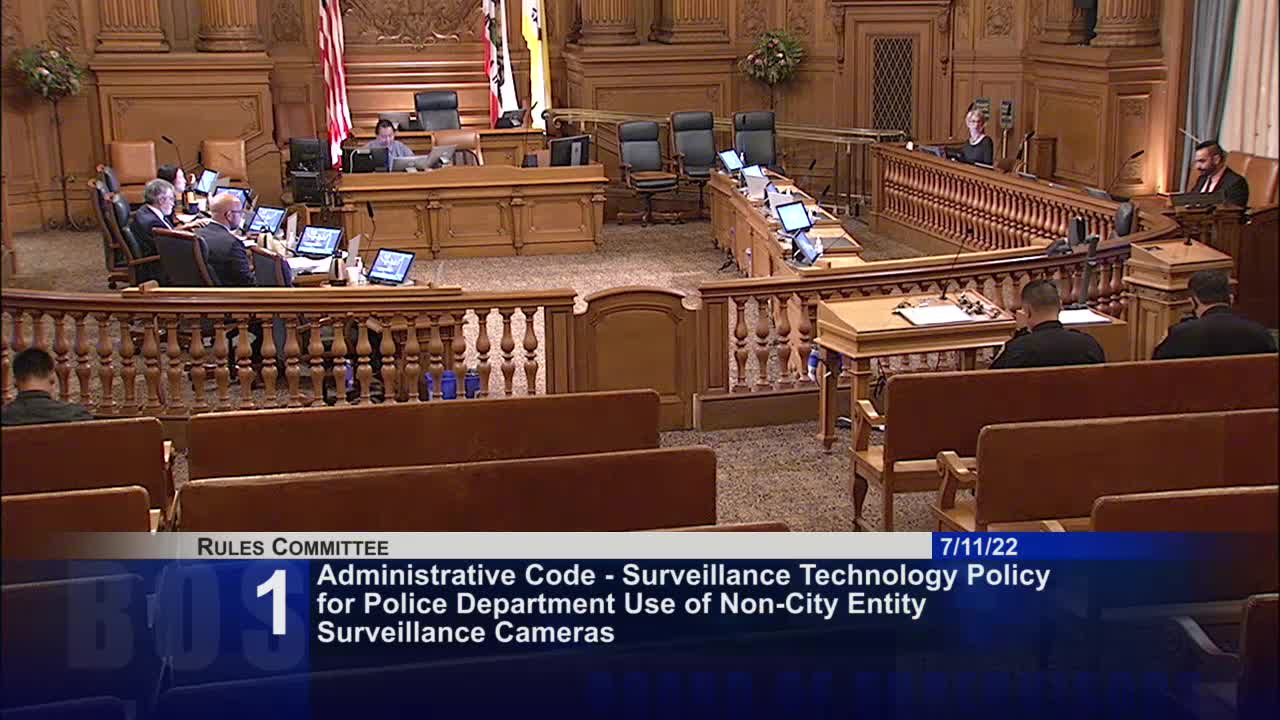
The Rules Committee of the San Francisco Board of Supervisors on July 11 continued consideration of a proposed San Francisco Police Department policy that would allow officers to request temporary live monitoring or historical footage from privately owned cameras.
Chair Aaron Peskin framed the measure as a review under Admin. Code §19B of current SFPD practice rather than an expansion of surveillance authority, but he said he planned to negotiate two amendments over the coming week, including one to tie retention periods to California evidence and penal code rules.
SFPD presenters, including Chief Scott and Special Projects Manager Aja Steves, told the committee the policy would cover non‑city‑entity cameras (corner stores, apartment complexes and doorbell cameras) and would allow temporary live monitoring during exigent circumstances, significant events or investigations into active misdemeanors and felonies. The department said temporary live monitoring would require captain‑level approval before officers asked an owner for access, and that owners may refuse and, if necessary, the department could seek a warrant.
“That is correct,” Chief Scott said when Chair Peskin summarized that SFPD would typically “knock on a door” to request access rather than keep standing access to a registry of cameras. SFPD also said historical footage requests would use an updated permission‑to‑search form and that footage tied to investigations would be retained as evidence consistent with state law.
Public comment filled much of the meeting. Dozens of callers and organization representatives — including the ACLU, Electronic Frontier Foundation, Council on American‑Islamic Relations and the San Francisco Public Defender’s Office — urged the committee to reject or substantially amend the proposal. Common concerns included vague definitions of “significant events,” a two‑year retention period for footage that does not contain evidence, the potential for sharing footage with out‑of‑state or federal agencies, and SFPD’s history of surveilling protesters.
“I am here for the second time to express my strong opposition,” said Alexi Folger, a resident of District 8. “The San Francisco Police Department’s current proposal proves yet again that it is bound and determined to find a way to countermand the will of the people.”
Civil‑liberties groups argued the proposal, as drafted, would allow broad live monitoring of protests and other First Amendment activity through a redeployment exception; SFPD officials said live monitoring would be limited to redeployment needs and not intended as general crowd surveillance. SFPD emphasized it has prohibitions in the policy against initiating monitoring on the basis of race, gender, religion or national origin, and stated internal affairs would investigate violations.
After hearing public testimony and questions from supervisors about consent, registries, thresholds for events and internal accountability, Chair Peskin moved to continue the item for one week to allow further discussions with the mayor’s office, the department and public advocates. The committee voted unanimously to continue the matter.
Next steps: the committee will reconvene to consider amended language and proposed redlines; Chair Peskin encouraged the department and advocates to negotiate in the intervening week.
Chair Aaron Peskin framed the measure as a review under Admin. Code §19B of current SFPD practice rather than an expansion of surveillance authority, but he said he planned to negotiate two amendments over the coming week, including one to tie retention periods to California evidence and penal code rules.
SFPD presenters, including Chief Scott and Special Projects Manager Aja Steves, told the committee the policy would cover non‑city‑entity cameras (corner stores, apartment complexes and doorbell cameras) and would allow temporary live monitoring during exigent circumstances, significant events or investigations into active misdemeanors and felonies. The department said temporary live monitoring would require captain‑level approval before officers asked an owner for access, and that owners may refuse and, if necessary, the department could seek a warrant.
“That is correct,” Chief Scott said when Chair Peskin summarized that SFPD would typically “knock on a door” to request access rather than keep standing access to a registry of cameras. SFPD also said historical footage requests would use an updated permission‑to‑search form and that footage tied to investigations would be retained as evidence consistent with state law.
Public comment filled much of the meeting. Dozens of callers and organization representatives — including the ACLU, Electronic Frontier Foundation, Council on American‑Islamic Relations and the San Francisco Public Defender’s Office — urged the committee to reject or substantially amend the proposal. Common concerns included vague definitions of “significant events,” a two‑year retention period for footage that does not contain evidence, the potential for sharing footage with out‑of‑state or federal agencies, and SFPD’s history of surveilling protesters.
“I am here for the second time to express my strong opposition,” said Alexi Folger, a resident of District 8. “The San Francisco Police Department’s current proposal proves yet again that it is bound and determined to find a way to countermand the will of the people.”
Civil‑liberties groups argued the proposal, as drafted, would allow broad live monitoring of protests and other First Amendment activity through a redeployment exception; SFPD officials said live monitoring would be limited to redeployment needs and not intended as general crowd surveillance. SFPD emphasized it has prohibitions in the policy against initiating monitoring on the basis of race, gender, religion or national origin, and stated internal affairs would investigate violations.
After hearing public testimony and questions from supervisors about consent, registries, thresholds for events and internal accountability, Chair Peskin moved to continue the item for one week to allow further discussions with the mayor’s office, the department and public advocates. The committee voted unanimously to continue the matter.
Next steps: the committee will reconvene to consider amended language and proposed redlines; Chair Peskin encouraged the department and advocates to negotiate in the intervening week.
View the Full Meeting & All Its Details
This article offers just a summary. Unlock complete video, transcripts, and insights as a Founder Member.
✓
Watch full, unedited meeting videos
✓
Search every word spoken in unlimited transcripts
✓
AI summaries & real-time alerts (all government levels)
✓
Permanent access to expanding government content
30-day money-back guarantee
