Rules Committee pauses vote on SFPD surveillance policy after hours of public testimony and staff amendments
July 18, 2022 | San Francisco County, California
This article was created by AI summarizing key points discussed. AI makes mistakes, so for full details and context, please refer to the video of the full meeting. Please report any errors so we can fix them. Report an error »
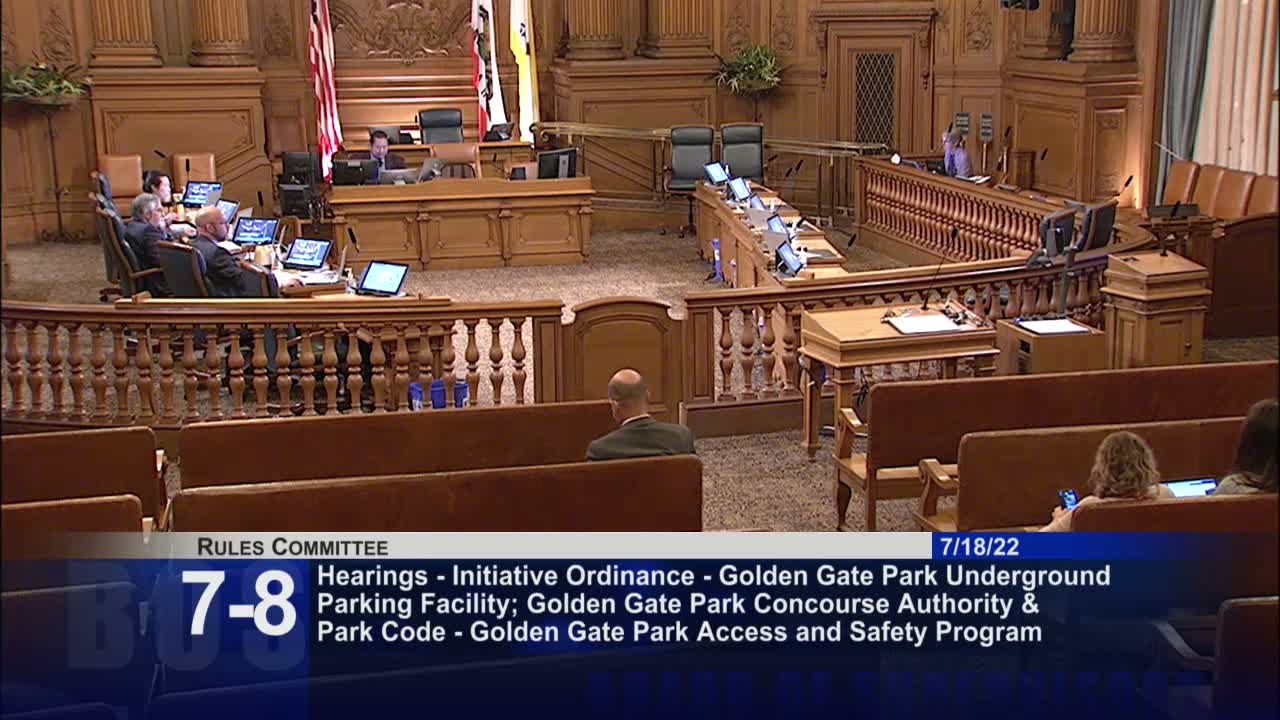
The Rules Committee continued a high‑profile debate over a proposed policy and ordinance that would govern San Francisco Police Department access to privately‑owned and non‑city camera systems. Chair Aaron Peskin said he would file both mayoral and chair amendments to the policy to clarify when live monitoring is permitted, default retention rules to state law, and limits on sharing footage with federal agencies; he asked for additional meetings with the public defender and advocates before a final ordinance.
Chief Scott of the SFPD described operational reasons for limited live monitoring and expedited access to third‑party cameras, saying live feeds can let officers identify and call in resources to address fast‑moving open‑air drug markets and mass looting "without posting officers at every corner." He described a 24‑hour authorization window for live monitoring tied to a discrete operation and said most uses would be for evidence and investigations rather than continuous surveillance.
Public comment numbered in the dozens; the clerk noted 45 callers on the line and 27 queued to speak. Callers were deeply divided: neighborhood business and safety coalitions, victims' advocates and some residents urged approval as a pragmatic tool to address looting, violent incidents and open‑air drug dealing; civil‑liberties and community groups, the Public Defender's Office and privacy advocates opposed expanding live access and raised concerns about First Amendment monitoring, disproportionate surveillance of marginalized communities, and unclear definitions for "exigent" or "significant" events.
Committee members including Supervisors Connie Chan and Safaei questioned implementation details: who would be authorized to monitor, how logs and audits would be maintained and published, how to define exigent circumstances and significant events, and whether live monitoring could become de facto continuous surveillance through repeated renewals. Chief Scott and staff described internal approval flows (captain approval, limited roles authorized to monitor, documented incident reports and an annual report) and said audits and logs would be part of the policy, but supervisors requested clearer written definitions and public reporting mechanisms.
Given the volume of public testimony and unresolved drafting questions, Chair Peskin moved and the committee voted to continue the item to July 25 to allow time for additional amendments and consultation with the mayor's office, the Public Defender and advocates; the motion passed without objection.
Chief Scott of the SFPD described operational reasons for limited live monitoring and expedited access to third‑party cameras, saying live feeds can let officers identify and call in resources to address fast‑moving open‑air drug markets and mass looting "without posting officers at every corner." He described a 24‑hour authorization window for live monitoring tied to a discrete operation and said most uses would be for evidence and investigations rather than continuous surveillance.
Public comment numbered in the dozens; the clerk noted 45 callers on the line and 27 queued to speak. Callers were deeply divided: neighborhood business and safety coalitions, victims' advocates and some residents urged approval as a pragmatic tool to address looting, violent incidents and open‑air drug dealing; civil‑liberties and community groups, the Public Defender's Office and privacy advocates opposed expanding live access and raised concerns about First Amendment monitoring, disproportionate surveillance of marginalized communities, and unclear definitions for "exigent" or "significant" events.
Committee members including Supervisors Connie Chan and Safaei questioned implementation details: who would be authorized to monitor, how logs and audits would be maintained and published, how to define exigent circumstances and significant events, and whether live monitoring could become de facto continuous surveillance through repeated renewals. Chief Scott and staff described internal approval flows (captain approval, limited roles authorized to monitor, documented incident reports and an annual report) and said audits and logs would be part of the policy, but supervisors requested clearer written definitions and public reporting mechanisms.
Given the volume of public testimony and unresolved drafting questions, Chair Peskin moved and the committee voted to continue the item to July 25 to allow time for additional amendments and consultation with the mayor's office, the Public Defender and advocates; the motion passed without objection.
Don't Miss a Word: See the Full Meeting!
Go beyond summaries. Unlock every video, transcript, and key insight with a Founder Membership.
✓
Get instant access to full meeting videos
✓
Search and clip any phrase from complete transcripts
✓
Receive AI-powered summaries & custom alerts
✓
Enjoy lifetime, unrestricted access to government data
30-day money-back guarantee
