Rules committee forwards SFPD policy allowing limited access to private cameras after contentious hearing
September 12, 2022 | San Francisco County, California
This article was created by AI summarizing key points discussed. AI makes mistakes, so for full details and context, please refer to the video of the full meeting. Please report any errors so we can fix them. Report an error »
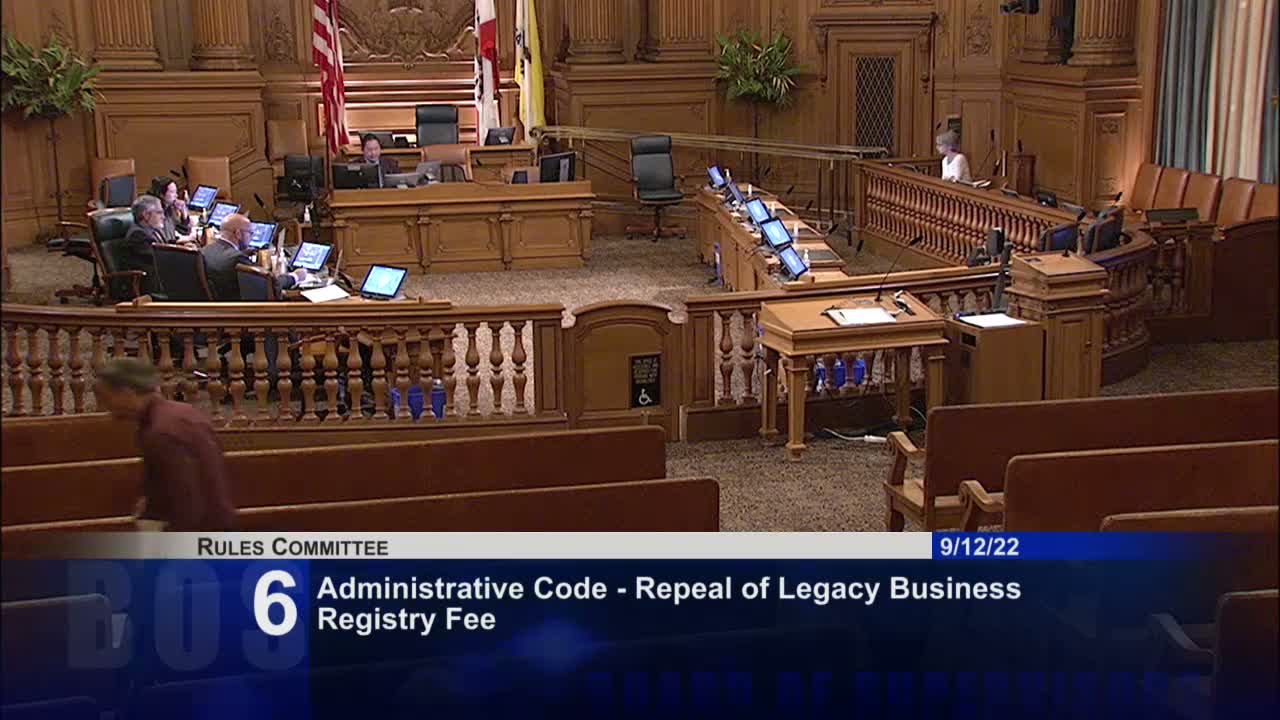
A divided San Francisco Board of Supervisors Rules Committee voted on Sept. 12 to send to the full board an SFPD surveillance-technology policy that would allow the department to request access to private cameras and, in narrow circumstances, conduct temporary live monitoring with express consent.
The committee adopted an amendment to extend the policy's sunset and evaluation window to 15 months and required metrics and reporting the committee said are necessary to reassess the policy after a trial period. Chair Aaron Peskin emphasized the time-limited approach, saying, “Is it perfect? Probably not. Is it worth trying? I think so.”
The policy (an implementation of San Francisco Administrative Code Section 19B) codifies procedures for SFPD to obtain historical footage from non-city entities and standardizes temporary live-monitoring requests through a chain-of-command approval process. Aja Steeves, a special projects manager in the police chief’s office, told the committee the policy is intended to cover “historical footage that captures a crime” and described safeguards including captain-level approvals, a prohibition on recording monitoring, and documentation that footage provided becomes part of an investigative file.
The hearing drew more than two dozen callers during a lengthy public-comment period. Supporters included business and merchant groups and nonprofit leaders who said the change would help solve crimes and support victims; opponents, including the ACLU of Northern California, the Asian Law Caucus and civil-rights coalitions, urged major revisions or delay and warned the policy risks chilling First Amendment activity and exacerbating racial disparities. Sarah Hussain of the Electronic Frontier Foundation told the committee it “would be premature for this committee to push it forward as it is and would endanger the rights of communities of color, abortion seekers, LGBTQ people, immigrants, and really all San Franciscans.”
Assistant Chief David Lazar and other SFPD presenters said the policy does not create a universal camera feed nor permit access without express consent or a warrant when required; they said the department lacks a standardized way to track historical-footage requests and that the STP would create required logging, retention rules and reporting to allow evaluation. Supervisors pressed the department on guardrails for live monitoring, data retention and whether the policy would enable sharing with other agencies.
In committee roll call, Supervisor Connie Chan voted no on the final motion to forward the item as amended; Vice Chair Mandelmann and Chair Peskin voted to advance it. The committee directed the policy to the full board with a positive recommendation and a dissent recorded in committee.
The full Board of Supervisors will now consider the ordinance and the STP at a forthcoming meeting; the committee set a 15‑month sunset to require a data-driven reassessment before any renewal.
The committee adopted an amendment to extend the policy's sunset and evaluation window to 15 months and required metrics and reporting the committee said are necessary to reassess the policy after a trial period. Chair Aaron Peskin emphasized the time-limited approach, saying, “Is it perfect? Probably not. Is it worth trying? I think so.”
The policy (an implementation of San Francisco Administrative Code Section 19B) codifies procedures for SFPD to obtain historical footage from non-city entities and standardizes temporary live-monitoring requests through a chain-of-command approval process. Aja Steeves, a special projects manager in the police chief’s office, told the committee the policy is intended to cover “historical footage that captures a crime” and described safeguards including captain-level approvals, a prohibition on recording monitoring, and documentation that footage provided becomes part of an investigative file.
The hearing drew more than two dozen callers during a lengthy public-comment period. Supporters included business and merchant groups and nonprofit leaders who said the change would help solve crimes and support victims; opponents, including the ACLU of Northern California, the Asian Law Caucus and civil-rights coalitions, urged major revisions or delay and warned the policy risks chilling First Amendment activity and exacerbating racial disparities. Sarah Hussain of the Electronic Frontier Foundation told the committee it “would be premature for this committee to push it forward as it is and would endanger the rights of communities of color, abortion seekers, LGBTQ people, immigrants, and really all San Franciscans.”
Assistant Chief David Lazar and other SFPD presenters said the policy does not create a universal camera feed nor permit access without express consent or a warrant when required; they said the department lacks a standardized way to track historical-footage requests and that the STP would create required logging, retention rules and reporting to allow evaluation. Supervisors pressed the department on guardrails for live monitoring, data retention and whether the policy would enable sharing with other agencies.
In committee roll call, Supervisor Connie Chan voted no on the final motion to forward the item as amended; Vice Chair Mandelmann and Chair Peskin voted to advance it. The committee directed the policy to the full board with a positive recommendation and a dissent recorded in committee.
The full Board of Supervisors will now consider the ordinance and the STP at a forthcoming meeting; the committee set a 15‑month sunset to require a data-driven reassessment before any renewal.
Don't Miss a Word: See the Full Meeting!
Go beyond summaries. Unlock every video, transcript, and key insight with a Founder Membership.
✓
Get instant access to full meeting videos
✓
Search and clip any phrase from complete transcripts
✓
Receive AI-powered summaries & custom alerts
✓
Enjoy lifetime, unrestricted access to government data
30-day money-back guarantee
