Rules committee amends and delays vote on SFPD policy for third‑party camera access after hours of public testimony
July 25, 2022 | San Francisco County, California
This article was created by AI summarizing key points discussed. AI makes mistakes, so for full details and context, please refer to the video of the full meeting. Please report any errors so we can fix them. Report an error »
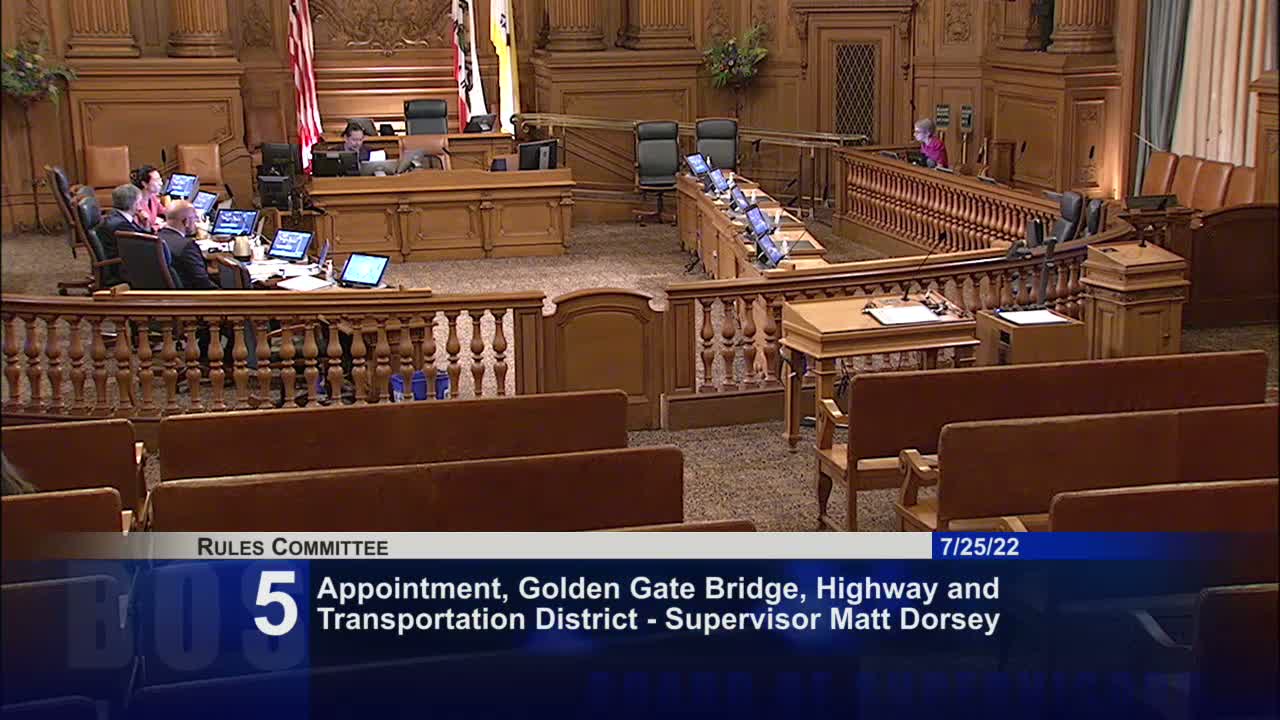
The San Francisco Board of Supervisors Rules Committee on July 25 amended and continued consideration of a proposed San Francisco Police Department policy that would allow SFPD limited access to third‑party (non‑city) surveillance cameras.
Chair Aaron Peskin described negotiated changes to the ordinance — most notably a one‑year sunset so the Board must reauthorize the policy after a year, and four quarterly reporting requirements to provide data on how the policy is used. Peskin said the revisions were intended to ‘‘balance civil liberties and an expectation of privacy in the public realm with law enforcement’s ability to have tools that it needs to make San Francisco safe.’’
Deputy City Attorney Anne Pearson told the committee she had ‘‘just received the amendments and had a chance to skim through them’’ and that she believed ‘‘they are substantive, so it would require a continuance.’’ Chief Scott of SFPD addressed the committee remotely, saying the negotiated changes ‘‘safeguard the constitutional rights and privacy that we all want to safeguard, but also put guardrails in place for responsible use of surveillance technology to address some of the criminal and crime issues in our city and protect large‑scale public events.’’
Public testimony stretched over several hours and roughly 48 callers. Speakers were sharply divided. Business owners, merchants associations, Chinatown advocates and some neighborhood residents urged the policy, saying access to private camera footage can deter crime, aid investigations and protect seniors and small businesses. Several public commenters cited local camera programs in Chinatown or Union Square and said enhanced access to footage would increase solvability of crimes.
Civil‑liberties organizations, legal advocacy groups and many residents urged the opposite: the Electronic Frontier Foundation, the ACLU of Northern California, the San Francisco Public Defender’s Office, the Asian Law Caucus, GLIDE and other groups said the draft policy as written would expand mass surveillance, risk discriminatory enforcement, enable over‑broad live monitoring, and allow sharing with outside agencies. Callers and organizations also pointed to prior incidents — including the SFPD’s contested access to footage during the 2020 protests — and asked for stricter limits on live monitoring, shorter retention for historical footage, and a prohibition on out‑of‑state or federal sharing without judicial review.
Because the city attorney advised that the new amendments were substantive, the committee voted to adopt the discussed amendments and continue the item to the first Rules Committee meeting after the summer recess to allow further review and refinement. The roll call on the motion to amend and continue recorded 'aye' votes from Supervisor Connie Chan, the vice chair (as spoken in the roll call), and Chair Peskin; the motion passed.
Chair Aaron Peskin described negotiated changes to the ordinance — most notably a one‑year sunset so the Board must reauthorize the policy after a year, and four quarterly reporting requirements to provide data on how the policy is used. Peskin said the revisions were intended to ‘‘balance civil liberties and an expectation of privacy in the public realm with law enforcement’s ability to have tools that it needs to make San Francisco safe.’’
Deputy City Attorney Anne Pearson told the committee she had ‘‘just received the amendments and had a chance to skim through them’’ and that she believed ‘‘they are substantive, so it would require a continuance.’’ Chief Scott of SFPD addressed the committee remotely, saying the negotiated changes ‘‘safeguard the constitutional rights and privacy that we all want to safeguard, but also put guardrails in place for responsible use of surveillance technology to address some of the criminal and crime issues in our city and protect large‑scale public events.’’
Public testimony stretched over several hours and roughly 48 callers. Speakers were sharply divided. Business owners, merchants associations, Chinatown advocates and some neighborhood residents urged the policy, saying access to private camera footage can deter crime, aid investigations and protect seniors and small businesses. Several public commenters cited local camera programs in Chinatown or Union Square and said enhanced access to footage would increase solvability of crimes.
Civil‑liberties organizations, legal advocacy groups and many residents urged the opposite: the Electronic Frontier Foundation, the ACLU of Northern California, the San Francisco Public Defender’s Office, the Asian Law Caucus, GLIDE and other groups said the draft policy as written would expand mass surveillance, risk discriminatory enforcement, enable over‑broad live monitoring, and allow sharing with outside agencies. Callers and organizations also pointed to prior incidents — including the SFPD’s contested access to footage during the 2020 protests — and asked for stricter limits on live monitoring, shorter retention for historical footage, and a prohibition on out‑of‑state or federal sharing without judicial review.
Because the city attorney advised that the new amendments were substantive, the committee voted to adopt the discussed amendments and continue the item to the first Rules Committee meeting after the summer recess to allow further review and refinement. The roll call on the motion to amend and continue recorded 'aye' votes from Supervisor Connie Chan, the vice chair (as spoken in the roll call), and Chair Peskin; the motion passed.
Don't Miss a Word: See the Full Meeting!
Go beyond summaries. Unlock every video, transcript, and key insight with a Founder Membership.
✓
Get instant access to full meeting videos
✓
Search and clip any phrase from complete transcripts
✓
Receive AI-powered summaries & custom alerts
✓
Enjoy lifetime, unrestricted access to government data
30-day money-back guarantee
