Rules committee sends SFPUC social impact partnership ordinance to full board after public testimony
December 05, 2022 | San Francisco County, California
This article was created by AI summarizing key points discussed. AI makes mistakes, so for full details and context, please refer to the video of the full meeting. Please report any errors so we can fix them. Report an error »
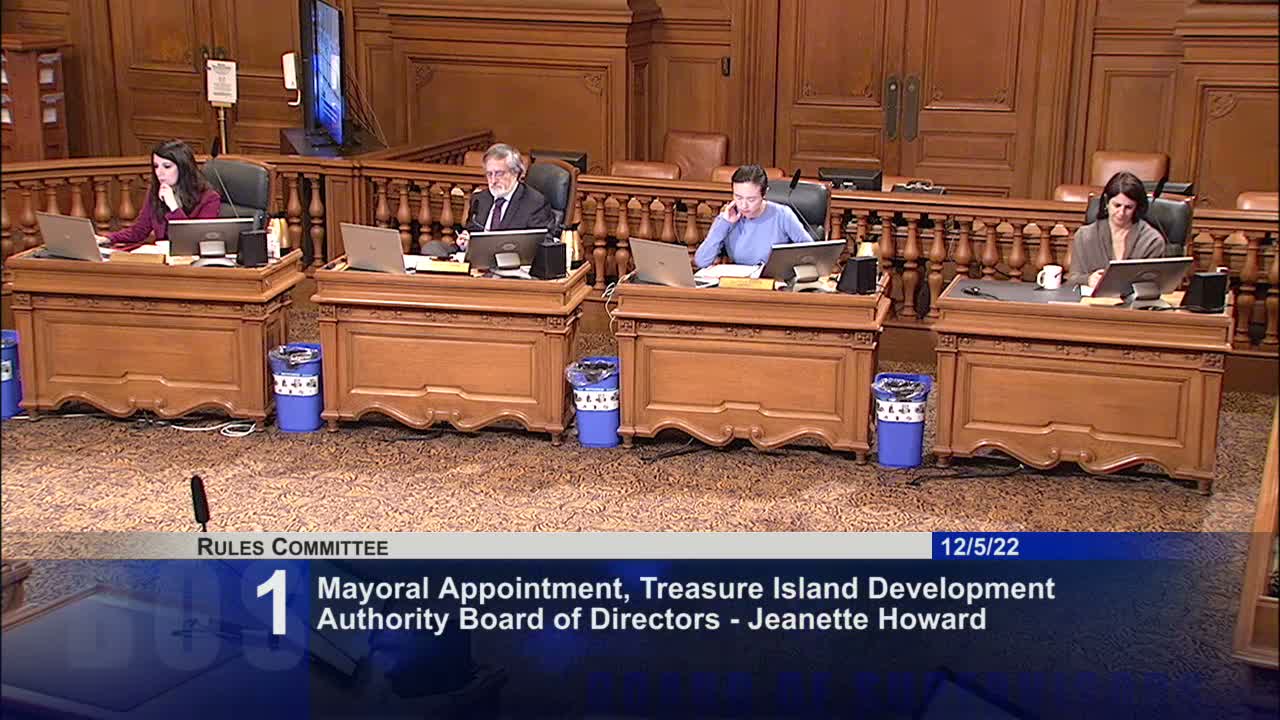
The San Francisco Board of Supervisors Rules Committee on Dec. 5 voted unanimously to send to the full board an ordinance that would codify and strengthen the San Francisco Public Utilities Commission’s (SFPUC) Social Impact Partnership (SIP) program.
The ordinance would amend the Administrative Code to allow the SFPUC to include social impact commitment criteria as a qualitatively scored element in solicitations for certain contracts at designated thresholds. Proponents told the committee the program encourages contractors to make voluntary commitments — financial and volunteer — to local nonprofits, public education providers and community programs in neighborhoods affected by PUC operations.
Supervisor Matt Haney Ronan (identified in the transcript as Supervisor Ronan) and SFPUC staff described SIP as a decade-old program (begun in 2011 and included in more than 90 contracts) that has supported STEM education, internships, a neurodiversity internship pilot, career-exposure opportunities and small-business development. SFPUC General Manager Dennis Herrera said staff have implemented audit recommendations ahead of schedule and introduced administrative improvements including upgraded data systems, stronger verification of reporting, a public interactive dashboard, a registry of potential nonprofit partners, and draft program rules and regulations.
Many public commenters — including nonprofit leaders, education fund representatives, contractors and beneficiaries — praised SIP’s workforce and community impacts. Examples included testimony from Shatzy Allen Jefferson of the Allen Group about internships leading to employment; Diane Gray of 100 Percent College Prep and Stacy Wang of the San Francisco Education Fund about STEM programming and scholarships; and Nancy Barnes of Stantec, who said Stantec has contributed over $1.4 million in volunteer hours and financial support through SIP since 2012.
A minority of callers expressed concern. One caller warned that the ordinance could create a loophole for 'behested' payments or pay‑to‑play contracting and urged broader citywide mechanisms and safeguards; another caller pointed to large cost increases on long-running PUC projects and urged attention to project governance.
After public comment, Chair Aaron Peskin moved to send the ordinance to the full board with a positive recommendation. Supervisors Chan and Stephanie voted aye; Peskin also voted aye and the motion passed without objection.
The committee record notes unanimous SFPUC Commission approval of the program on Oct. 24; the ordinance is scheduled for full board consideration the following day.
The ordinance would amend the Administrative Code to allow the SFPUC to include social impact commitment criteria as a qualitatively scored element in solicitations for certain contracts at designated thresholds. Proponents told the committee the program encourages contractors to make voluntary commitments — financial and volunteer — to local nonprofits, public education providers and community programs in neighborhoods affected by PUC operations.
Supervisor Matt Haney Ronan (identified in the transcript as Supervisor Ronan) and SFPUC staff described SIP as a decade-old program (begun in 2011 and included in more than 90 contracts) that has supported STEM education, internships, a neurodiversity internship pilot, career-exposure opportunities and small-business development. SFPUC General Manager Dennis Herrera said staff have implemented audit recommendations ahead of schedule and introduced administrative improvements including upgraded data systems, stronger verification of reporting, a public interactive dashboard, a registry of potential nonprofit partners, and draft program rules and regulations.
Many public commenters — including nonprofit leaders, education fund representatives, contractors and beneficiaries — praised SIP’s workforce and community impacts. Examples included testimony from Shatzy Allen Jefferson of the Allen Group about internships leading to employment; Diane Gray of 100 Percent College Prep and Stacy Wang of the San Francisco Education Fund about STEM programming and scholarships; and Nancy Barnes of Stantec, who said Stantec has contributed over $1.4 million in volunteer hours and financial support through SIP since 2012.
A minority of callers expressed concern. One caller warned that the ordinance could create a loophole for 'behested' payments or pay‑to‑play contracting and urged broader citywide mechanisms and safeguards; another caller pointed to large cost increases on long-running PUC projects and urged attention to project governance.
After public comment, Chair Aaron Peskin moved to send the ordinance to the full board with a positive recommendation. Supervisors Chan and Stephanie voted aye; Peskin also voted aye and the motion passed without objection.
The committee record notes unanimous SFPUC Commission approval of the program on Oct. 24; the ordinance is scheduled for full board consideration the following day.
View the Full Meeting & All Its Details
This article offers just a summary. Unlock complete video, transcripts, and insights as a Founder Member.
✓
Watch full, unedited meeting videos
✓
Search every word spoken in unlimited transcripts
✓
AI summaries & real-time alerts (all government levels)
✓
Permanent access to expanding government content
30-day money-back guarantee
