Rules Committee sends controversial remote‑comment proposal to full board after hours of public opposition
February 27, 2023 | San Francisco County, California
This article was created by AI summarizing key points discussed. AI makes mistakes, so for full details and context, please refer to the video of the full meeting. Please report any errors so we can fix them. Report an error »
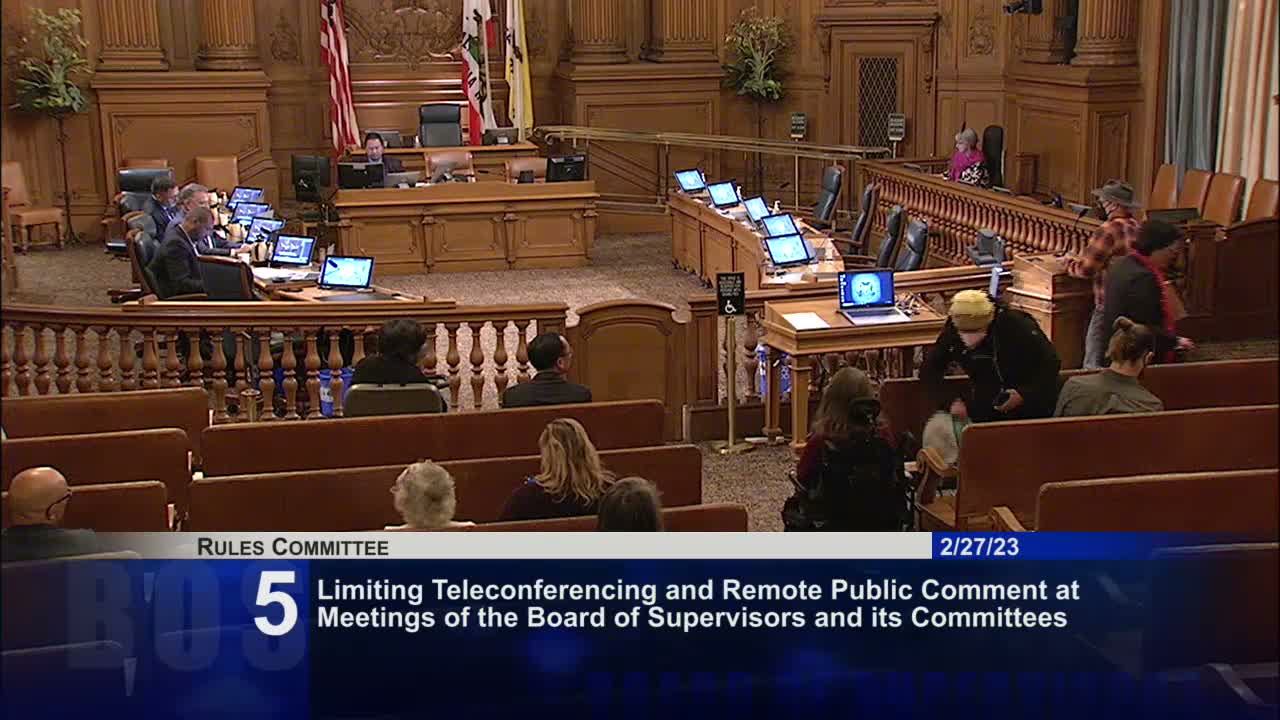
The San Francisco Board of Supervisors Rules Committee on Feb. 27 advanced a mayoral proposal on remote meeting access to the full board without recommendation after prolonged public comment and staff briefing.
The proposal as introduced would discontinue general remote public comment at meetings of the Board and its committees and limit remote participation to individuals legally entitled to an accommodation under the Americans with Disabilities Act. Chair Supervisor Matt Dorsey said he was moving the measure to the full board to continue the conversation and avoid an immediate vote in committee.
The issue drew sustained public outcry. Dozens of callers and in‑person speakers — including disability advocates, senior groups, tenants, domestic‑violence advocates and housing‑access organizations — urged the supervisors to keep telephone and video public comment available to everyone. “Public asset access to community decision making is a crucial point of oversight in our democracy,” said Anak Sal Rama of Senior and Disability Action, who testified in person. Multiple speakers stressed that remote access allows seniors, people with disabilities, parents, working people and neighborhood residents who cannot reach City Hall to participate.
Deputy City Administrator Jennifer Johnston told the committee the mayor’s office issued guidance advising city policy bodies to treat remote attendance as a reasonable modification for ADA accommodations, to accommodate late requests when possible, and to provide a limited time‑blocked portion of remote comment for members of the public not requesting ADA accommodations. “Remote attendance and participation is generally must be allowed as a reasonable modification for members of the public who are unable to provide public comment under the ADA,” Johnston said.
Committee members acknowledged the tension between preventing rare abuses of remote testimony and preserving broad public access. Vice Chair Shimon Walton said he opposed eliminating remote comment entirely and supported reasonable accommodation for seniors and disabled people. Chair Dorsey withdrew an amendment and moved to send the matter to the full board without recommendation as a committee report; the motion passed unanimously.
What happens next: the full Board of Supervisors will consider the proposal and the mayor’s citywide guidelines; the Rules Committee’s vote means supervisors will have an opportunity to weigh competing concerns about access, staffing and the scope of ADA accommodations before adopting any rule changes.
Key details and next steps: the mayoral guidelines advise city bodies to continue hybrid setups where feasible, accept ADA‑based remote participation requests up to the day of the meeting, and allow time‑limited remote comment for other members of the public. The committee’s referral preserves the status quo while the full board and staff review implementation, staffing and legal concerns.
The proposal as introduced would discontinue general remote public comment at meetings of the Board and its committees and limit remote participation to individuals legally entitled to an accommodation under the Americans with Disabilities Act. Chair Supervisor Matt Dorsey said he was moving the measure to the full board to continue the conversation and avoid an immediate vote in committee.
The issue drew sustained public outcry. Dozens of callers and in‑person speakers — including disability advocates, senior groups, tenants, domestic‑violence advocates and housing‑access organizations — urged the supervisors to keep telephone and video public comment available to everyone. “Public asset access to community decision making is a crucial point of oversight in our democracy,” said Anak Sal Rama of Senior and Disability Action, who testified in person. Multiple speakers stressed that remote access allows seniors, people with disabilities, parents, working people and neighborhood residents who cannot reach City Hall to participate.
Deputy City Administrator Jennifer Johnston told the committee the mayor’s office issued guidance advising city policy bodies to treat remote attendance as a reasonable modification for ADA accommodations, to accommodate late requests when possible, and to provide a limited time‑blocked portion of remote comment for members of the public not requesting ADA accommodations. “Remote attendance and participation is generally must be allowed as a reasonable modification for members of the public who are unable to provide public comment under the ADA,” Johnston said.
Committee members acknowledged the tension between preventing rare abuses of remote testimony and preserving broad public access. Vice Chair Shimon Walton said he opposed eliminating remote comment entirely and supported reasonable accommodation for seniors and disabled people. Chair Dorsey withdrew an amendment and moved to send the matter to the full board without recommendation as a committee report; the motion passed unanimously.
What happens next: the full Board of Supervisors will consider the proposal and the mayor’s citywide guidelines; the Rules Committee’s vote means supervisors will have an opportunity to weigh competing concerns about access, staffing and the scope of ADA accommodations before adopting any rule changes.
Key details and next steps: the mayoral guidelines advise city bodies to continue hybrid setups where feasible, accept ADA‑based remote participation requests up to the day of the meeting, and allow time‑limited remote comment for other members of the public. The committee’s referral preserves the status quo while the full board and staff review implementation, staffing and legal concerns.
View the Full Meeting & All Its Details
This article offers just a summary. Unlock complete video, transcripts, and insights as a Founder Member.
✓
Watch full, unedited meeting videos
✓
Search every word spoken in unlimited transcripts
✓
AI summaries & real-time alerts (all government levels)
✓
Permanent access to expanding government content
30-day money-back guarantee
