Committee backs resolution supporting SB 110 to expand contingency-management treatment in Medi‑Cal
April 22, 2021 | San Francisco County, California
This article was created by AI summarizing key points discussed. AI makes mistakes, so for full details and context, please refer to the video of the full meeting. Please report any errors so we can fix them. Report an error »
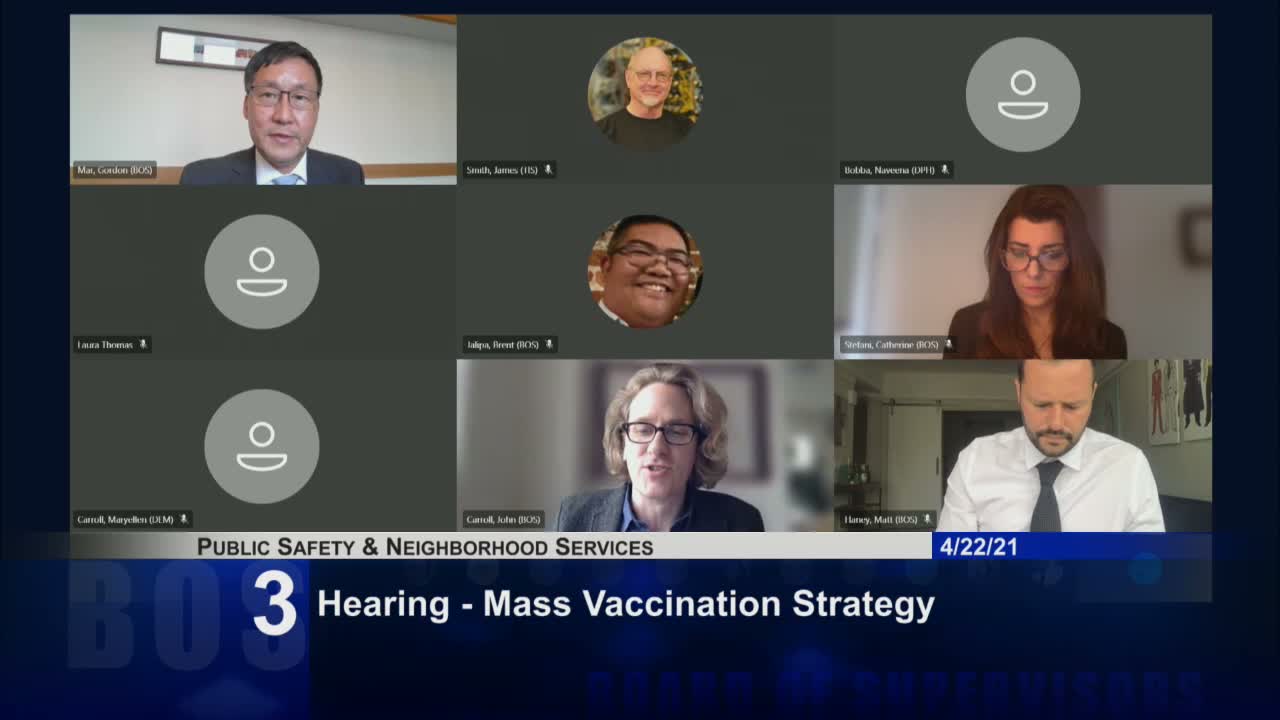
The committee on April 22 voted to send a resolution to the Board supporting California Senate Bill 110, the Recovery Incentives Act, which would make contingency management an approved, reimbursable treatment modality under Medi‑Cal.
Supervisor Acha Safaei, sponsor of the local resolution, described contingency management as an evidence-based, reward-based treatment that provides financial incentives (often gift cards) for verified positive behavior change, such as negative stimulant tests. Laura Thomas, director of harm reduction policy at the San Francisco AIDS Foundation, presented data from the Foundation’s PROP program, reporting that in a recent program year 63 percent of participants stopped using stimulants and another 19 percent reduced use, and said the organization has been providing contingency management in a harm-reduction, client-centered model.
Ms. Thomas noted that legal and administrative barriers at the state and federal level have limited wider use and reimbursement of contingency management; the proposed state law would clarify that contingency management does not violate anti‑kickback rules and would allow Medi‑Cal coverage. Supervisors asked about the relationship between low‑barrier harm-reduction models and abstinence‑focused residential treatment; presenters and supervisors agreed the modalities can be complementary and that a continuum of services is needed.
Public commenters included people with lived experience who described contingency management as lifesaving and advocates who urged expansion while some callers asked for greater oversight to prevent fraud and for more residential abstinence programs. Vice Chair Catherine Stephanie moved to forward the resolution with a positive recommendation; the motion passed by roll call (three ayes).
Supervisor Acha Safaei, sponsor of the local resolution, described contingency management as an evidence-based, reward-based treatment that provides financial incentives (often gift cards) for verified positive behavior change, such as negative stimulant tests. Laura Thomas, director of harm reduction policy at the San Francisco AIDS Foundation, presented data from the Foundation’s PROP program, reporting that in a recent program year 63 percent of participants stopped using stimulants and another 19 percent reduced use, and said the organization has been providing contingency management in a harm-reduction, client-centered model.
Ms. Thomas noted that legal and administrative barriers at the state and federal level have limited wider use and reimbursement of contingency management; the proposed state law would clarify that contingency management does not violate anti‑kickback rules and would allow Medi‑Cal coverage. Supervisors asked about the relationship between low‑barrier harm-reduction models and abstinence‑focused residential treatment; presenters and supervisors agreed the modalities can be complementary and that a continuum of services is needed.
Public commenters included people with lived experience who described contingency management as lifesaving and advocates who urged expansion while some callers asked for greater oversight to prevent fraud and for more residential abstinence programs. Vice Chair Catherine Stephanie moved to forward the resolution with a positive recommendation; the motion passed by roll call (three ayes).
View the Full Meeting & All Its Details
This article offers just a summary. Unlock complete video, transcripts, and insights as a Founder Member.
✓
Watch full, unedited meeting videos
✓
Search every word spoken in unlimited transcripts
✓
AI summaries & real-time alerts (all government levels)
✓
Permanent access to expanding government content
30-day money-back guarantee
