City departments outline plans to make services more user‑centered and accessible
May 13, 2021 | San Francisco County, California
This article was created by AI summarizing key points discussed. AI makes mistakes, so for full details and context, please refer to the video of the full meeting. Please report any errors so we can fix them. Report an error »
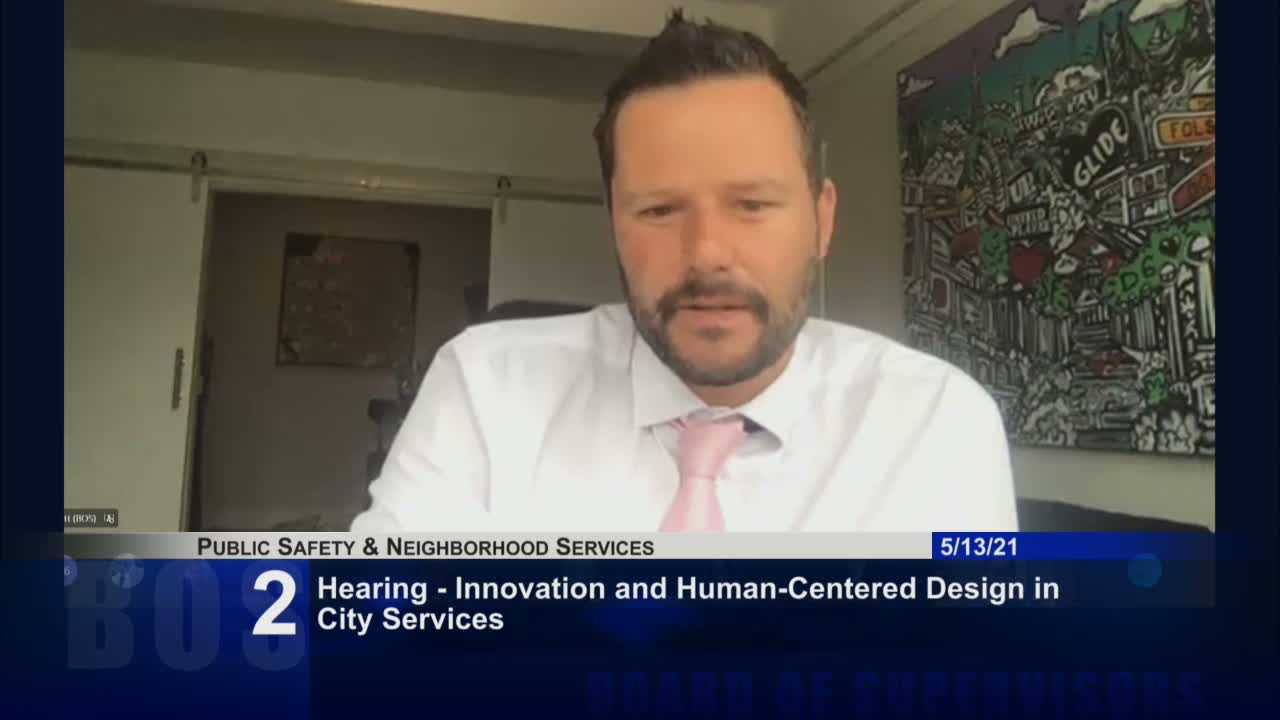
City technology and innovation leaders told the Public Safety and Neighborhood Services Committee on May 13 that they are pressing to make resident‑facing services easier to use, more accessible and coordinated across departments.
Jamie (CoIT) described the citys five‑year ICT plan as both a financial and strategic document and highlighted a new citywide service inventory cataloguing 967 resident‑facing services; the inventory found only 194 services were mobile‑accessible or fully designed for users with disabilities. “Only 194 out of the total 967 services were discovered to be mobile accessible and designed to be used by people with disabilities,” Jamie said.
Linda Jarrell, City Chief Information Officer, outlined infrastructure investments including identity and access management covering more than 60,000 city employees, a next‑generation network and migration to a hybrid data center. She said the citys mainframe retirement is expected to save roughly $2,000,000 a year and touted the Fiber to Housing initiative that has delivered connectivity to about 7,000 housing units.
Carrie Bishop, Chief Digital Services Officer, summarized Digital Serviceshuman‑centered design work: analytics and user feedback on sf.gov (roughly 5,200 monthly "was this page helpful" responses), bilingual user research and a service‑design team that has worked on the permit center and other in‑person experiences. "We start with humans," Bishop said, describing a emphasis on plain language, mobile‑first design and compensating community partners who help recruit research participants.
Dee Prasad, director of the Office of Civic Innovation, discussed the Civic Bridge program that pairs private‑sector experts with city departments for prototyping and pilot work; the program has supported 29 departments and credited nearly $5.5 million in pro bono contributions.
Supervisors pressed presenters about embedding design capacity across departments, language access and how offline, in‑person services are being redesigned. Digital Services and the Office of Civic Innovation said they are expanding service design work, partnering with departments and community‑based organizations, and pressing departments to move content onto sf.gov where translation and accessibility features are baked into the platform.
The committee accepted the presentations and filed the hearing.
Jamie (CoIT) described the citys five‑year ICT plan as both a financial and strategic document and highlighted a new citywide service inventory cataloguing 967 resident‑facing services; the inventory found only 194 services were mobile‑accessible or fully designed for users with disabilities. “Only 194 out of the total 967 services were discovered to be mobile accessible and designed to be used by people with disabilities,” Jamie said.
Linda Jarrell, City Chief Information Officer, outlined infrastructure investments including identity and access management covering more than 60,000 city employees, a next‑generation network and migration to a hybrid data center. She said the citys mainframe retirement is expected to save roughly $2,000,000 a year and touted the Fiber to Housing initiative that has delivered connectivity to about 7,000 housing units.
Carrie Bishop, Chief Digital Services Officer, summarized Digital Serviceshuman‑centered design work: analytics and user feedback on sf.gov (roughly 5,200 monthly "was this page helpful" responses), bilingual user research and a service‑design team that has worked on the permit center and other in‑person experiences. "We start with humans," Bishop said, describing a emphasis on plain language, mobile‑first design and compensating community partners who help recruit research participants.
Dee Prasad, director of the Office of Civic Innovation, discussed the Civic Bridge program that pairs private‑sector experts with city departments for prototyping and pilot work; the program has supported 29 departments and credited nearly $5.5 million in pro bono contributions.
Supervisors pressed presenters about embedding design capacity across departments, language access and how offline, in‑person services are being redesigned. Digital Services and the Office of Civic Innovation said they are expanding service design work, partnering with departments and community‑based organizations, and pressing departments to move content onto sf.gov where translation and accessibility features are baked into the platform.
The committee accepted the presentations and filed the hearing.
Don't Miss a Word: See the Full Meeting!
Go beyond summaries. Unlock every video, transcript, and key insight with a Founder Membership.
✓
Get instant access to full meeting videos
✓
Search and clip any phrase from complete transcripts
✓
Receive AI-powered summaries & custom alerts
✓
Enjoy lifetime, unrestricted access to government data
30-day money-back guarantee
