Public Works says funding shortfall will shrink pit‑stop footprint; advocates demand 24/7 expansion
June 10, 2021 | San Francisco County, California
This article was created by AI summarizing key points discussed. AI makes mistakes, so for full details and context, please refer to the video of the full meeting. Please report any errors so we can fix them. Report an error »
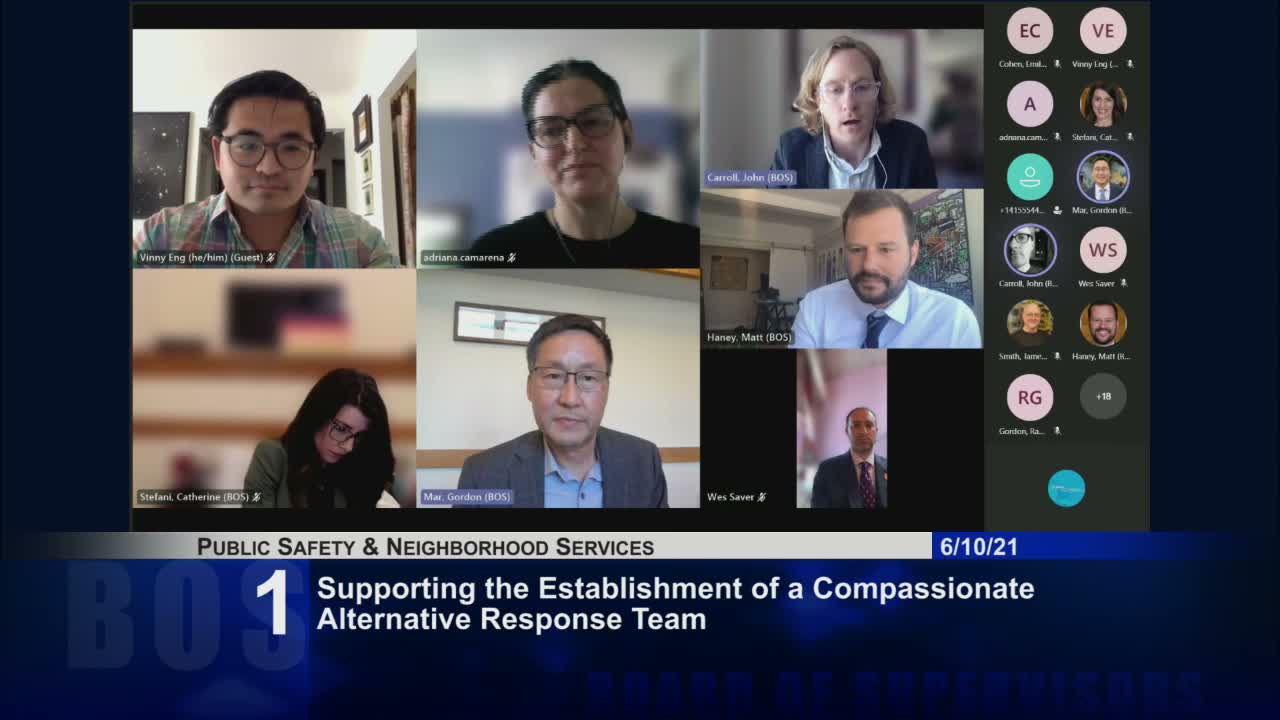
The Public Works Department and the Budget & Legislative Analyst (BLA) briefed the Public Safety and Neighborhood Services Committee on June 22 about the city's pit‑stop public‑restroom program and the status of 24‑hour access established during the pandemic.
Director of Public Works Alec DeGraffenreid and Pit Stop manager Jonathan Gumwal summarized the program: since its 2014 start the city expanded to dozens of locations, added attendant staffing and — during the COVID‑19 emergency — rapidly scaled temporary units. Gumwal said attendants improve safety and usage, and that the program provides disposal services and workforce development opportunities.
BLA findings: The Budget & Legislative Analyst compared May 2020 to May 2021 numbers and found a fall in temporary pit‑stop sites: from 62 sites (136 toilets) after the 2020 emergency expansion to 45 sites (123 toilets) in May 2021; temporary sites dropped from 31 to 11. BLA estimated annualized operating costs across the configuration at roughly $14.1 million. Converting the existing 36 pit‑stop sites to 24/7 operation would add about $6.9 million annually; restoring the 20 closed temporary sites and operating them 24/7 would add about $11.3 million annually.
FEMA and funding: Public Works and city finance staff said a September 15, 2020 FEMA guidance change narrowed eligibility for reimbursement; only sites adjacent to eligible healthcare locations were clearly covered, complicating expected federal assistance. Public Works said it has not yet received FEMA reimbursement for most pit‑stop costs.
Supervisors pressed for data: Supervisor Matt Haney asked why roughly 20 temporary units were removed during the year and whether removals were based on declining usage or other criteria. Public Works replied that funding constraints drove contractions and that placement decisions consider counts, partner input and street conditions; the department committed to better public notice when units are removed and to share granular usage data with supervisors.
Public comment: More than a dozen callers urged continuing and expanding 24/7 bathroom access, invoking public‑health and human‑rights standards, citing UN guidance and local examples of public feces complaints. Many asked the Board to restore hours and funding rather than roll back pandemic gains.
Committee action: Supervisor Haney moved to file the hearing and the committee voted 3–0 to file it, while members signaled intent to seek funding during the budget process.
Director of Public Works Alec DeGraffenreid and Pit Stop manager Jonathan Gumwal summarized the program: since its 2014 start the city expanded to dozens of locations, added attendant staffing and — during the COVID‑19 emergency — rapidly scaled temporary units. Gumwal said attendants improve safety and usage, and that the program provides disposal services and workforce development opportunities.
BLA findings: The Budget & Legislative Analyst compared May 2020 to May 2021 numbers and found a fall in temporary pit‑stop sites: from 62 sites (136 toilets) after the 2020 emergency expansion to 45 sites (123 toilets) in May 2021; temporary sites dropped from 31 to 11. BLA estimated annualized operating costs across the configuration at roughly $14.1 million. Converting the existing 36 pit‑stop sites to 24/7 operation would add about $6.9 million annually; restoring the 20 closed temporary sites and operating them 24/7 would add about $11.3 million annually.
FEMA and funding: Public Works and city finance staff said a September 15, 2020 FEMA guidance change narrowed eligibility for reimbursement; only sites adjacent to eligible healthcare locations were clearly covered, complicating expected federal assistance. Public Works said it has not yet received FEMA reimbursement for most pit‑stop costs.
Supervisors pressed for data: Supervisor Matt Haney asked why roughly 20 temporary units were removed during the year and whether removals were based on declining usage or other criteria. Public Works replied that funding constraints drove contractions and that placement decisions consider counts, partner input and street conditions; the department committed to better public notice when units are removed and to share granular usage data with supervisors.
Public comment: More than a dozen callers urged continuing and expanding 24/7 bathroom access, invoking public‑health and human‑rights standards, citing UN guidance and local examples of public feces complaints. Many asked the Board to restore hours and funding rather than roll back pandemic gains.
Committee action: Supervisor Haney moved to file the hearing and the committee voted 3–0 to file it, while members signaled intent to seek funding during the budget process.
View the Full Meeting & All Its Details
This article offers just a summary. Unlock complete video, transcripts, and insights as a Founder Member.
✓
Watch full, unedited meeting videos
✓
Search every word spoken in unlimited transcripts
✓
AI summaries & real-time alerts (all government levels)
✓
Permanent access to expanding government content
30-day money-back guarantee
