San Francisco supervisors hear merchants’ pleas as police, DA and city programs outline responses to commercial-corridor crime
December 09, 2021 | San Francisco County, California
This article was created by AI summarizing key points discussed. AI makes mistakes, so for full details and context, please refer to the video of the full meeting. Please report any errors so we can fix them. Report an error »
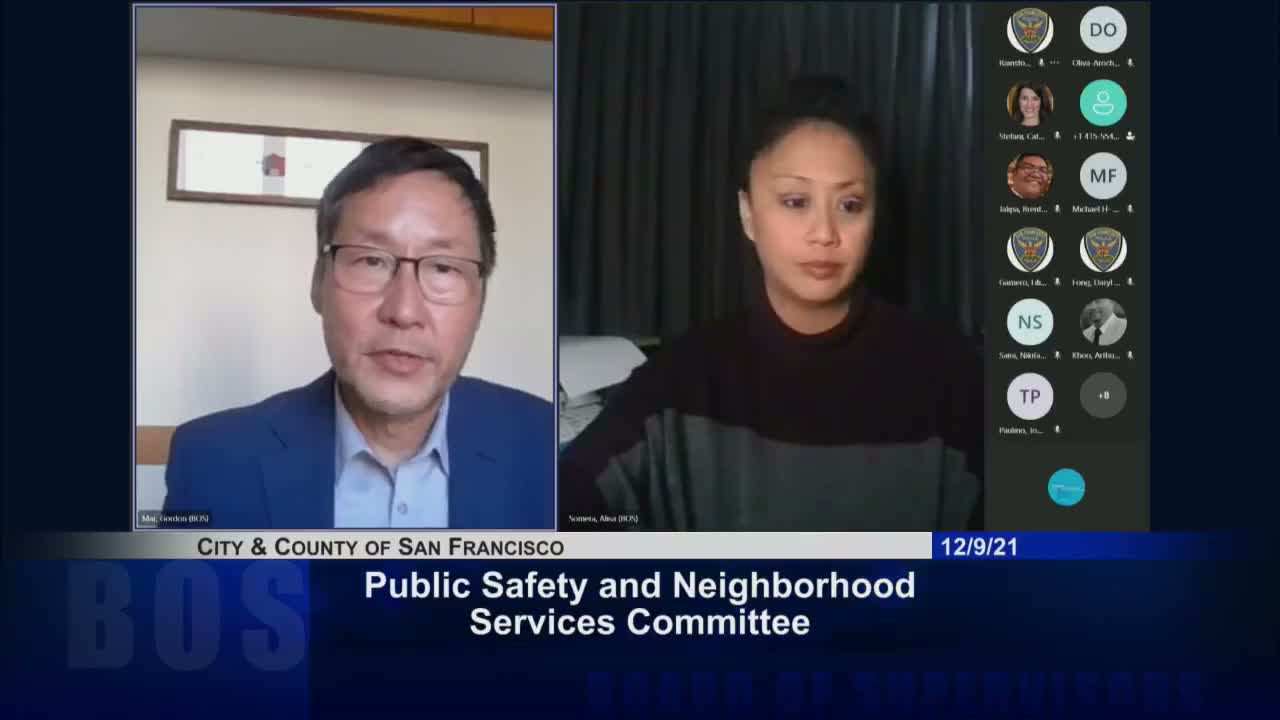
Supervisor Gordon Marr convened the Public Safety and Neighborhood Services Committee on Dec. 9 for a hearing on crime in San Francisco’s commercial corridors and its effect on neighborhood small businesses.
The hearing centered on merchant testimony about repeat burglaries and shop property damage, SFPD crime data and strategies, economic-relief grants and non‑law‑enforcement prevention programs. “We don’t feel safe,” Michael Hsu, owner of Footprint Shoe Store, said of neighborhood merchants’ experience after repeated burglaries.
Commander Daryl Fong of the San Francisco Police Department presented data focused on vandalism, burglary, robbery and theft across 25 commercial corridors. He reported year‑to‑date clearance rates of about 21% for vandalism, 13% for burglary and 33% for robbery and said those percentages reflect cases presented in the commercial corridors he outlined. Fong described SFPD deployments including foot beats, bicycle patrols, fixed posts, targeted abatement operations and a Union Square “Safe Shoppers” deployment intended to increase visibility and deterrence.
Supervisors pressed SFPD on staffing, noting an independent pre‑pandemic consultant study that recommended hundreds more officers. “These strategies are so important,” Supervisor Katherine Stephanie said, and asked how cuts to overtime and academy classes had affected operations. Fong said COVID‑era attrition and the vaccine mandate reduced staffing and that some patrol functions are sustained through overtime/backfill, but the department seeks additional staffing to expand proactive patrols.
Office of Economic and Workforce Development staff described the Storefront Vandalism Relief Grant, created this fall to help merchants repair damage. OEWD reported roughly $368,000 awarded so far with an average award of about $1,291; roughly half of awards to date have gone to AAPI‑owned businesses. OEWD also described camera installations on several corridors, ambassador programs and Community Benefit District funding that can support safety services.
Adrianne Pahn of the Office of Civic Engagement and Immigrant Affairs summarized the community ambassador programs and language‑access work. OCS/OCIA said ambassador teams have logged more than 11,000 merchant visits since July 2020 and provided direct merchant assistance in hundreds of cases. Pahn outlined a pilot to certify community interpreters and said the office is expanding ambassador teams to additional districts.
Marshall Kine, Chief Assistant District Attorney, told the committee the DA’s office has prioritized organized‑retail‑theft investigations and prosecutions and is participating in multi‑jurisdictional operations. He said the office received 638 commercial burglary case referrals in 2021 and filed felony charges in about 70% (436) of those cases through November, with other actions such as probation‑revocation motions where appropriate.
Supervisors and the DA’s staff discussed charging, plea outcomes, diversion and when the office seeks detention. Cicely Brewster, an assistant district attorney, described merchant trainings the office provides and a community‑liaison program assigned by supervisorial district.
Chair Marr moved to file the hearing record. The clerk recorded two aye votes (Supervisor Katherine Stephanie and Chair Marr) with Supervisor Matt Haney absent, and the motion was filed.
The committee did not adopt new policy at the hearing; several supervisors said follow-up is needed on staffing levels, grant criteria and communications with merchants to improve evidence collection and prosecution outcomes.
The hearing centered on merchant testimony about repeat burglaries and shop property damage, SFPD crime data and strategies, economic-relief grants and non‑law‑enforcement prevention programs. “We don’t feel safe,” Michael Hsu, owner of Footprint Shoe Store, said of neighborhood merchants’ experience after repeated burglaries.
Commander Daryl Fong of the San Francisco Police Department presented data focused on vandalism, burglary, robbery and theft across 25 commercial corridors. He reported year‑to‑date clearance rates of about 21% for vandalism, 13% for burglary and 33% for robbery and said those percentages reflect cases presented in the commercial corridors he outlined. Fong described SFPD deployments including foot beats, bicycle patrols, fixed posts, targeted abatement operations and a Union Square “Safe Shoppers” deployment intended to increase visibility and deterrence.
Supervisors pressed SFPD on staffing, noting an independent pre‑pandemic consultant study that recommended hundreds more officers. “These strategies are so important,” Supervisor Katherine Stephanie said, and asked how cuts to overtime and academy classes had affected operations. Fong said COVID‑era attrition and the vaccine mandate reduced staffing and that some patrol functions are sustained through overtime/backfill, but the department seeks additional staffing to expand proactive patrols.
Office of Economic and Workforce Development staff described the Storefront Vandalism Relief Grant, created this fall to help merchants repair damage. OEWD reported roughly $368,000 awarded so far with an average award of about $1,291; roughly half of awards to date have gone to AAPI‑owned businesses. OEWD also described camera installations on several corridors, ambassador programs and Community Benefit District funding that can support safety services.
Adrianne Pahn of the Office of Civic Engagement and Immigrant Affairs summarized the community ambassador programs and language‑access work. OCS/OCIA said ambassador teams have logged more than 11,000 merchant visits since July 2020 and provided direct merchant assistance in hundreds of cases. Pahn outlined a pilot to certify community interpreters and said the office is expanding ambassador teams to additional districts.
Marshall Kine, Chief Assistant District Attorney, told the committee the DA’s office has prioritized organized‑retail‑theft investigations and prosecutions and is participating in multi‑jurisdictional operations. He said the office received 638 commercial burglary case referrals in 2021 and filed felony charges in about 70% (436) of those cases through November, with other actions such as probation‑revocation motions where appropriate.
Supervisors and the DA’s staff discussed charging, plea outcomes, diversion and when the office seeks detention. Cicely Brewster, an assistant district attorney, described merchant trainings the office provides and a community‑liaison program assigned by supervisorial district.
Chair Marr moved to file the hearing record. The clerk recorded two aye votes (Supervisor Katherine Stephanie and Chair Marr) with Supervisor Matt Haney absent, and the motion was filed.
The committee did not adopt new policy at the hearing; several supervisors said follow-up is needed on staffing levels, grant criteria and communications with merchants to improve evidence collection and prosecution outcomes.
View the Full Meeting & All Its Details
This article offers just a summary. Unlock complete video, transcripts, and insights as a Founder Member.
✓
Watch full, unedited meeting videos
✓
Search every word spoken in unlimited transcripts
✓
AI summaries & real-time alerts (all government levels)
✓
Permanent access to expanding government content
30-day money-back guarantee
