Budget office audit prompts push for dedicated tree‑planting funds and staffing to sustain San Francisco’s urban canopy
November 19, 2021 | San Francisco County, California
This article was created by AI summarizing key points discussed. AI makes mistakes, so for full details and context, please refer to the video of the full meeting. Please report any errors so we can fix them. Report an error »
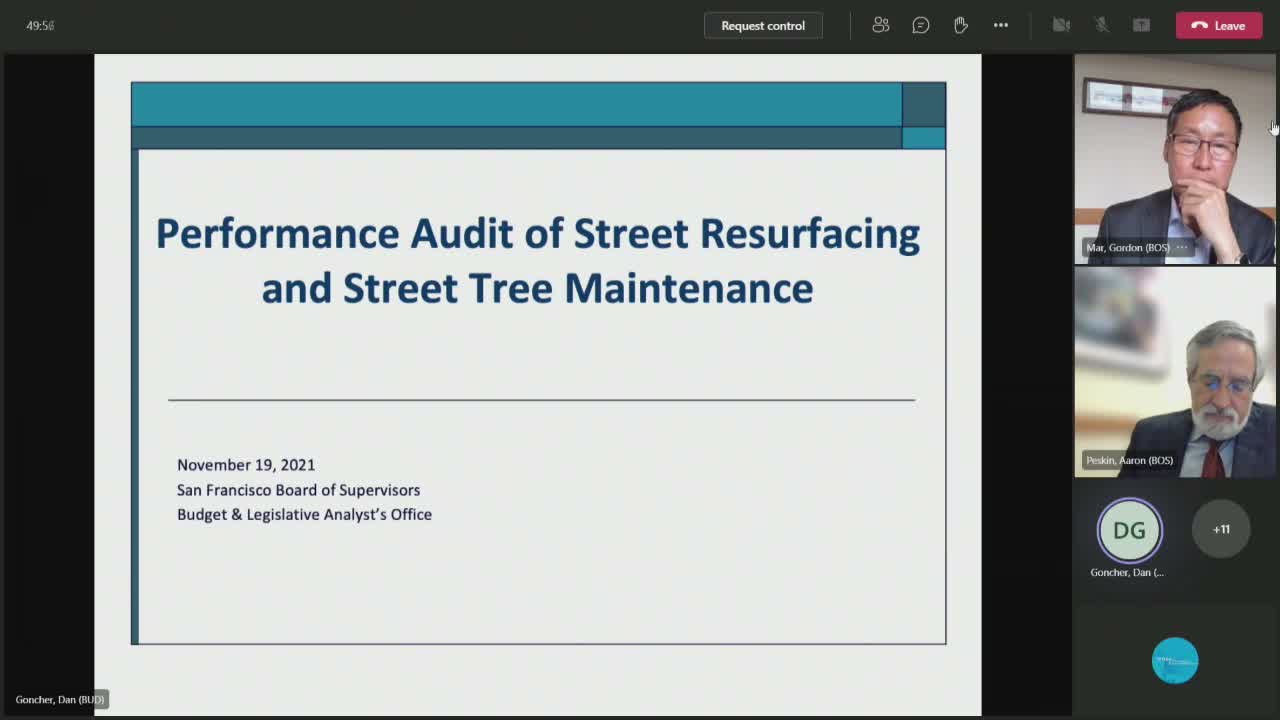
The committee received a detailed presentation on Nov. 19 from the Budget and Legislative Analyst (BLA) on the Department of Public Works’ Street Tree SF program and the city’s urban canopy, and heard a robust public response urging dedicated planting funding, better data and expanded staffing.
Dan Goncher of the BLA summarized the June audit’s findings: Street Tree SF completed about 21% of its key maps and addressed roughly 32% of street trees within key maps during the program’s first three years, and the office now projects eight years to complete baseline pruning rather than the originally projected three to five years. The audit identified five key problem areas: baseline pruning progress, staffing vacancies, geographic inequities in service and canopy distribution, insufficient annual planting to offset mortality, and data/asset‑management limitations that produce unreliable program reporting.
Acting Director Carla Short of Public Works and the Bureau of Urban Forestry told the committee the bureau welcomes the audit and supports many of its recommendations. Short said the bureau had projected to complete baseline pruning in "4 and a half years" prior to COVID disruptions, signaled plans to relaunch an arborist apprenticeship in partnership with DHR and Local 261 with smaller cohorts, and confirmed that a recently completed street‑tree planting strategy lays out a goal of planting 4,000 trees per year (2,500 replacements and 1,500 new trees). Short estimated the per‑tree cost at roughly $2,000 — about $1,500 of which is for watering — and said the planting goal would cost "a little bit over $8,000,000" annually under current costing assumptions.
During public comment, neighborhood advocates and nonprofit groups urged clearer responsibility for watering, dedicated planting funding (including a general‑fund allocation or bond), creation of a city forest officer or office to coordinate across departments, and more equitable distribution of plantings to neighborhoods such as Chinatown, Visitacion Valley and the Sunset. Judy Irving (Telegraph Hill Dwellers) and Brian Wiedenmeier (Friends of the Urban Forest) emphasized that the BLA report documents a longstanding shortfall in planting and maintenance; Joshua Klipp (Mission Verde) highlighted a community‑driven watering model; others recommended better interagency coordination to avoid competing removal processes.
Supervisors thanked presenters and callers, and the committee voted 3–0 to file the hearing. Chair Marr and Supervisor Peskin said they will continue working with Public Works and advocates on funding, staffing and a management plan to make planting and maintenance sustainable.
Dan Goncher of the BLA summarized the June audit’s findings: Street Tree SF completed about 21% of its key maps and addressed roughly 32% of street trees within key maps during the program’s first three years, and the office now projects eight years to complete baseline pruning rather than the originally projected three to five years. The audit identified five key problem areas: baseline pruning progress, staffing vacancies, geographic inequities in service and canopy distribution, insufficient annual planting to offset mortality, and data/asset‑management limitations that produce unreliable program reporting.
Acting Director Carla Short of Public Works and the Bureau of Urban Forestry told the committee the bureau welcomes the audit and supports many of its recommendations. Short said the bureau had projected to complete baseline pruning in "4 and a half years" prior to COVID disruptions, signaled plans to relaunch an arborist apprenticeship in partnership with DHR and Local 261 with smaller cohorts, and confirmed that a recently completed street‑tree planting strategy lays out a goal of planting 4,000 trees per year (2,500 replacements and 1,500 new trees). Short estimated the per‑tree cost at roughly $2,000 — about $1,500 of which is for watering — and said the planting goal would cost "a little bit over $8,000,000" annually under current costing assumptions.
During public comment, neighborhood advocates and nonprofit groups urged clearer responsibility for watering, dedicated planting funding (including a general‑fund allocation or bond), creation of a city forest officer or office to coordinate across departments, and more equitable distribution of plantings to neighborhoods such as Chinatown, Visitacion Valley and the Sunset. Judy Irving (Telegraph Hill Dwellers) and Brian Wiedenmeier (Friends of the Urban Forest) emphasized that the BLA report documents a longstanding shortfall in planting and maintenance; Joshua Klipp (Mission Verde) highlighted a community‑driven watering model; others recommended better interagency coordination to avoid competing removal processes.
Supervisors thanked presenters and callers, and the committee voted 3–0 to file the hearing. Chair Marr and Supervisor Peskin said they will continue working with Public Works and advocates on funding, staffing and a management plan to make planting and maintenance sustainable.
View the Full Meeting & All Its Details
This article offers just a summary. Unlock complete video, transcripts, and insights as a Founder Member.
✓
Watch full, unedited meeting videos
✓
Search every word spoken in unlimited transcripts
✓
AI summaries & real-time alerts (all government levels)
✓
Permanent access to expanding government content
30-day money-back guarantee
