San Francisco supervisors seek master plan as departments outline shortfall in senior, disability housing
January 27, 2022 | San Francisco County, California
This article was created by AI summarizing key points discussed. AI makes mistakes, so for full details and context, please refer to the video of the full meeting. Please report any errors so we can fix them. Report an error »
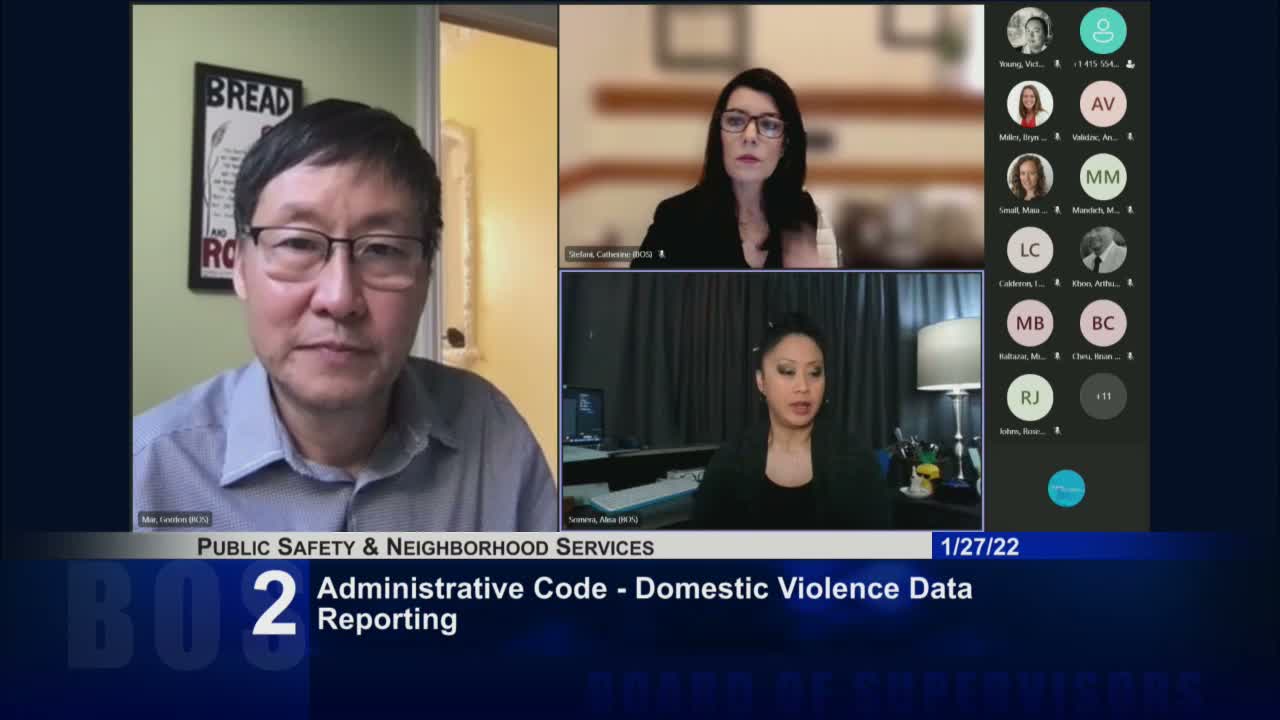
Supervisor Gordon Marr convened the Public Safety and Neighborhood Services Committee hearing on Jan. 27, 2022 to review the city’s approach to housing and supportive services for older adults and people with disabilities. Departments from planning, housing, homelessness response, public health and aging services presented current programs, constraints and proposed next steps.
City officials framed the hearing as a first step to quantify need and coordinate cross-department planning. "This hearing today is really what I'm viewing it as a first step in looking at how we can better plan as a city to meet the full spectrum of housing needs and supportive services needs for our aging population and people with disabilities," Chair Gordon Marr said at the start of the hearing.
The Planning Department presented housing-element analysis showing about 138,000 residents age 65 or older (2018 data used in the draft needs assessment) and reported that roughly 48% of seniors are very low income; the department said senior-specific policy work (Policy 27) and tools such as ADUs and co-housing can help but that market conditions and construction costs limit supply. "Under current planning regulations, the department recognizes two specific definitions of note: senior housing, which is a residential use, and residential care facilities," Planning's Maya Small told the committee and described recent regulatory changes that require conditional-use review where a residential care facility would be demolished or converted.
The Mayor’s Office of Housing and Community Development (MOHCD) said the city’s affordable portfolio includes "more than 13,000 units for seniors and people with disabilities" and that ‘‘more than 10,000 are senior units;’’ MOHCD also reported producing 510 permanently affordable senior units in FY 2019–20 and having roughly 898 senior-designated units in the pipeline. MOHCD Director of Policy Sheila Nicholas cautioned that federal funding streams that previously supported seniors (HUD Section 202 and ample Section 8 vouchers) have diminished, and that state competitive funding rules and tax-credit allocation (CDLAC) affect what projects can move forward.
The Department of Homelessness and Supportive Housing described site-based permanent supportive units and targeted vouchers for older adults exiting shelter-in-place hotels; HSH said it has a portfolio with many units designated for older adults, cited 143 units opening this year and noted 300 locally funded flexible housing subsidy slots for people age 60+ leaving SIP hotels. DPH highlighted medical and behavioral-health services for older adults, the ACE acute-care-for-the-elderly unit, and the loss of roughly 27 board-and-care facilities (about 163 beds) over five years; Mental Health San Francisco/Prop C funding will add approximately 73 board-and-care beds targeted to behavioral-health populations.
Kelly Dearman of the Department of Disability and Aging Services outlined DAS’s supportive programs—two small-scale rental-subsidy programs serving roughly 430 people annually, the Community Living Fund and IHSS-related pilots—and reminded the committee that DOS’s role focuses on services rather than direct housing production. DOS and MOHCD said they will coordinate a needs assessment and that a completed report is expected later in 2022.
Public comment emphasized urgency and deep affordability: callers representing Senior and Disability Action, Open House, South Park for the Elderly, Chinatown Community Development Center and other groups urged 100% subsidized senior housing for people on SSI, preservation of RCFEs and nursing beds, expansion and full funding of the senior operating subsidy (SOS), and better access to the Dahlia housing portal. Community organizer Patrick Monette Shaw said MOHCD’s bond reporting "inflates the number of housing units funded by the bonds by adding on units that are receiving only predevelopment funding and not actual units that are produced." MOHCD did not directly rebut that claim during the hearing; supervisors asked for clearer accounting in follow-up materials.
Supervisors asked detailed questions about data definitions (planning uses 65+ for projections while planning-code references and other program rules sometimes use 62+ or 55+), how many very low-income seniors and seniors experiencing homelessness exist, the number of pipeline units versus quantified need, and strategies to preserve and expand RCFE/skilled-nursing supply. Departments committed to follow-up data and interagency coordination; Planning said a draft needs assessment and housing-element materials are available and will be shared.
As a result of the hearing, Chair Marr said he had asked the Budget and Legislative Analyst to analyze gaps in housing for seniors and people with disabilities and to survey other cities’ approaches. Marr moved to continue the hearing to the call of the chair pending that BLA analysis; the committee voted to continue (Vice Chair Catherine Stephanie — Aye; Member Matt Haney — Absent; Chair Marr — Aye). Marr flagged the budget process as an opportunity to invest in urgently needed subsidies and supports and expressed support for considering a senior/disability operating-subsidy program.
What’s next: departments will provide follow-up data requested by supervisors, MOHCD and DOS will continue a coordinated needs-assessment process for release later in 2022, and the committee will reconvene after the BLA analysis to consider specific policy and budget options.
City officials framed the hearing as a first step to quantify need and coordinate cross-department planning. "This hearing today is really what I'm viewing it as a first step in looking at how we can better plan as a city to meet the full spectrum of housing needs and supportive services needs for our aging population and people with disabilities," Chair Gordon Marr said at the start of the hearing.
The Planning Department presented housing-element analysis showing about 138,000 residents age 65 or older (2018 data used in the draft needs assessment) and reported that roughly 48% of seniors are very low income; the department said senior-specific policy work (Policy 27) and tools such as ADUs and co-housing can help but that market conditions and construction costs limit supply. "Under current planning regulations, the department recognizes two specific definitions of note: senior housing, which is a residential use, and residential care facilities," Planning's Maya Small told the committee and described recent regulatory changes that require conditional-use review where a residential care facility would be demolished or converted.
The Mayor’s Office of Housing and Community Development (MOHCD) said the city’s affordable portfolio includes "more than 13,000 units for seniors and people with disabilities" and that ‘‘more than 10,000 are senior units;’’ MOHCD also reported producing 510 permanently affordable senior units in FY 2019–20 and having roughly 898 senior-designated units in the pipeline. MOHCD Director of Policy Sheila Nicholas cautioned that federal funding streams that previously supported seniors (HUD Section 202 and ample Section 8 vouchers) have diminished, and that state competitive funding rules and tax-credit allocation (CDLAC) affect what projects can move forward.
The Department of Homelessness and Supportive Housing described site-based permanent supportive units and targeted vouchers for older adults exiting shelter-in-place hotels; HSH said it has a portfolio with many units designated for older adults, cited 143 units opening this year and noted 300 locally funded flexible housing subsidy slots for people age 60+ leaving SIP hotels. DPH highlighted medical and behavioral-health services for older adults, the ACE acute-care-for-the-elderly unit, and the loss of roughly 27 board-and-care facilities (about 163 beds) over five years; Mental Health San Francisco/Prop C funding will add approximately 73 board-and-care beds targeted to behavioral-health populations.
Kelly Dearman of the Department of Disability and Aging Services outlined DAS’s supportive programs—two small-scale rental-subsidy programs serving roughly 430 people annually, the Community Living Fund and IHSS-related pilots—and reminded the committee that DOS’s role focuses on services rather than direct housing production. DOS and MOHCD said they will coordinate a needs assessment and that a completed report is expected later in 2022.
Public comment emphasized urgency and deep affordability: callers representing Senior and Disability Action, Open House, South Park for the Elderly, Chinatown Community Development Center and other groups urged 100% subsidized senior housing for people on SSI, preservation of RCFEs and nursing beds, expansion and full funding of the senior operating subsidy (SOS), and better access to the Dahlia housing portal. Community organizer Patrick Monette Shaw said MOHCD’s bond reporting "inflates the number of housing units funded by the bonds by adding on units that are receiving only predevelopment funding and not actual units that are produced." MOHCD did not directly rebut that claim during the hearing; supervisors asked for clearer accounting in follow-up materials.
Supervisors asked detailed questions about data definitions (planning uses 65+ for projections while planning-code references and other program rules sometimes use 62+ or 55+), how many very low-income seniors and seniors experiencing homelessness exist, the number of pipeline units versus quantified need, and strategies to preserve and expand RCFE/skilled-nursing supply. Departments committed to follow-up data and interagency coordination; Planning said a draft needs assessment and housing-element materials are available and will be shared.
As a result of the hearing, Chair Marr said he had asked the Budget and Legislative Analyst to analyze gaps in housing for seniors and people with disabilities and to survey other cities’ approaches. Marr moved to continue the hearing to the call of the chair pending that BLA analysis; the committee voted to continue (Vice Chair Catherine Stephanie — Aye; Member Matt Haney — Absent; Chair Marr — Aye). Marr flagged the budget process as an opportunity to invest in urgently needed subsidies and supports and expressed support for considering a senior/disability operating-subsidy program.
What’s next: departments will provide follow-up data requested by supervisors, MOHCD and DOS will continue a coordinated needs-assessment process for release later in 2022, and the committee will reconvene after the BLA analysis to consider specific policy and budget options.
Don't Miss a Word: See the Full Meeting!
Go beyond summaries. Unlock every video, transcript, and key insight with a Founder Membership.
✓
Get instant access to full meeting videos
✓
Search and clip any phrase from complete transcripts
✓
Receive AI-powered summaries & custom alerts
✓
Enjoy lifetime, unrestricted access to government data
30-day money-back guarantee
