Committee votes to reinstate parts of graffiti‑abatement law, outlines small‑business safeguards
March 10, 2022 | San Francisco County, California
This article was created by AI summarizing key points discussed. AI makes mistakes, so for full details and context, please refer to the video of the full meeting. Please report any errors so we can fix them. Report an error »
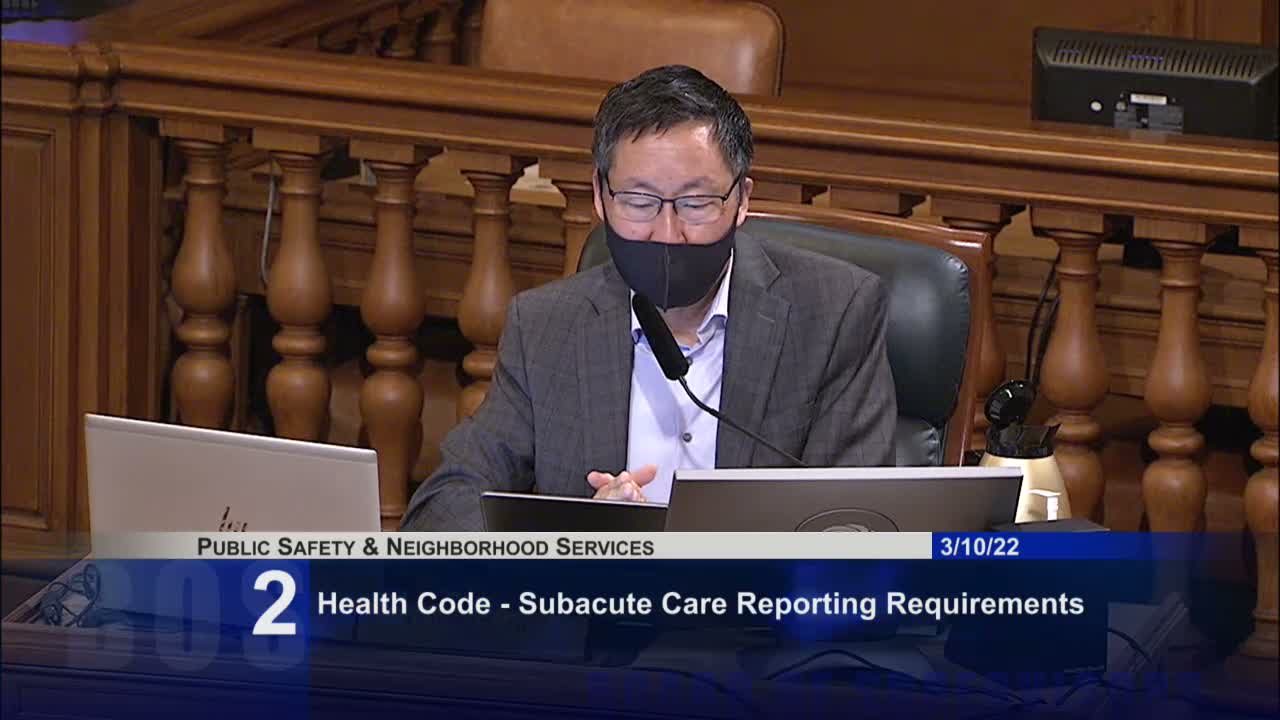
The Public Safety and Neighborhood Services Committee voted unanimously on March 10 to lift the pandemic suspension of certain provisions of the city’s graffiti removal and abatement ordinance (Chapter 23), reinstating the issuance of some violations and collection of assessed fees and affirming CEQA findings. Supervisor Aaron Peskin sponsored the legislation and presented two non‑substantive amendments that the committee accepted.
Peskin said the suspension adopted during the pandemic should end and told the committee that Public Works has a backlog of private‑property cases that have not been issued notices. “There are right now 11,000 cases that we have not sent out any notices or abatement enforcement actions on,” Peskin said, citing the city’s files. He said the vast majority of graffiti is on vacant or absentee‑owned properties and that DPW has continued to abate graffiti on public property during the pandemic.
Public Works’ Jonathan Viong described the Chapter 23 process: the department posts a 30‑day notice (with a high compliance rate on the first notice), reinspects and issues an additional 15‑day notice before penalties are considered, and serves the notice to the property owner of record. Viong said DPW has abated roughly 29,000 public structures on the street and that about 11,000 private‑property cases remain pending.
Supervisor Catherine Stephanie said she supports reinstating enforcement but emphasized concern for small businesses that are victims of crime and said the city should explore pilot programs and administrative hardship determinations so small businesses do not bear undue costs. Peskin noted an existing hardship provision in the law that historically applies in roughly 3% of cases.
Peskin’s two amendments instruct Public Works to give graffiti‑abatement notices to any community benefit district, green benefit district, or business improvement district that serves the area and to report back to the Board within two months with updates on forms and procedures. The committee voted to accept the amendments and to forward the item to the full Board with a positive recommendation on a 3‑0 vote.
Action: Ordinance to reinstate selected Chapter 23 enforcement provisions amended and forwarded to the Board of Supervisors with a positive recommendation.
Peskin said the suspension adopted during the pandemic should end and told the committee that Public Works has a backlog of private‑property cases that have not been issued notices. “There are right now 11,000 cases that we have not sent out any notices or abatement enforcement actions on,” Peskin said, citing the city’s files. He said the vast majority of graffiti is on vacant or absentee‑owned properties and that DPW has continued to abate graffiti on public property during the pandemic.
Public Works’ Jonathan Viong described the Chapter 23 process: the department posts a 30‑day notice (with a high compliance rate on the first notice), reinspects and issues an additional 15‑day notice before penalties are considered, and serves the notice to the property owner of record. Viong said DPW has abated roughly 29,000 public structures on the street and that about 11,000 private‑property cases remain pending.
Supervisor Catherine Stephanie said she supports reinstating enforcement but emphasized concern for small businesses that are victims of crime and said the city should explore pilot programs and administrative hardship determinations so small businesses do not bear undue costs. Peskin noted an existing hardship provision in the law that historically applies in roughly 3% of cases.
Peskin’s two amendments instruct Public Works to give graffiti‑abatement notices to any community benefit district, green benefit district, or business improvement district that serves the area and to report back to the Board within two months with updates on forms and procedures. The committee voted to accept the amendments and to forward the item to the full Board with a positive recommendation on a 3‑0 vote.
Action: Ordinance to reinstate selected Chapter 23 enforcement provisions amended and forwarded to the Board of Supervisors with a positive recommendation.
View the Full Meeting & All Its Details
This article offers just a summary. Unlock complete video, transcripts, and insights as a Founder Member.
✓
Watch full, unedited meeting videos
✓
Search every word spoken in unlimited transcripts
✓
AI summaries & real-time alerts (all government levels)
✓
Permanent access to expanding government content
30-day money-back guarantee
