SF supervisors press SFPUC on plan to expand emergency firefighting water system; cost estimates range from $2B to $6B depending on timeline and options
April 28, 2022 | San Francisco County, California
This article was created by AI summarizing key points discussed. AI makes mistakes, so for full details and context, please refer to the video of the full meeting. Please report any errors so we can fix them. Report an error »
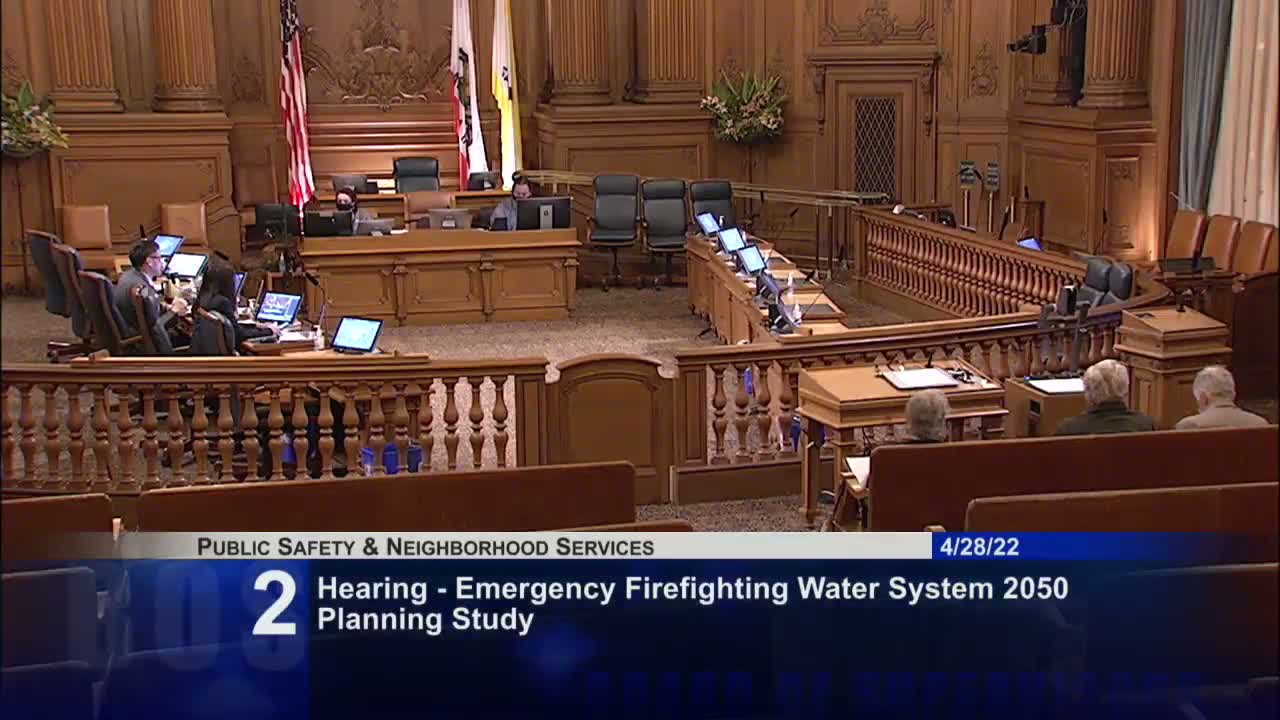
SAN FRANCISCO — The Public Safety and Neighborhood Services Committee on April 28 heard an SFPUC planning study laying out options to expand the city’s emergency firefighting water system (EFWS) so that all neighborhoods have high‑pressure fire protection.
John Scarpulla of the San Francisco Public Utilities Commission told supervisors the existing EFWS can supply about 80,000 gallons per minute (GPM). Using a modeled 7.8–7.9 magnitude San Andreas earthquake scenario and projected 2050 demands, the study estimates the city will need roughly 255,000 GPM to fight post‑seismic fires. The plan combines pipeline buildout, added water sources and system reliability upgrades.
Scarpulla said phase 1 of a Westside potable EFWS is funded by the 2020 voter bond and construction has begun, but later phases are unfunded. He summarized three build options and associated ranges of conceptual costs: roughly $2.0 billion for a baseline option, about $2.7 billion for a seawater‑heavy option, and up to $2.9 billion for a combined approach in the near term; long‑range, escalated 25‑year costs could rise as high as $4.0–$6.1 billion depending on scope and inflation assumptions.
Community advocates pressed for faster action and different water strategies. Nancy Werfel, speaking for a group of retired firefighting experts, said the SFPUC study is “a planning study with no commitment to provide equal protection in all neighborhoods,” and urged a comprehensive, actionable plan and use of seawater as an alternate source. **** Morton, representing a citywide coalition, said the report failed to provide financing mechanisms and urged a standalone bond for completion by 2034 and consideration of moving EFWS oversight to the city administrator.
Brian Strong, chief resilience officer in the Office of Resilience and Capital Planning, said the city currently projects about $1.2 billion in geobond funding available across all capital needs over the next 10 years, and that meeting the higher costs for EFWS will require additional revenue sources or federal/state funds. Strong said officials have pursued federal funding but noted federal programs typically fund projects after a disaster occurs.
SFPUC project manager Dave Meyerson said the 255,000 GPM target would be met with a mix of potable sources, Lake Merced on the West Side, and expanded seawater supply on the East Side; the study estimates roughly 60,000 GPM of new seawater supply for the conventional EFWS and about 90,000 GPM to meet West Side potable EFWS needs under some options.
Deputy Chief Tom O’Connor of the San Francisco Fire Department updated the committee on interim capacity: the department has contracts for three new hose tenders (first delivery expected Aug–Sept 2022) and expects to have five new tenders online by mid‑2024 for a total of 10, but adding 20 tenders (the number cited in the Board’s resolution) would require additional facility space and funding.
Supervisors asked for a clear financing plan and tighter timelines. Chair Supervisor Gordon Marr said he will press departments to develop a financing strategy and a schedule that could meet the Board’s 2034 target if additional resources are secured. The hearing concluded with a motion to continue the item to the call of the chair for further follow‑up; the motion passed unanimously.
Why it matters: The EFWS is designed to provide high‑pressure water for firefighting during and after major earthquakes, when ordinary water delivery can be disrupted. Advocates warned that delays in expansion risk unequal protection across neighborhoods and urged the city to pursue multiple funding streams and earlier permit engagement for seawater options.
John Scarpulla of the San Francisco Public Utilities Commission told supervisors the existing EFWS can supply about 80,000 gallons per minute (GPM). Using a modeled 7.8–7.9 magnitude San Andreas earthquake scenario and projected 2050 demands, the study estimates the city will need roughly 255,000 GPM to fight post‑seismic fires. The plan combines pipeline buildout, added water sources and system reliability upgrades.
Scarpulla said phase 1 of a Westside potable EFWS is funded by the 2020 voter bond and construction has begun, but later phases are unfunded. He summarized three build options and associated ranges of conceptual costs: roughly $2.0 billion for a baseline option, about $2.7 billion for a seawater‑heavy option, and up to $2.9 billion for a combined approach in the near term; long‑range, escalated 25‑year costs could rise as high as $4.0–$6.1 billion depending on scope and inflation assumptions.
Community advocates pressed for faster action and different water strategies. Nancy Werfel, speaking for a group of retired firefighting experts, said the SFPUC study is “a planning study with no commitment to provide equal protection in all neighborhoods,” and urged a comprehensive, actionable plan and use of seawater as an alternate source. **** Morton, representing a citywide coalition, said the report failed to provide financing mechanisms and urged a standalone bond for completion by 2034 and consideration of moving EFWS oversight to the city administrator.
Brian Strong, chief resilience officer in the Office of Resilience and Capital Planning, said the city currently projects about $1.2 billion in geobond funding available across all capital needs over the next 10 years, and that meeting the higher costs for EFWS will require additional revenue sources or federal/state funds. Strong said officials have pursued federal funding but noted federal programs typically fund projects after a disaster occurs.
SFPUC project manager Dave Meyerson said the 255,000 GPM target would be met with a mix of potable sources, Lake Merced on the West Side, and expanded seawater supply on the East Side; the study estimates roughly 60,000 GPM of new seawater supply for the conventional EFWS and about 90,000 GPM to meet West Side potable EFWS needs under some options.
Deputy Chief Tom O’Connor of the San Francisco Fire Department updated the committee on interim capacity: the department has contracts for three new hose tenders (first delivery expected Aug–Sept 2022) and expects to have five new tenders online by mid‑2024 for a total of 10, but adding 20 tenders (the number cited in the Board’s resolution) would require additional facility space and funding.
Supervisors asked for a clear financing plan and tighter timelines. Chair Supervisor Gordon Marr said he will press departments to develop a financing strategy and a schedule that could meet the Board’s 2034 target if additional resources are secured. The hearing concluded with a motion to continue the item to the call of the chair for further follow‑up; the motion passed unanimously.
Why it matters: The EFWS is designed to provide high‑pressure water for firefighting during and after major earthquakes, when ordinary water delivery can be disrupted. Advocates warned that delays in expansion risk unequal protection across neighborhoods and urged the city to pursue multiple funding streams and earlier permit engagement for seawater options.
Don't Miss a Word: See the Full Meeting!
Go beyond summaries. Unlock every video, transcript, and key insight with a Founder Membership.
✓
Get instant access to full meeting videos
✓
Search and clip any phrase from complete transcripts
✓
Receive AI-powered summaries & custom alerts
✓
Enjoy lifetime, unrestricted access to government data
30-day money-back guarantee
