Supervisors hear hours of testimony on UCSF’s planned purchase of St. Francis and St. Mary’s; committee files hearing and asks for enforceable commitments
March 18, 2024 | San Francisco County, California
This article was created by AI summarizing key points discussed. AI makes mistakes, so for full details and context, please refer to the video of the full meeting. Please report any errors so we can fix them. Report an error »
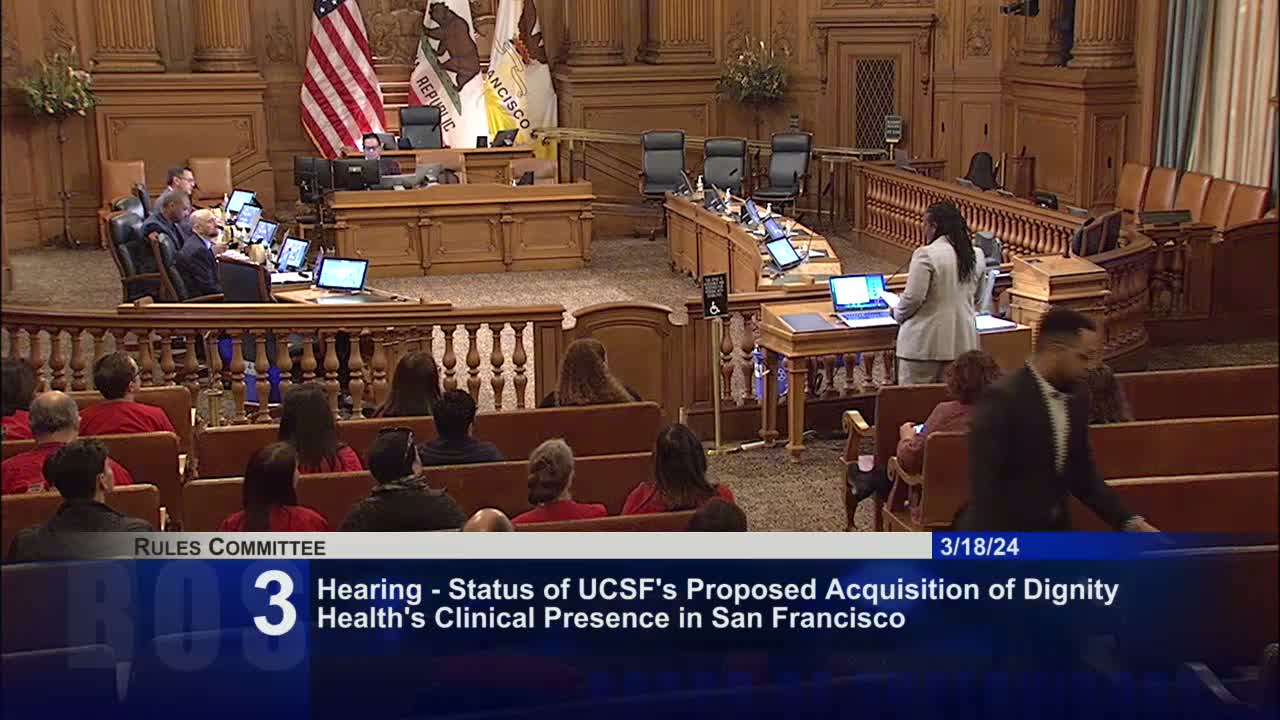
The San Francisco Rules Committee on March 18 held an extended hearing on the proposed acquisition by UCSF Health of Dignity Health’s local hospitals, Saint Francis Memorial Hospital and Saint Mary’s Medical Center. Supervisor Safai convened the hearing to examine the acquisition’s likely effects on staffing, specialty services (including the city’s only burn center and adolescent psychiatric units), charity care and access for vulnerable patients.
Shay Strahan (vice president of partnerships for UCSF Health’s affiliate network) presented UCSF’s commitments: the hospitals would remain full-service community hospitals, open medical staff models would be retained, collective bargaining agreements would be honored, no layoffs were planned as part of the transaction, and UCSF estimated immediate investments of $75 million to $100 million for deferred maintenance and equipment. Strahan said UCSF expects to assess seismic retrofit needs post-close and projected larger seismic costs—on the order of hundreds of millions when fully assessed.
Claire Altman of the Department of Public Health summarized the Health Commission’s Prop Q review: Prop Q requires at least 90 days’ public notice before closing or reducing services at private hospitals and mandates hearings; the Health Commission concluded on March 5 that the acquisition would not be detrimental to health care services provided UCSF honors commitments to staff, services and facilities, and directed UCSF to provide monitoring updates to the Health Commission every six months through June 2027.
Frontline nurses, CNA representatives, and numerous community members testified at length with a mix of endorsements and deep concerns. Nurses from both hospitals described chronic short staffing, confusion over the proposed two‑tiered affiliate governance and a lack of transparency from UCSF. The California Nurses Association presented comparative data showing Saint Francis and Saint Mary’s deliver a disproportionate share of charity care and care for people experiencing homelessness relative to UCSF and urged enforceable, specific and legally binding commitments to maintain those services.
Supporters of the acquisition — including reproductive-rights groups and some community health partners — said UCSF’s clinical policies would expand reproductive and LGBTQ-inclusive services at the hospitals and praised UCSF’s commitment to preserve patient access in the near term. Several commenters cited UCSF’s prior investments after its 2014 acquisition of Children’s Hospital Oakland as evidence UCSF can invest in facilities, while other speakers cited that acquisition as an example where services and programs later changed and urged caution.
After questions and follow-up requests for written documentation of UCSF’s commitments, Supervisor Safai moved to file the hearing. The committee voted in favor (Engadio, Safai and Walton: Aye) and the hearing was considered heard and filed. Committee members asked UCSF to deliver clear, memorialized commitments to labor representatives and to the Health Commission and requested ongoing oversight of implementation.
Shay Strahan (vice president of partnerships for UCSF Health’s affiliate network) presented UCSF’s commitments: the hospitals would remain full-service community hospitals, open medical staff models would be retained, collective bargaining agreements would be honored, no layoffs were planned as part of the transaction, and UCSF estimated immediate investments of $75 million to $100 million for deferred maintenance and equipment. Strahan said UCSF expects to assess seismic retrofit needs post-close and projected larger seismic costs—on the order of hundreds of millions when fully assessed.
Claire Altman of the Department of Public Health summarized the Health Commission’s Prop Q review: Prop Q requires at least 90 days’ public notice before closing or reducing services at private hospitals and mandates hearings; the Health Commission concluded on March 5 that the acquisition would not be detrimental to health care services provided UCSF honors commitments to staff, services and facilities, and directed UCSF to provide monitoring updates to the Health Commission every six months through June 2027.
Frontline nurses, CNA representatives, and numerous community members testified at length with a mix of endorsements and deep concerns. Nurses from both hospitals described chronic short staffing, confusion over the proposed two‑tiered affiliate governance and a lack of transparency from UCSF. The California Nurses Association presented comparative data showing Saint Francis and Saint Mary’s deliver a disproportionate share of charity care and care for people experiencing homelessness relative to UCSF and urged enforceable, specific and legally binding commitments to maintain those services.
Supporters of the acquisition — including reproductive-rights groups and some community health partners — said UCSF’s clinical policies would expand reproductive and LGBTQ-inclusive services at the hospitals and praised UCSF’s commitment to preserve patient access in the near term. Several commenters cited UCSF’s prior investments after its 2014 acquisition of Children’s Hospital Oakland as evidence UCSF can invest in facilities, while other speakers cited that acquisition as an example where services and programs later changed and urged caution.
After questions and follow-up requests for written documentation of UCSF’s commitments, Supervisor Safai moved to file the hearing. The committee voted in favor (Engadio, Safai and Walton: Aye) and the hearing was considered heard and filed. Committee members asked UCSF to deliver clear, memorialized commitments to labor representatives and to the Health Commission and requested ongoing oversight of implementation.
Don't Miss a Word: See the Full Meeting!
Go beyond summaries. Unlock every video, transcript, and key insight with a Founder Membership.
✓
Get instant access to full meeting videos
✓
Search and clip any phrase from complete transcripts
✓
Receive AI-powered summaries & custom alerts
✓
Enjoy lifetime, unrestricted access to government data
30-day money-back guarantee
