Budget analysts outline gaps in senior housing, project sharper needs through 2042
July 14, 2022 | San Francisco County, California
This article was created by AI summarizing key points discussed. AI makes mistakes, so for full details and context, please refer to the video of the full meeting. Please report any errors so we can fix them. Report an error »
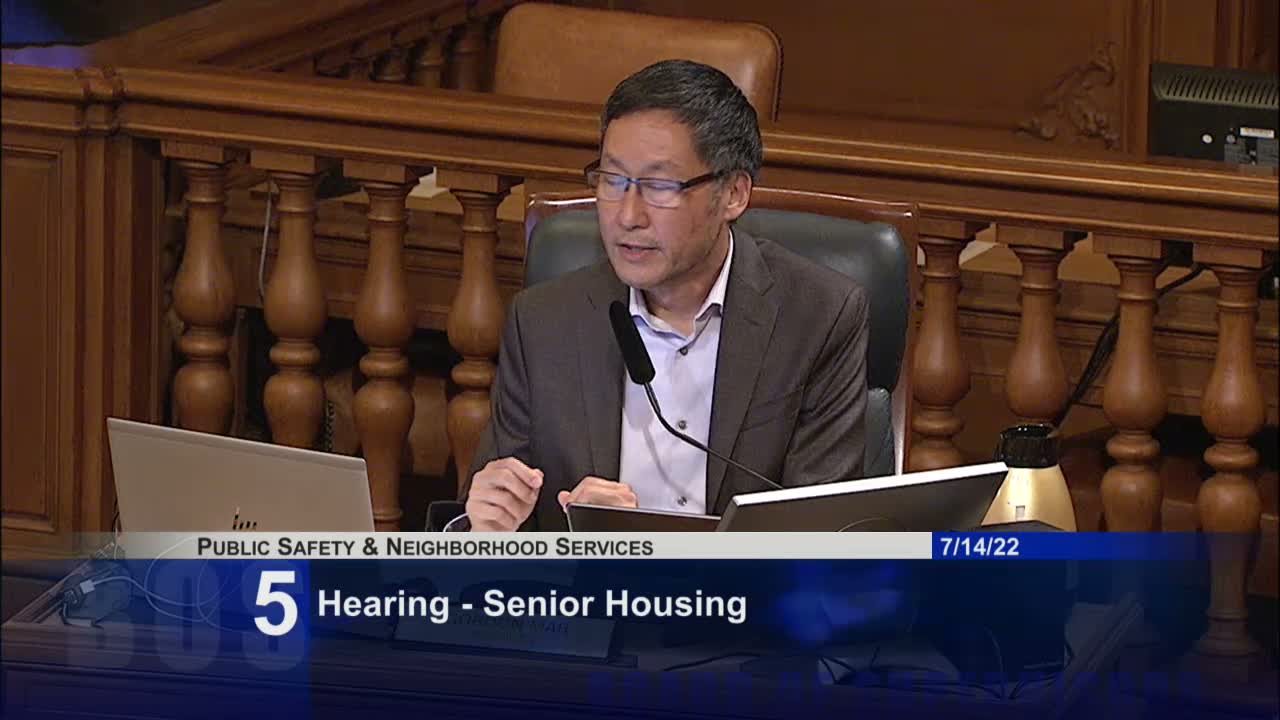
Budget and policy staff told the committee July 14 that San Francisco lacks coordinated capacity to meet the needs of a fast‑growing senior population and people with disabilities.
Fred Brousseau of the Budget & Legislative Analyst’s (BLA) office said the city currently has about 164,036 residents aged 65 and older and that projections show that number could increase to roughly 243,000 by 2042. The BLA described gaps across programs that support “aging in place,” home modification subsidies, tenant‑based rental subsidies, assisted living and skilled‑nursing capacity, and recommended a set of 39 policy options to close gaps.
Key findings flagged by the BLA included the following: a plurality of programs are small and siloed, many departments report wait lists, and the city lacks consistent performance measures to judge whether investments prevent institutionalization or meet demand. The BLA’s illustrative estimate showed the city would need several thousand additional senior‑designated or supported units and more assisted‑living and skilled‑nursing beds over the next 20 years to maintain current service ratios — a gap the office said could be refined with a more extensive needs assessment.
Planning department staff said an added Planner 3 position will coordinate cross‑departmental strategy and help refine needs analysis; supervisors asked the BLA and departments to produce supplemental analysis that accounts for the existing backlog of unmet need as well as projected demand.
Public commenters urged stronger, faster city action, culturally competent outreach, and more readily accessible application pathways for seniors and residents with limited English proficiency.
Next steps: the committee continued the hearing to the call of the chair and requested follow‑up demographic and needs‑assessment work from BLA and department staff.
Fred Brousseau of the Budget & Legislative Analyst’s (BLA) office said the city currently has about 164,036 residents aged 65 and older and that projections show that number could increase to roughly 243,000 by 2042. The BLA described gaps across programs that support “aging in place,” home modification subsidies, tenant‑based rental subsidies, assisted living and skilled‑nursing capacity, and recommended a set of 39 policy options to close gaps.
Key findings flagged by the BLA included the following: a plurality of programs are small and siloed, many departments report wait lists, and the city lacks consistent performance measures to judge whether investments prevent institutionalization or meet demand. The BLA’s illustrative estimate showed the city would need several thousand additional senior‑designated or supported units and more assisted‑living and skilled‑nursing beds over the next 20 years to maintain current service ratios — a gap the office said could be refined with a more extensive needs assessment.
Planning department staff said an added Planner 3 position will coordinate cross‑departmental strategy and help refine needs analysis; supervisors asked the BLA and departments to produce supplemental analysis that accounts for the existing backlog of unmet need as well as projected demand.
Public commenters urged stronger, faster city action, culturally competent outreach, and more readily accessible application pathways for seniors and residents with limited English proficiency.
Next steps: the committee continued the hearing to the call of the chair and requested follow‑up demographic and needs‑assessment work from BLA and department staff.
View the Full Meeting & All Its Details
This article offers just a summary. Unlock complete video, transcripts, and insights as a Founder Member.
✓
Watch full, unedited meeting videos
✓
Search every word spoken in unlimited transcripts
✓
AI summaries & real-time alerts (all government levels)
✓
Permanent access to expanding government content
30-day money-back guarantee
